Introduction
Managing taxes is one of the most critical responsibilities for any growing enterprise. However, effective tax management is not merely about meeting annual filing deadlines or reacting when tax season arrives.
Proactive business tax planning services help companies anticipate future liabilities, identify legitimate deductions, optimize cash flow, and align financial strategies with long-term commercial goals.
For small and medium-sized businesses, startups, SaaS companies, e-commerce platforms, agencies, and international enterprises, tax planning offers clarity in an increasingly complex global marketplace.
Whether you operate locally or run a cross-border organization, working with a remote accounting partner ensures your financial operations remain fully compliant, transparent, and structured for sustainable growth.
With integrated accounting and bookkeeping services, businesses can turn routine financial reporting into a strategic advantage.
What Are Business Tax Planning Services?
Business tax planning services involve analyzing a company’s financial situation, operations, and structure to minimize tax liabilities legally and optimize financial performance. Unlike tax preparation, which focuses on historical compliance and filing returns, tax planning looks forward to evaluate how business decisions will affect future tax obligations.
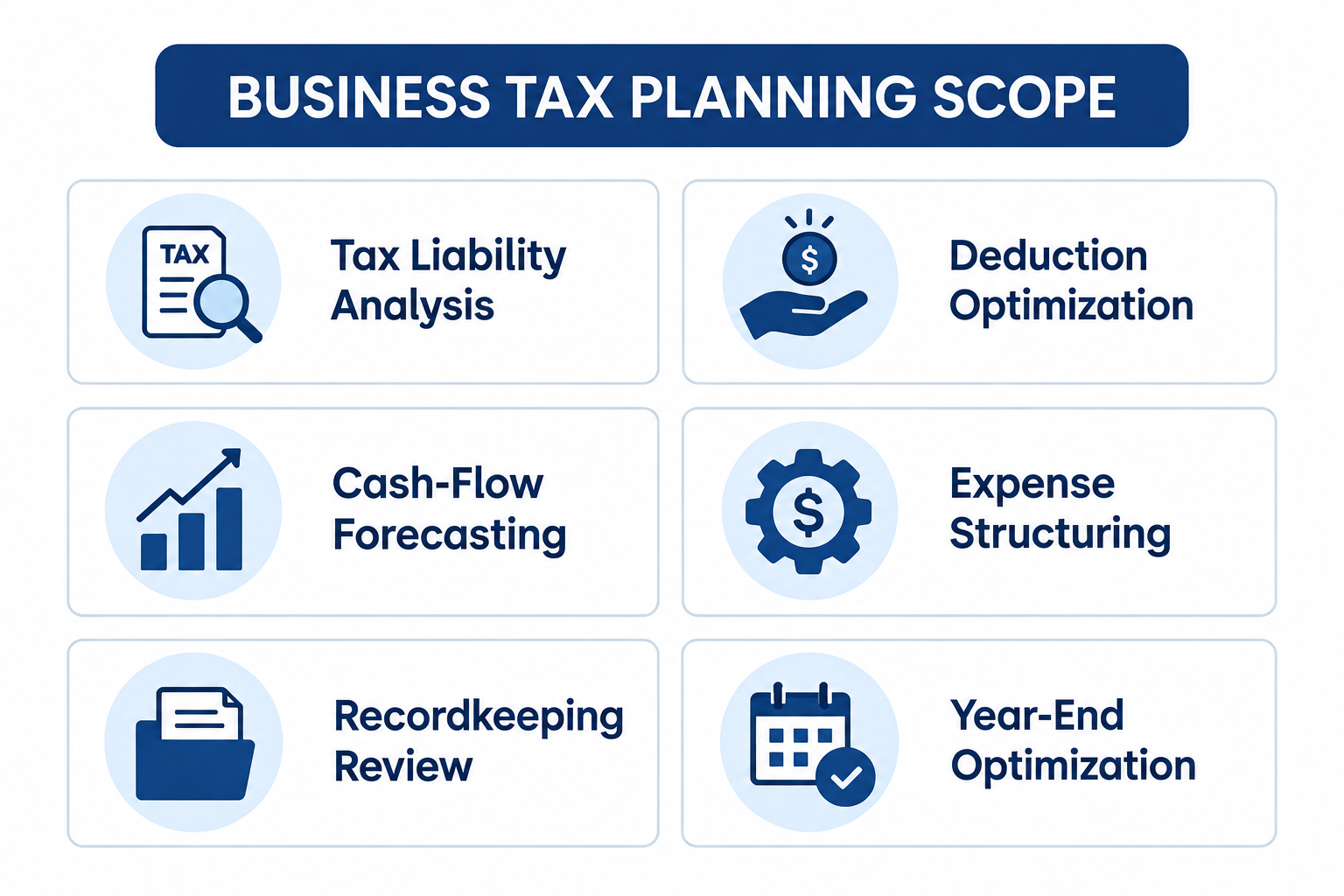
Professional tax planning enables business leaders to:
Understand Tax Obligations: Stay ahead of regional, national, and international tax commitments.
Forecast Liabilities: Estimate future tax bills so cash reserves are never caught short.
Identify Eligible Deductions: Maximize legitimate tax deductions and allowances permitted by law.
Review Business Expenses: Categorize operational expenses correctly to maximize tax efficiency.
Guide Financial Decisions: Evaluate the tax impact of major purchases, hires, expansions, or corporate restructurings.
Maintain Accurate Records: Establish clean financial reporting routines that withstand audit scrutiny.
Why Is Tax Planning Important for Businesses?
Tax planning is a core pillar of sound corporate finance. It bridges the gap between basic accounting and high-level strategic advisory.
Reduce Tax Liabilities Legally
The primary objective of tax planning is to pay no more tax than required by law. By taking full advantage of legal tax credits, incentives, and allowable deductions, businesses retain more revenue to reinvest in growth. This stands in stark contrast to improper tax reporting, which carries severe financial penalties.
Improve Cash Flow Management
Unplanned tax obligations create severe cash crunches. By integrating tax projections into your routine cash flow management, your business maintains clear visibility over incoming and outgoing funds, ensuring sufficient liquidity for operational commitments throughout the fiscal year.
Avoid Unexpected Tax Bills
Surprise tax bills typically occur when rapid revenue growth outpaces tax forecasting. Proactive planning eliminates these surprises by continually tracking taxable income and calculating estimated tax payments quarter by quarter.
Support Better Business Decisions
Tax considerations impact virtually every commercial decision, including:
Hiring & Compensation: Employee payroll vs. contractor arrangements and equity plans.
Capital Investments: Equipment, technology, and facility purchases.
Market Expansion: Cross-border sales, subsidiary structures, and international trade.
Corporate Structure: LLCs, Corporations, Partnerships, or offshore holding structures.
Financing Strategy: Debt vs. equity financing implications.
Reduce Compliance Risks
Inaccurate financial records and late filings invite penalties, interest charges, and costly tax audits. Tax planning establishes robust recordkeeping routines, keeping your business fully compliant across every jurisdiction where you operate.
What Is Included in Business Tax Planning Services?
Comprehensive tax planning integrates multiple analytical and advisory services:
Tax Planning Service | How It Helps Businesses |
Tax Liability Analysis | Estimates potential tax obligations based on current income and expense trends. |
Tax Forecasting | Models future revenue scenarios to prepare businesses for upcoming liabilities. |
Tax Deduction Review | Conducts deep reviews to identify overlooked industry-specific deductions. |
Business Expense Analysis | Audits capital and operating expenses for optimal tax treatment. |
Tax Compliance Planning | Schedules key tax deadlines and reporting requirements across jurisdictions. |
Financial Record Review | Ensures general ledgers and bookkeeping data meet regulatory standards. |
Year-End Tax Planning | Implements tax strategies before the close of the fiscal year. |
Strategic Tax Advice | Provides executive advice on major corporate transactions and restructuring. |
How Does Business Tax Planning Work?
An effective tax planning workflow follows a structured, step-by-step methodology:
1. Review Financial Records: Prerequisite for accurate planning.
Financial advisors examine general ledgers, income statements, balance sheets, payroll records, and asset registers to establish a clean baseline of your company's true financial position.
2. Analyze Jurisdiction & Entity Obligations: Essential for cross-border operations.
Tax obligations vary significantly depending on country, state/province, business structure, industry, and the physical or digital location of your customers. Advisors assess local rules across all operating regions.
3. Identify Planning Opportunities: Maximizing tax efficiency.
Advisors review allowable write-offs, depreciation schedules, research credits, allowable expenses, and the timing of income/expenses to optimize your overall position.
4. Forecast Tax Liabilities: Aligning with general financial forecasting.
Using projected income statements and operational budgets, advisors calculate estimated quarterly tax obligations, linking these directly to your broader financial forecasting models.
5. Continuous Year-Round Monitoring: Proactive ongoing advisory.
Tax planning is not a one-time annual event. Continuous monitoring ensures your strategy adapts as revenue shifts, tax codes update, or new business opportunities emerge.
Common Business Tax Planning Strategies
Proactive businesses utilize several legal strategies to organize their finances efficiently:
Review Eligible Business Deductions: Ensure all operational costs such as software subscriptions, professional fees, marketing expenses, and office supplies are fully tracked and claimed.
Track Expenses Accurately: Implement cloud accounting software to capture receipts and categorize transactions in real time.
Time Major Business Purchases: Accelerate or defer asset purchases near year-end to take advantage of first-year depreciation allowances or immediate write-offs.
Evaluate Business Entity Structure: Periodically review whether your operating structure (e.g., Sole Proprietorship, S-Corp, C-Corp, LLC, Limited Company) remains the most tax-efficient choice as income grows.
Forecast Taxable Income: Monitor year-to-date net profit margins to estimate total annual taxable income accurately.
Plan Estimated Tax Payments: Schedule regular quarterly tax allocations to protect cash reserves from year-end tax shocks.
Conduct Pre-Year-End Reviews: Review tax positions in Q4 while time remains to execute legal tax optimization moves.
Tax Planning vs. Tax Compliance
Understanding the distinction between planning and compliance is vital for managing corporate finances effectively:
Feature | Tax Planning | Tax Compliance |
Focus | Proactive and future-focused | Reactive and historical |
Timing | Year-round ongoing strategy | Periodic filing deadlines |
Primary Goal | Minimize tax liability legally | Ensure legal adherence & avoid penalties |
Scope | Business decision-making & structure | Preparing and submitting tax returns |
Value | Saves money and improves cash flow | Prevents legal fines and audits |
Tax Planning vs. Tax Avoidance vs. Tax Evasion
Maintaining regulatory trust requires a clear understanding of legal boundaries.
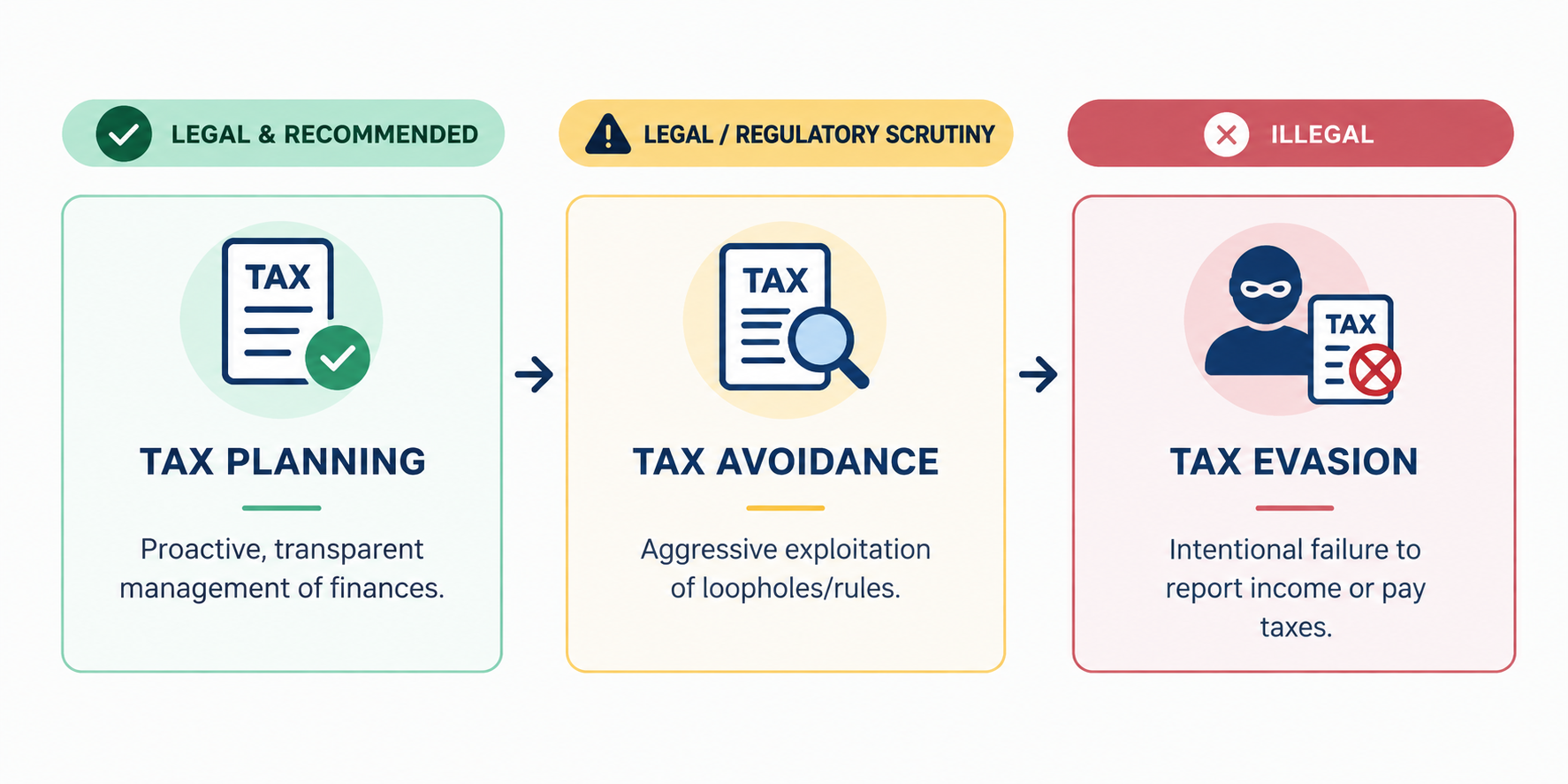
Tax Planning: The fully legal, transparent, and ethical structuring of financial affairs to utilize statutory tax allowances, credits, and deductions provided by tax authorities.
Tax Avoidance: Bending tax codes or creating artificial financial arrangements to minimize tax payments. While not always illegal, aggressive tax avoidance frequently triggers regulatory audits, penalties, and legal challenges.
Tax Evasion: The deliberate, illegal concealment, underreporting, or misrepresentation of financial activity to avoid paying taxes.
Businesses should work strictly within legal, transparent financial planning standards to ensure long-term stability and reputation.
Are Business Setup Costs Tax Deductible?
A common question among startup founders is whether initial incorporation and setup costs can be written off against business income.
In most jurisdictions, business setup costs such as legal incorporation fees, state registration costs, accounting setup fees, and market research are deductible, but tax treatment varies according to:
Jurisdiction: For example, the IRS in the United States allows up to $5,000 in startup costs to be deducted in the first year, amortizing any excess over 180 months. Similarly, guidelines from tax authorities such as the HMRC (UK), ATO (Australia), and CRA (Canada) offer specific rules on capital vs. revenue expenditure.
Type of Expense: Legal fees and state setup charges are treated differently than machinery or initial inventory purchases.
Date Incurred: Expenses incurred before official business operations begin are subject to startup amortization rules.
Because capital and operating expense rules differ worldwide, cross-border businesses should review setup cost classification with experienced financial advisors.
Do Businesses Charge Tax on Services?
Determining whether to charge consumption taxes such as Sales Tax, Value Added Tax (VAT), or Goods and Services Tax (GST) on service revenue depends on several operational factors:
Customer Location: Cross-border service delivery often follows "place of supply" rules. Exported services supplied to foreign B2B clients are frequently zero-rated or exempt.
Type of Service: Professional consulting, SaaS software platforms, and physical services often carry distinct indirect tax rules.
Registration Thresholds: Most jurisdictions enforce annual turnover limits before indirect tax registration becomes mandatory.
Cross-Border Transactions: Organizations like the OECD establish international guidelines for indirect taxation on digital and cross-border service trade.
Consulting an accounting partner ensures your digital or remote service operations implement accurate billing rules and maintain international compliance.
Example of Business Tax Planning: A Growing SaaS Business
To see how integrated tax planning works in practice, consider a growing Software-as-a-Service (SaaS) company.
The Scenario
A SaaS business projects its revenue will grow from $500,000 to $2,000,000 over the coming fiscal year. The executive team plans to expand engineering staff, increase digital ad spending, and acquire new cloud infrastructure.
The Advisory Process
Working with a remote financial advisor, the company:
Analyzes Financial Statements: Reviews historical margins and project revenue trajectories through dedicated financial analysis services.
Plans Capital Purchases: Schedules server and software infrastructure investments before year-end to utilize allowable equipment write-offs.
Evaluates R&D Incentives: Identifies software development activities eligible for R&D tax credits.
Structures Overseas Sales: Ensures digital subscriptions sold internationally comply with regional VAT/Sales tax rules.
Forecasts Liquidity Needs: Calculates quarterly estimated tax payments and incorporates them into corporate cash flow budgets.
The Result
The business avoids a surprise tax liability at year-end, optimizes its working capital, claims legitimate software development tax credits, and retains sufficient capital to fuel continuous product development.
How Much Do Business Tax Planning Services Cost?
The cost of hiring professional tax advisors varies based on the scope, scale, and complexity of your organization. Key cost drivers include:
Business Size & Revenue: Larger organizations with higher transaction volumes require deeper analytical review.
Multi-Jurisdictional Footprint: Operating across multiple countries or states adds regulatory complexity.
Entity Complexity: Organizations with parent companies, subsidiaries, or foreign branches require specialized international tax structuring.
Service Scope: One-time tax return preparation costs far less than year-round advisory, bookkeeping, and financial forecasting support.
Working with an outsourced financial partner provides access to specialized financial teams at a fraction of the cost of hiring full-time, in-house CFOs and tax directors. Organizations can partner with remote financial providers for comprehensive outsourced accounting services tailored to their growth stage.
When Should a Business Start Tax Planning?
Tax planning is an ongoing cadence rather than a single event.
Monthly Management
Monthly
Maintain clean books, reconcile bank accounts, categorize expenses correctly, and review monthly profit and loss statements.
Quarterly Review
Quarterly
Review financial performance, update income projections, calculate estimated tax liabilities, and adjust quarterly tax payments.
Major Transactions
Ad Hoc
Consult financial advisors before signing major contracts, raising capital, making large equipment purchases, or restructuring ownership.
Pre-Year-End Planning
Q4 (Pre-Year-End)
Conduct a dedicated tax strategy session to review eligible write-offs, accelerate expenses, or manage revenue timing legally before the fiscal year closes.
Filing & Confirmation
Tax Season
Finalize financial statements, verify supporting documentation, and submit compliant filings to relevant authorities.
How MBC Consulting Supports Business Tax Planning
At MBC Consulting, we provide remote accounting, bookkeeping, and financial advisory support for businesses, startups, and international companies worldwide. We believe tax planning should not exist in isolation; it must be integrated directly into your accounting workflows, financial reporting, and long-term strategic decisions.
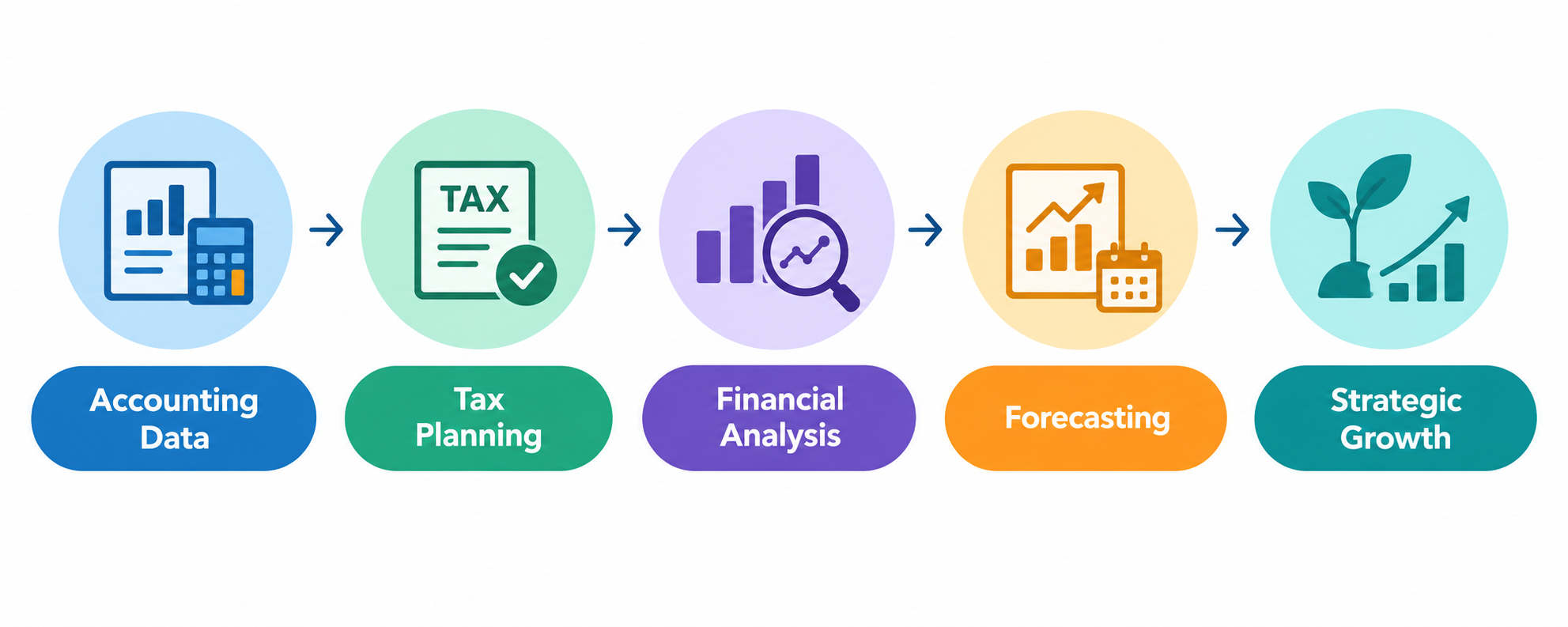
Our comprehensive service suite supports every stage of your company's financial journey:
Accurate Accounting & Bookkeeping: Clean general ledgers, timely reconciliations, and structured recordkeeping form the foundation of effective tax strategy through our accounting and bookkeeping services.
Tax Compliance & Planning: Proactive guidance keeps your financial operations transparent, legal, and organized year-round.
Financial Analysis: In-depth evaluations of your revenue streams, expenditure trends, and profit margins using robust financial analysis services.
Financial Forecasting: Forward-looking cash flow and tax obligation modelling built via custom financial forecasting services and detailed financial modelling services.
Virtual CFO Support: High-level executive advice, strategic budgeting, and cash flow leadership through scalable virtual CFO services.
By connecting accurate bookkeeping data with executive advisory, MBC Consulting delivers the clarity needed to make confident, growth-focused business decisions.
Frequently Asked Questions
What is included in business tax planning?
Business tax planning includes estimating tax liabilities, identifying eligible tax deductions, analyzing business expenses, conducting pre-year-end strategy reviews, structuring major financial transactions, and aligning business decision-making with tax regulations.
What is the cost of a tax advisor?
The cost depends on company revenue, multi-state or international presence, transaction complexity, and whether you engage an advisor for one-time tax return preparation or year-round strategic support.
What are tax management services?
Tax management services encompass the full lifecycle of business tax responsibilities, combining routine tax compliance (filing tax returns) with forward-looking tax planning (optimizing cash flow, managing liabilities, and planning transactions).
Can you give an example of tax planning?
A common example is a company planning a major technology purchase in Q4 instead of Q1 of the following year. By accelerating the purchase, the business can utilize depreciation deductions in the current tax year to offset higher-than-expected net profits.
Do I charge sales tax on services?
Whether you charge sales tax, VAT, or GST on services depends on local tax laws, the location of your customer, the specific nature of the service, and whether cross-border digital service rules apply.
Are business setup costs tax deductible?
Yes, in many jurisdictions, setup costs are deductible or can be amortized over several years. However, specific rules depend on tax authority regulations, expense categorization, and when operations officially commence.
How often should a business review its tax strategy?
Businesses should review their tax strategy quarterly, with a dedicated pre-year-end strategy session in Q4. Crucial reviews should also take place before executing major corporate transactions or structural changes.
Conclusion
Effective business tax planning is a year-round strategy, not a seasonal filing chore. By combining structured bookkeeping, accurate financial forecasting, proactive tax planning, and expert advisory support, business leaders gain total clarity over their future liabilities while legally protecting their bottom line.
Whether you run an emerging startup or an established cross-border enterprise, MBC