
Cash Flow Management for Startups: A Complete Guide to Forecasting, Runway & Growth
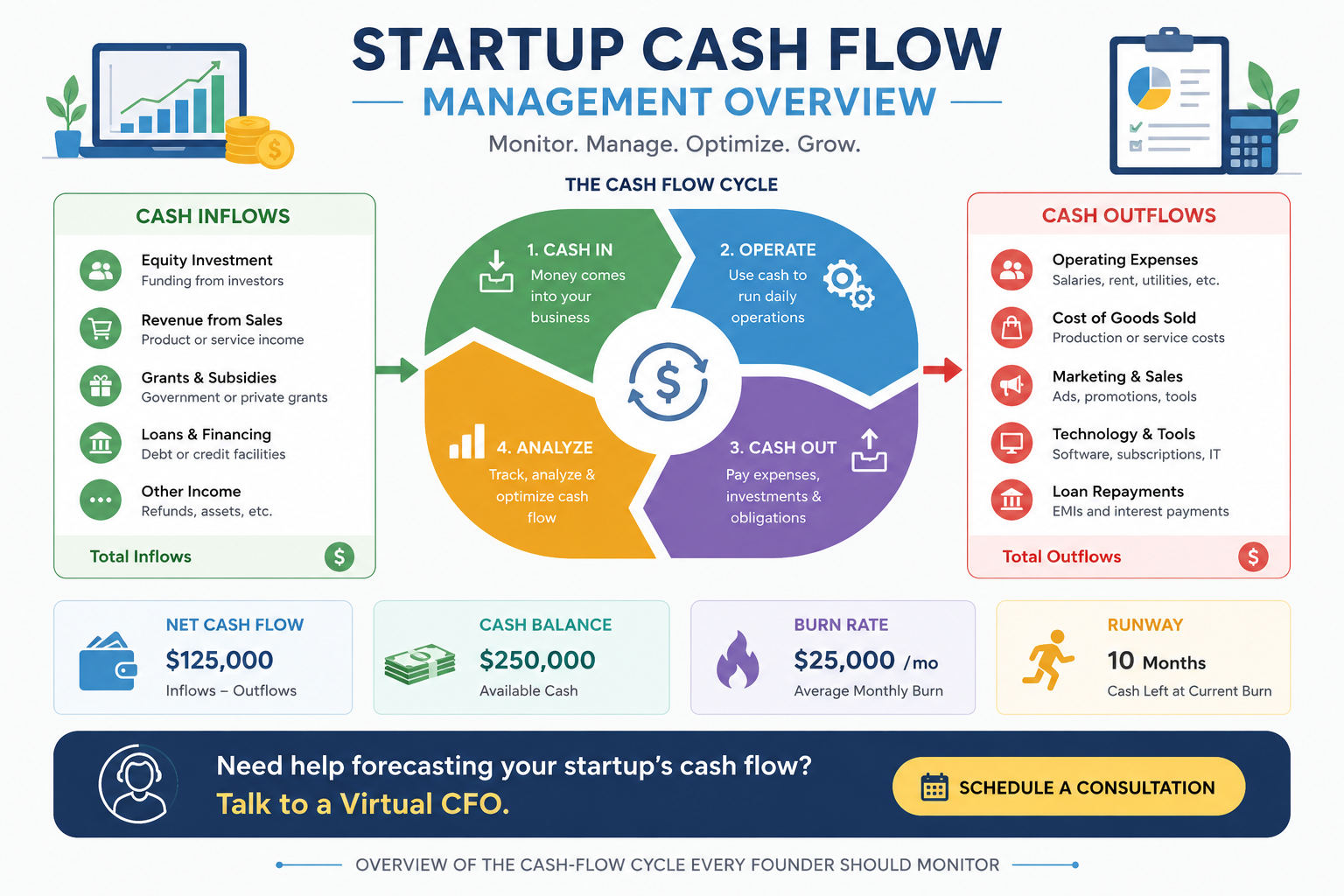
Cash flow management for startups is the discipline of tracking, forecasting, and controlling the actual movement of money in and out of the business so the company never runs out of cash. Profit looks good on an income statement. Cash pays salaries, vendors, rent, and taxes. Many startups that appear profitable on paper still face sudden shortages because customers pay late, large expenses hit before revenue arrives, or growth spending outpaces collections.
This guide explains what cash flow management means for early-stage and growth-stage companies, how to calculate burn rate and runway, how to build a practical 13-week forecast, and how to turn those numbers into better decisions. You will also see concrete formulas, stage-by-stage guidance, common problems, and when professional support, such as the Virtual CFO Services Guide, becomes useful.
Book a Free Cash Flow Consultation
What Is Cash Flow Management for Startups?
Cash flow management is the ongoing process of monitoring cash inflows and outflows, forecasting future balances, and taking action so the business stays liquid. It covers tracking daily bank positions, projecting collections and payments, controlling discretionary spend, and planning for large or irregular items such as tax payments, annual software renewals, or inventory builds.
Cash Flow Management Definition
Effective cash flow management includes six linked activities:
- Tracking actual cash movements
- Monitoring balances and trends
- Forecasting short- and medium-term positions
- Controlling timing of payments and collections
- Optimizing working capital
- Planning reserves and contingency actions
Cash Flow vs. Profit
Aspect | Cash Flow | Profit |
|---|---|---|
What it measures | Actual movement of cash | Accounting performance |
Focus | Liquidity | Profitability |
Timing | Affected by payment dates | Based on recognition rules |
Primary use | Paying obligations | Evaluating operating performance |
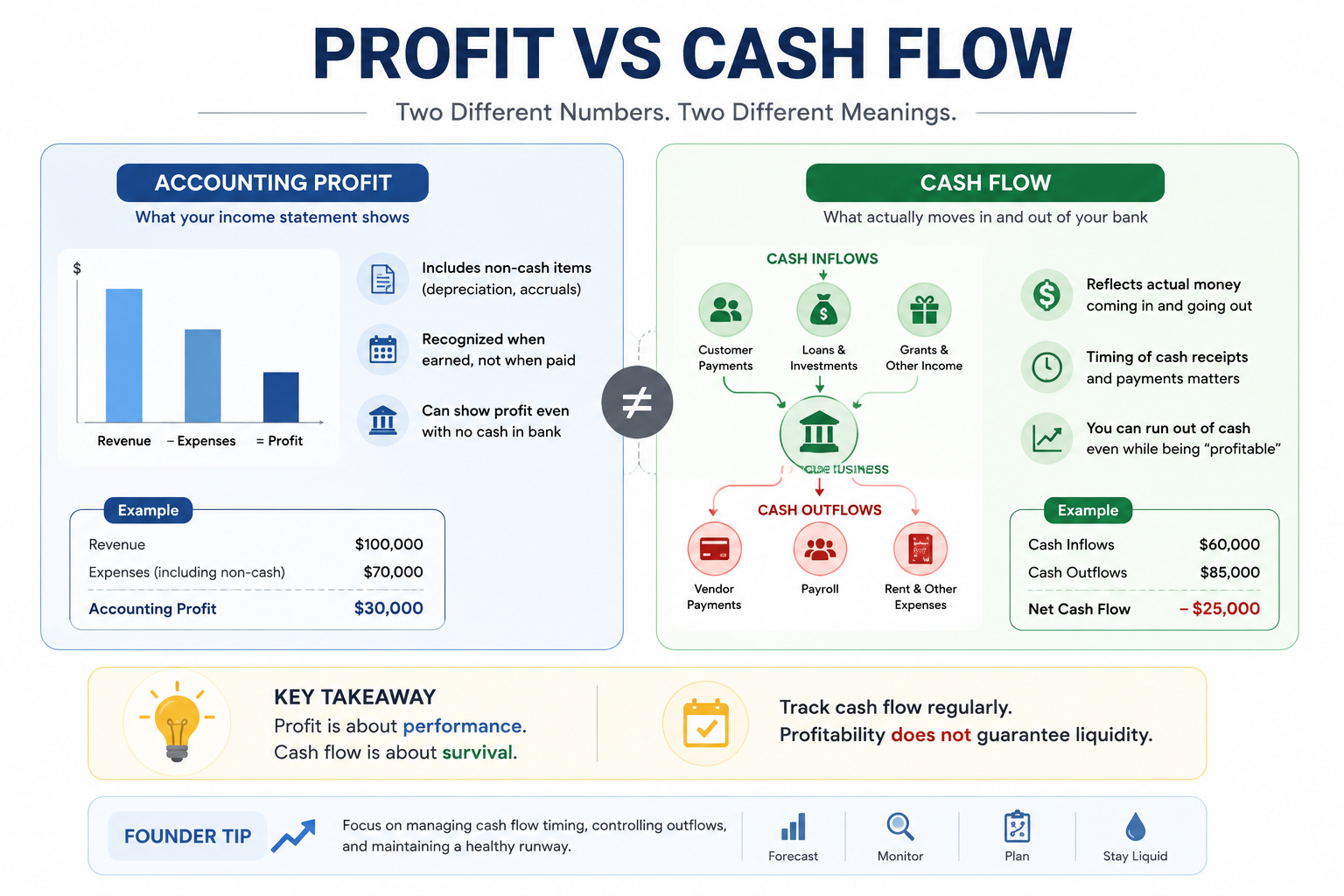
A company can report positive net income even as its bank account balance declines. Accrual accounting records revenue when earned and expenses when incurred; cash flow records money only when it changes hands.
Why Startups Can Be Profitable but Still Run Out of Cash
Common situations include:
- Customers on 45- or 60-day terms while payroll is due every two weeks
- Large inventory purchases or equipment buys before related sales close
- Annual software or insurance payments that hit in a single month
- Rapid hiring that increases fixed costs faster than cash collections
- Debt repayments or tax obligations that are not smoothed into monthly forecasts
Why Is Cash Flow Management Important for Startups?
Strong cash flow management prevents shortages, extends runway, supports better hiring and spending decisions, improves investor confidence, and gives founders clearer visibility. Startups are especially vulnerable because many begin with limited reserves, irregular revenue, and rapid cost growth.
Key benefits:
- Prevents cash shortages that force emergency fundraising or painful cuts
- Extends startup runway by revealing the true months of cash remaining
- Supports smarter hiring by linking headcount plans to available cash
- Helps control operating expenses before they become structural
- Improves investor confidence through transparent forecasting and reporting
- Enables sustainable growth rather than growth that consumes cash faster than it generates
- Prepares the company for unexpected expenses or delayed collections
- Gives founders better financial visibility so decisions rest on data rather than hope
When founders can answer “How much cash do we have, how long will it last, and what happens if revenue drops 20%?”, they reduce the anxiety that comes with payroll deadlines and investor updates.
How Startup Cash Flow Works
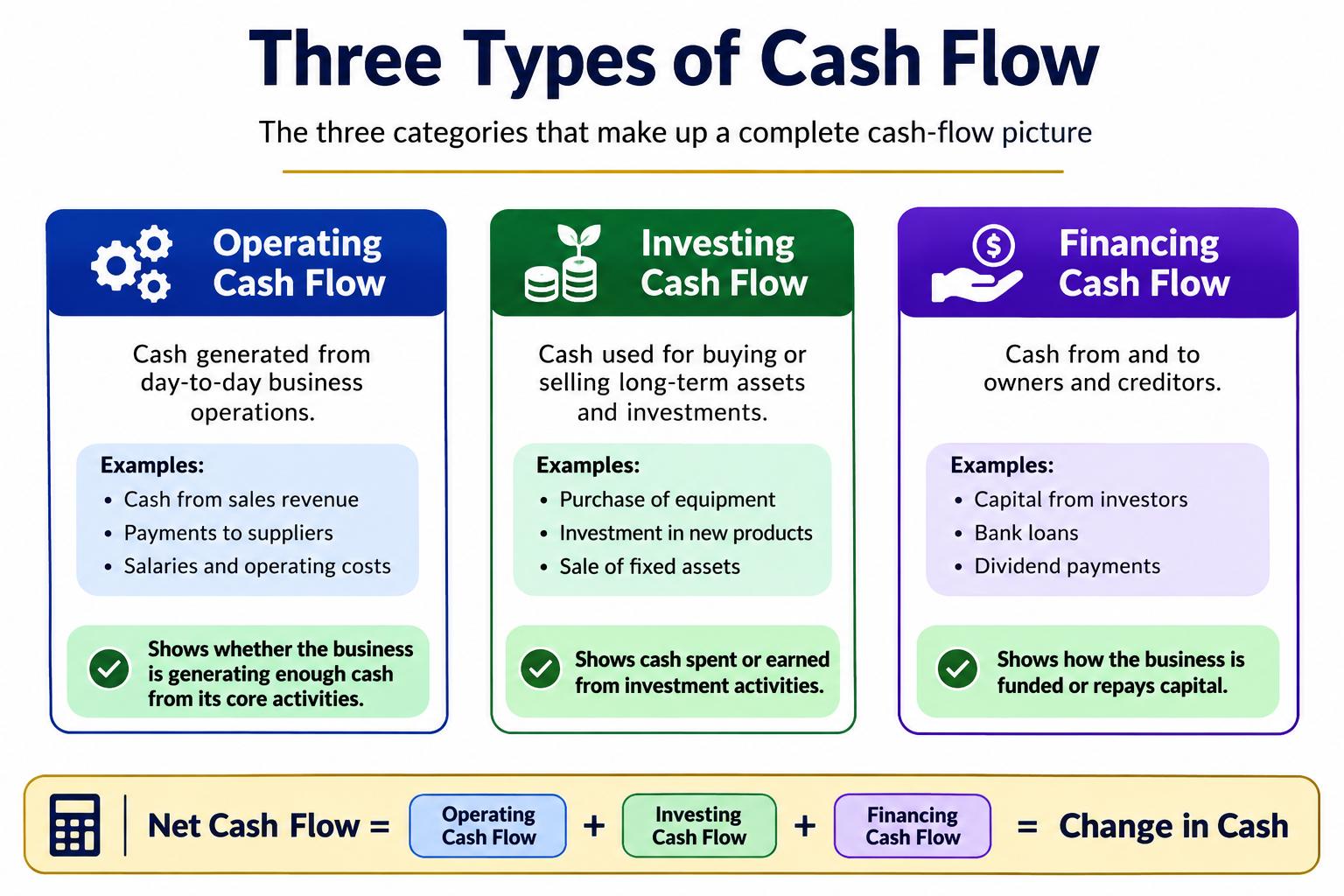
Cash moves through three activities: operating, investing, and financing.
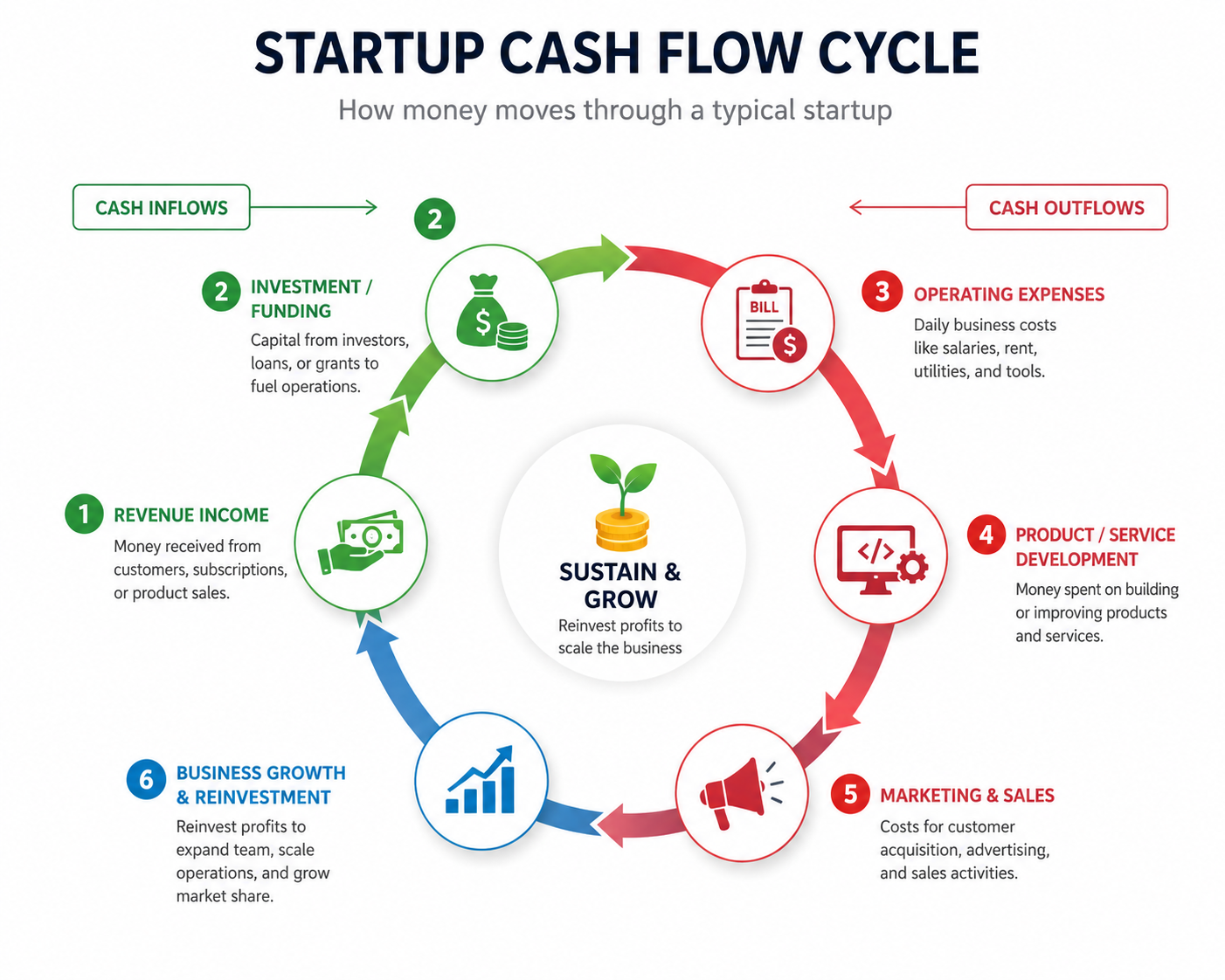
Cash Inflows
Typical sources include customer payments (one-time or subscription), new investment, loans, grants, and occasional asset sales.
Cash Outflows
Common outflows include payroll and benefits, rent or coworking, software subscriptions, marketing, inventory or cost of goods, taxes, vendor payments, and loan principal and interest.
Operating, Investing, and Financing Activities
- Operating covers day-to-day trading: collections from customers and payments to suppliers, employees, and for operating expenses.
- Investing covers the purchase or sale of long-term assets such as equipment, technology platforms, or acquisitions.
- Financing covers equity raises, debt draws and repayments, and any distributions.
The Three Types of Cash Flow
Operating Cash Flow
Cash generated or used by core business activities. For a SaaS startup, this is primarily subscription collections minus payroll, hosting, support, and sales costs. Positive operating cash flow is the long-term goal; most early-stage companies run negative operating cash flow while they invest in growth.
Investing Cash Flow
Usually negative in growth phases because startups buy equipment, build technology, or acquire other companies. Occasional positive spikes occur when assets are sold.
Financing Cash Flow
Positive when the company raises equity or debt; negative when it repays loans or, rarely at early stages, returns capital. Many startups rely on financing cash flow to fund operations until operating cash flow turns positive.
How to Prepare a Cash Flow Statement for a Small Business
A simple cash-flow statement answers five questions: opening balance, inflows, outflows, net change, and closing balance.
Step 1 — Determine Opening Cash Balance
Start with the actual bank and cash balances at the beginning of the period.
Step 2 — List Cash Inflows
Include all money received: customer payments, investment proceeds, loan draws, grants, and other receipts.
Step 3 — List Cash Outflows
Include every payment: payroll, rent, vendors, taxes, loan repayments, capital purchases, and other disbursements.
Step 4 — Calculate Net Cash Flow
Net Cash Flow = Total Cash Inflows − Total Cash Outflows
Step 5 — Calculate Closing Cash Balance
Closing Cash Balance = Opening Cash Balance + Net Cash Flow
Direct vs. Indirect Cash Flow Statement
The direct method lists actual cash receipts and payments. The indirect method starts with net income and adjusts for non-cash items and changes in working capital. Most startups begin with a direct-method forecast because it is easier to maintain and more intuitive for founders.
Example Startup Cash Flow Statement
Month | Opening Cash |
| Outflows | Net Cash Flow | Closing Cash |
January | $500,000 | $95,000 | $140,000 | −$45,000 | $455,000 |
February | $455,000 | $110,000 | $135,000 | −$25,000 | $430,000 |
March | $430,000 | $125,000 | $145,000 | −$20,000 | $410,000 |
How to Calculate Business Cash Flow
Basic Cash Flow Formula
Cash Flow = Cash Inflows − Cash Outflows
Operating Cash Flow
For practical startup use, approximate operating cash flow as cash collected from customers minus cash paid for operating expenses and working-capital changes. More formal versions start from net income and adjust for depreciation, amortization, and changes in receivables, payables, and inventory.
Free Cash Flow
Free Cash Flow = Operating Cash Flow − Capital Expenditures
This shows cash available after maintaining or expanding the asset base.
Startup Example (Fictional SaaS)
A company collects $80,000 in customer payments, pays $95,000 in operating costs, and spends $10,000 on equipment. Approximate operating cash flow is −$15,000; free cash flow is −$25,000.
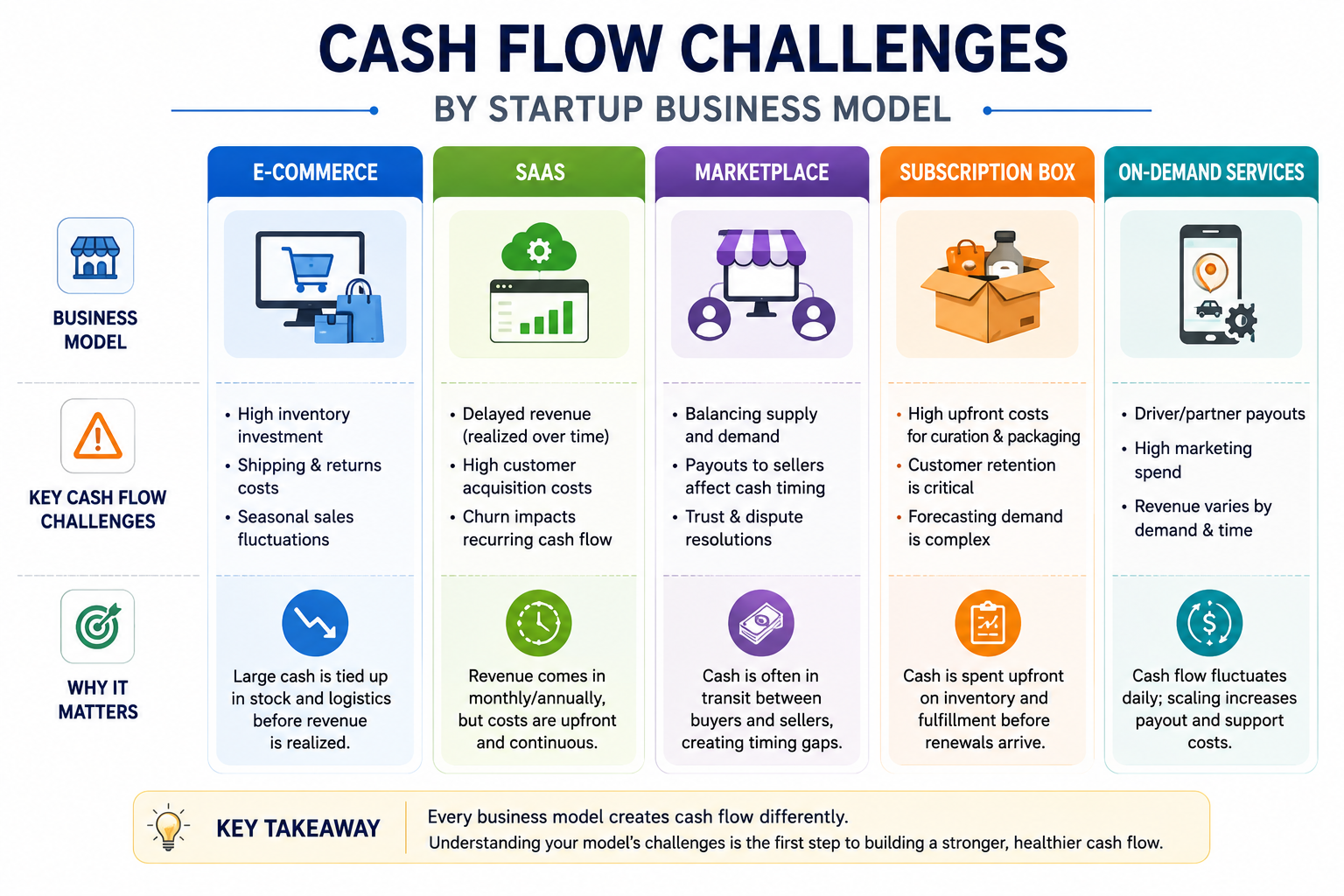
Startup Cash Flow Management by Business Model
SaaS Startups
Focus on MRR/ARR collection timing, annual versus monthly billing mix, churn impact on cash, CAC payback, and the lag between sales effort and cash receipt.
Ecommerce Startups
Inventory purchases, supplier terms, shipping costs, returns, and payment-processor timing dominate the cash cycle.
Agencies and Professional Services
Client payment terms, retainer versus project billing, and the need to fund payroll while waiting for invoices create classic working-capital pressure.
Marketplace and Product-Based Startups
Two-sided cash flows, inventory or fulfilment costs, and platform fees require careful mapping of when cash is received versus when it must be paid out.
Cash Flow Management at Different Startup Stages
Startup Stage | Primary Cash Challenge | Key Metric |
|---|---|---|
Pre-revenue | Capital preservation | Cash balance |
Seed | Controlled growth | Burn rate |
Series A | Scaling efficiently | Runway |
Growth | Working capital | Operating cash flow |
Pre-revenue companies prioritize stretch. Seed-stage companies begin to balance growth spend against runway. Series A and later companies must show improving operating cash flow metrics while still investing.
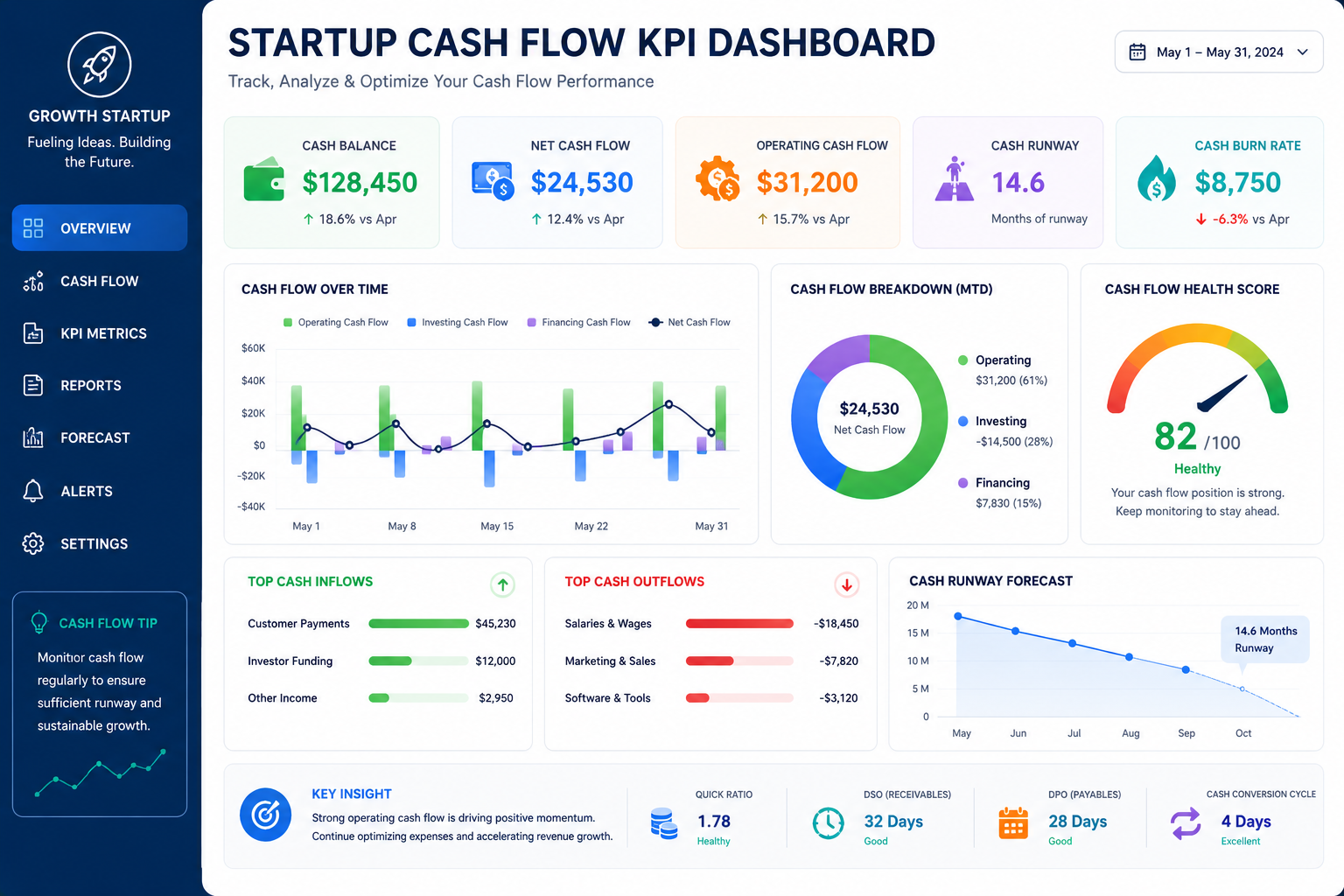
Key Cash Flow Metrics Every Startup Founder Should Monitor
- Cash balance
- Net burn rate
- Gross burn rate
- Cash runway
- Operating cash flow
- Free cash flow
- Accounts receivable days (DSO)
- Accounts payable days (DPO)
- Cash conversion cycle
- Operating cash flow margin
- Revenue growth versus cash growth
Working Capital and Startup Cash Flow
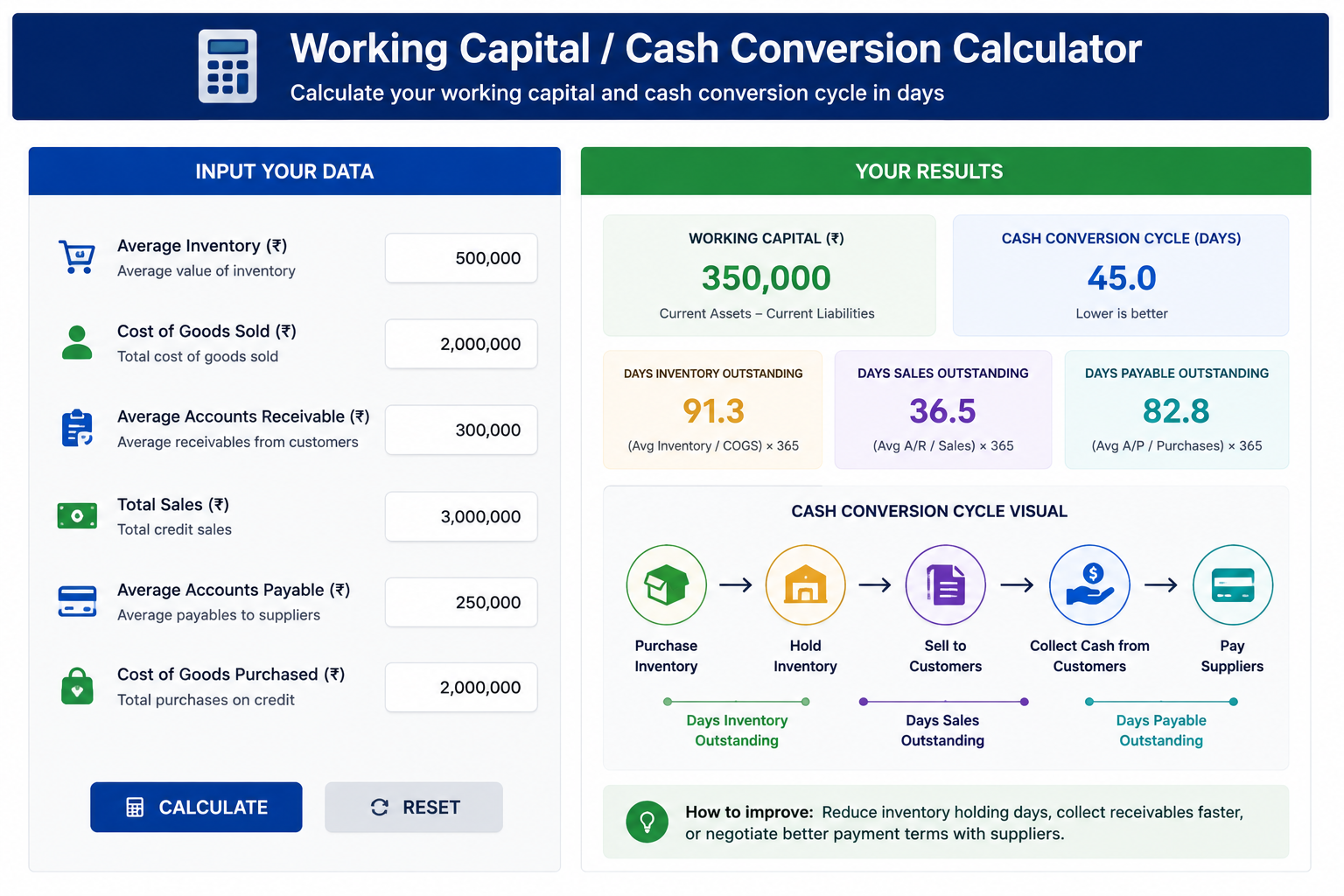
Working capital is current assets minus current liabilities. For most startups, the largest moving parts are accounts receivable, accounts payable, and (where relevant) inventory.
Cash Conversion Cycle = Days Inventory Outstanding + Days Sales Outstanding − Days Payable Outstanding
Shortening the cycle—by collecting faster, paying later where appropriate, and holding less inventory—frees cash without new funding.
Common Startup Cash Flow Problems and How to Fix Them
- Revenue growing but cash declining → tighten collections and review payment terms
- Customers paying too slowly → automate reminders, offer early-payment incentives, escalate systematically
- Spending too quickly → implement weekly spend reviews and clear approval thresholds
- Hiring too early → link new headcount to runway and milestone funding
- Excess inventory → improve demand forecasting and supplier flexibility
- Unexpected tax bills → build tax forecasts into the 13-week model
- Large annual expenses → spread or pre-plan in the cash forecast
- Poor financial forecasting → move from annual budgets to rolling weekly forecasts
- Mixing personal and business finances → separate accounts immediately
- No cash reserve → set a target reserve and treat it as non-negotiable
- Relying too heavily on funding → build a path to positive operating cash flow
Startup Cash Flow Warning Signs
- Cash balance consistently falling
- Runway shrinking rapidly
- Increasing receivables aging
- Suppliers being paid late
- Payroll becoming difficult to cover
- Increasing reliance on credit cards or short-term debt
- Forecasts repeatedly missing actual results
- Revenue growing while operating cash flow deteriorates
- Unplanned expenses repeatedly consuming reserves
CTA: If several of these warning signs apply, consider a professional cash-flow review.
Cash Flow Forecasting vs Cash Flow Management
Cash Flow Forecasting | Cash Flow Management |
|---|---|
Predicts future cash | Manages actual cash |
Identifies future shortages | Prevents or solves shortages |
Forward-looking | Ongoing and action-oriented |
Scenario-based | Decision- and process-based |
Startups need both: forecasting reveals the problem; management solves it.
Cash Flow Management Tools for Startups
Tool Type | Best For | Limitation |
|---|---|---|
Spreadsheet | Early-stage startups | Manual and error-prone |
Accounting software | Growing businesses | Requires proper setup |
Forecasting software | Complex or multi-entity | Cost and learning curve |
Virtual CFO | Strategic leadership | Professional service cost |
Popular platforms include QuickBooks, Xero, Zoho Books, and NetSuite for accounting; Stripe and PayPal for payments. Spreadsheets remain useful for custom 13-week models until volume and complexity justify dedicated tools.
How Accounting Automation Improves Cash Flow Management
Automated invoicing, payment reminders, bank reconciliation, expense capture, receivables and payables reporting, and real-time dashboards reduce lag between activity and visibility. Better visibility supports faster decisions on collections, spend, and runway.

Cash Flow Management for International Startups
Multi-currency balances, foreign-exchange risk, differing payment rails and timing, cross-border banking, international payroll, and multiple legal entities all complicate cash visibility. Tax and compliance treatment varies by jurisdiction; local qualified professionals should review specific obligations. Global receivables and payables require consistent processes and clear ownership.
Cash Flow Management for U.S., UK, Canadian, Australian and European Startups
Core principles remain the same. Local differences appear mainly in tax payment timing, statutory reporting, and banking practices. Avoid treating any single country’s rules as universal; always confirm current requirements with qualified local advisors.
How a Virtual CFO Helps Startups Manage Cash Flow
A Virtual CFO brings forecasting discipline, runway monitoring, budgeting, scenario planning, management reporting, working-capital optimization, financial modelling, investor-ready reporting, and oversight of the accounting team. The role turns raw numbers into decisions about hiring, pricing, fundraising timing, and cost structure.
Primary CTA: Book a Free Cash Flow Consultation
When Should a Startup Hire a Virtual CFO?
Consider professional support when:
- Revenue is growing rapidly
- Funding has been raised and must be managed carefully
- Hiring plans are expanding
- Financial reports are delayed or unreliable
- Runway is unclear
- Founders spend excessive time on finance tasks
- The company is preparing for fundraising
- International markets are opening
- Multiple revenue streams or entities exist
Cash Flow Management vs. Bookkeeping vs. Virtual CFO
Service | Main Purpose | Best For |
|---|---|---|
Bookkeeping | Accurate financial records | All businesses |
Cash Flow Management | Liquidity and cash planning | Growing businesses |
Virtual CFO | Strategic financial leadership | Startups and SMEs |
Bookkeeping and Accountancy form the foundation. Cash-flow management sits on top of clean data. Virtual CFO Services add forward-looking strategy and decision support. Link each to the relevant service page where contextually appropriate.
Startup Cash Flow Management Checklist
Daily
- Monitor bank balances
- Review urgent payments
- Track major incoming payments
Weekly
- Update cash-flow forecast
- Review receivables
- Review payables
- Review runway
- Compare actual versus forecast
Monthly
- Reconcile accounts
- Review financial statements
- Analyze burn rate
- Update budget
- Review working capital
Quarterly
- Review financial model
- Reassess runway assumptions
- Review growth plans
- Conduct scenario analysis
Startup Cash Flow Example
Example company: B2B SaaS
Starting cash: $500,000
Monthly revenue (cash collections): $80,000
Monthly cash expenses: $120,000
Net burn: $40,000
Estimated runway: 12.5 months
Scenario impacts
- Revenue falls 20% → net burn rises, runway shortens
- Payroll rises 15% → higher fixed burn, shorter runway
- Customers pay 30 days late → temporary cash gap even if revenue is unchanged
Suggested visual: Three-scenario cash runway chart.
Best Practices for Improving Startup Cash Flow
The 5-Pillar Framework
1. Forecast — Maintain a living 13-week model and longer-term scenarios.
2. Collect — Invoice promptly, follow up systematically, reduce DSO.
3. Control — Separate essential from discretionary spend; require clear approval for large items.
4. Reserve — Keep a cash buffer sized to the business risk and funding cycle.
5. Optimize — Shorten the cash conversion cycle and automate reporting.
Frequently Asked Questions
Why is cash flow management important for startups?
It prevents shortages, extends runway, supports better hiring and spending decisions, and gives founders and investors clear visibility into how long the company can operate.
How do you manage cash flow in a business?
Track actual cash, forecast the next 13 weeks, tighten collections, control discretionary spend, maintain reserves, and review the numbers weekly.
How do you prepare a cash flow statement for a small business?
Start with opening cash, list all inflows and outflows, calculate net cash flow, and arrive at closing cash. Use the direct method for clarity.
How do you calculate business cash flow?
Cash Flow = Cash Inflows − Cash Outflows. Operating and free cash flow versions add more detail for analysis.
How much cash reserve should a startup maintain?
Enough to cover several months of net burn plus a buffer for surprises; the exact number depends on revenue predictability and funding access.
What is a good cash runway for a startup?
Many aim for 12–18 months after a raise, but the right target depends on growth plans and fundraising environment.
What is the difference between burn rate and cash flow?
Burn rate measures the speed of cash consumption; cash flow is the broader measure of inflows minus outflows.
What is a 13-week cash flow forecast?
A rolling weekly projection of cash position for the next quarter, updated with actual results each week.
How often should startups review cash flow?
Weekly for the short-term forecast; monthly for deeper analysis and budget updates.
Can a profitable startup run out of cash?
Yes. Timing differences between revenue recognition and cash collection, plus high upfront costs, can create shortages even when the income statement looks healthy.
What is the difference between cash flow and revenue?
Revenue is earned sales; cash flow is actual money received and paid.
What is the difference between cash flow and profit?
Profit is an accounting measure; cash flow is the actual movement of money.
Which accounting software is best for startup cash flow management?
The best tool is the one the team will use consistently. QuickBooks, Xero, and Zoho Books are common starting points; more complex needs may require NetSuite or dedicated forecasting tools.
When should a startup hire a virtual CFO?
When complexity, growth speed, or fundraising needs exceed the founders’ bandwidth and the existing bookkeeping setup.
Conclusion
Cash flow management is an operating system, not an annual accounting exercise. Know your current cash position, forecast the next 13 weeks and beyond, monitor burn and runway weekly, improve collections, control expenses, manage working capital, automate reporting, run scenarios, and bring in professional support as complexity grows.
Primary CTA: Book a Free Cash Flow & Financial Planning Consultation