Bookkeeping for Ecommerce Businesses | Complete 2026 Guide
Learn bookkeeping for ecommerce businesses with expert tips on inventory, sales tax, multi-channel sales, reconciliation, software, and financial growth.
11 min readBy camadhav2020
Bookkeeping for Ecommerce Business | Complete Guide to Accurate Financial Management & Growth
Running an online store is fast-paced, making bookkeeping for ecommerce businesses uniquely complex. Orders roll in around the clock from Shopify, Amazon, and eBay. Money flows through PayPal, Stripe, and Klarna.
Managing this steady stream of money isn't like managing a standard brick-and-mortar store. High transaction volumes, marketplace fees, multi-state sales tax, and fluctuating inventory quickly make traditional accounting methods obsolete.
Without clear financial records, your online store can easily run out of cash even while showing high revenue.
This complete guide breaks down bookkeeping for ecommerce businesses. You will learn how to organize your financial records, overcome multi-channel sales challenges, track key metrics, and use clear data to scale your store profitably.
What is Bookkeeping for Ecommerce Businesses?
Ecommerce bookkeeping is the process of tracking, recording, and organising all financial transactions for an online business.
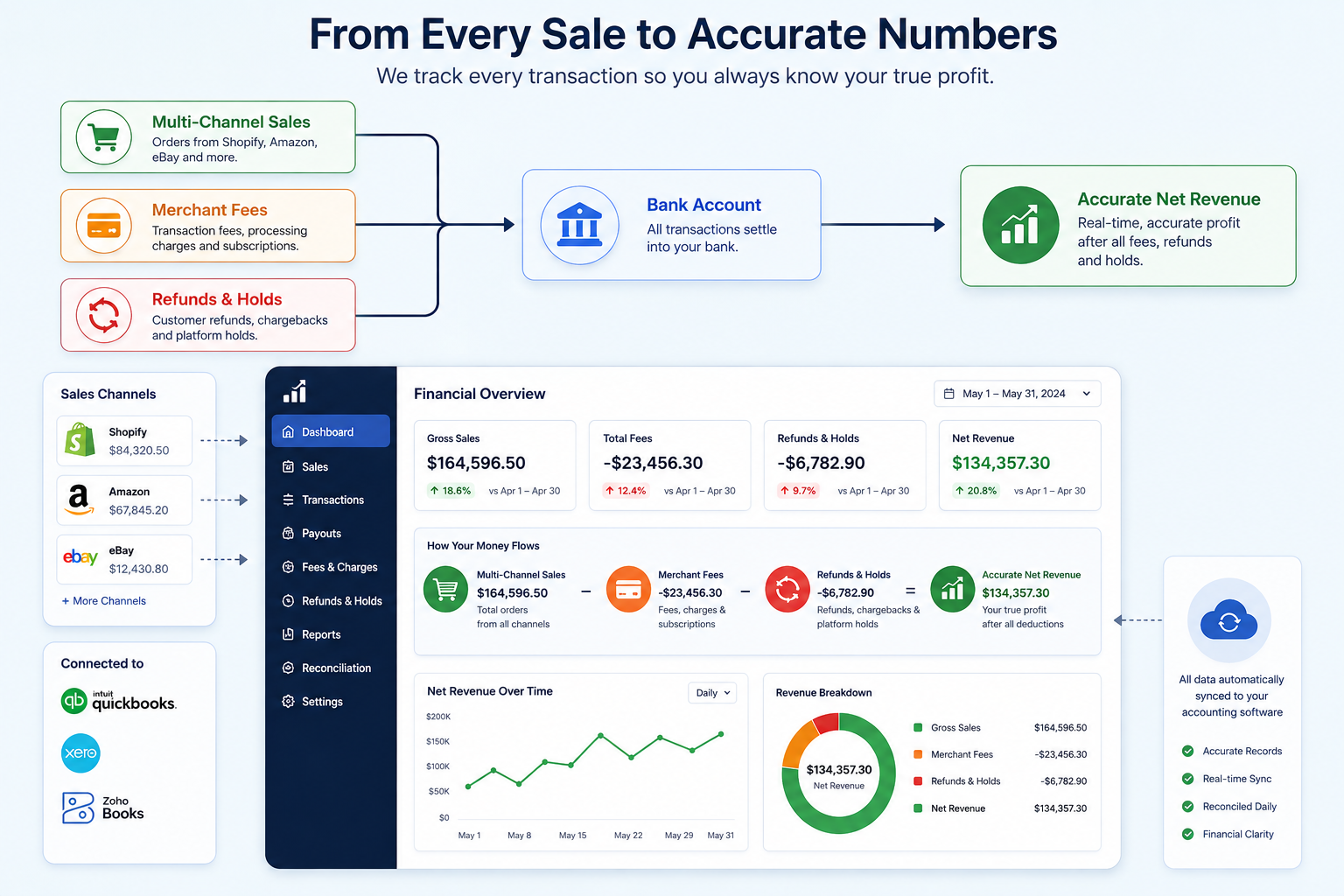
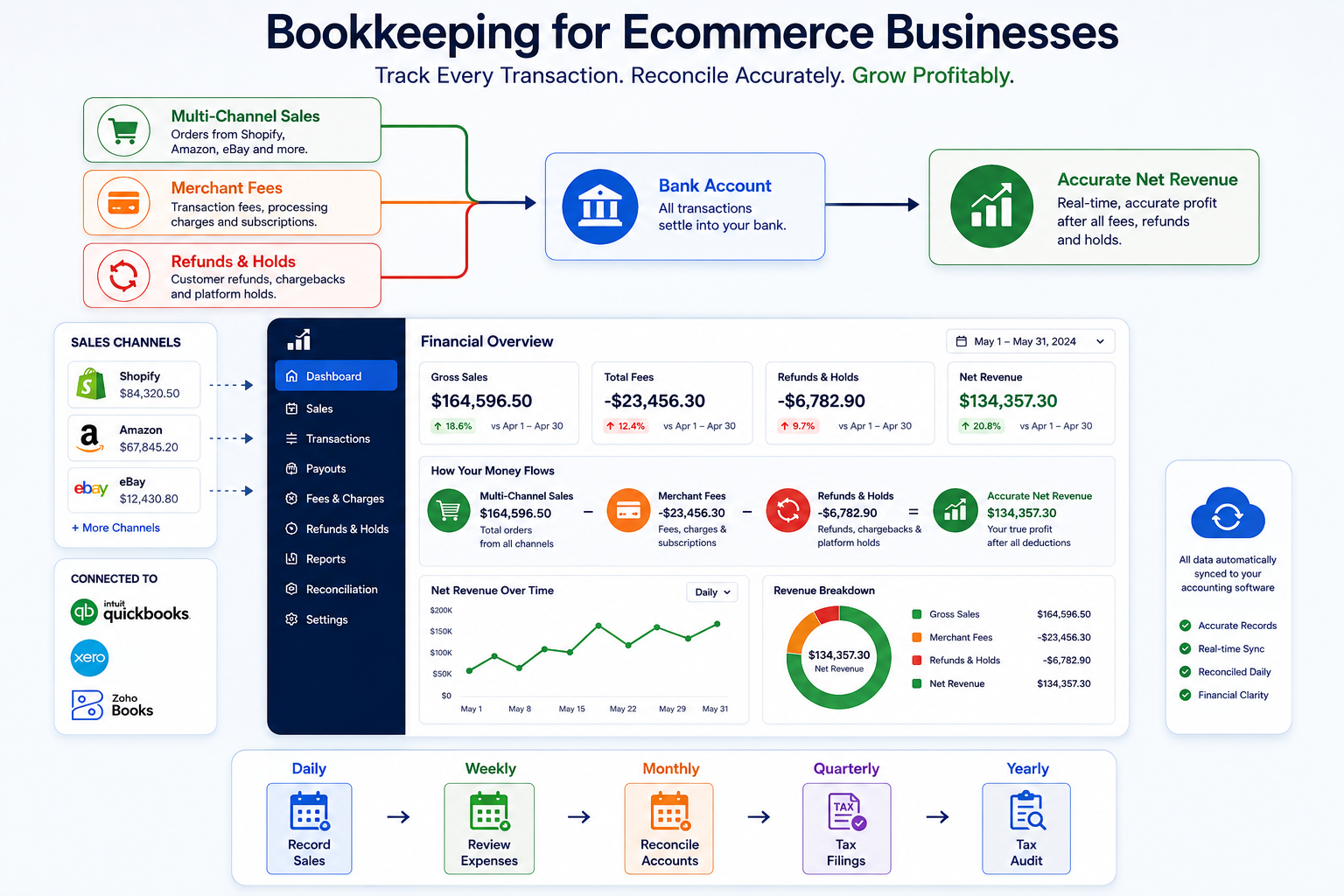
It tracks gross sales, payment processor fees, shipping costs, refunds, inventory costs, and advertising spend across all sales channels.
How Ecommerce Bookkeeping Differs from Traditional Bookkeeping
Traditional brick-and-mortar stores usually record a single daily cash register payout. Ecommerce stores work differently.
When a customer buys a product online, the money does not go straight to your bank account. It passes through a payment gateway (like Stripe or PayPal). The gateway deducts processing fees and holds the payout for several days.
Traditional Bookkeeping
Ecommerce Bookkeeping
Single physical sales location
Multi-channel sales platforms
Direct cash or card payouts
Delayed payouts with merchant fee deductions
Simple local or state sales tax
Multi-jurisdiction & international sales tax rules
Periodic physical inventory checks
Real-time, multi-warehouse cost of goods sold (COGS)
Why Accurate Bookkeeping Matters for Online Stores
Accurate books give you a clear picture of your cash position. They show your exact profit margins after accounting for shipping and merchant fees. Good bookkeeping prevents inventory stockouts, protects you during tax audits, and gives you the clean financial records needed to secure business loans or investor funding.
Why Ecommerce Businesses Need Professional Bookkeeping
As your online store grows, keeping financial records in basic spreadsheets becomes risky. Professional bookkeeping brings clarity to your operations and protects your margins.
Better Cash Flow Management: Payout delays can mask shortfalls. Clean books show your exact cash balance so you can pay vendors on time.
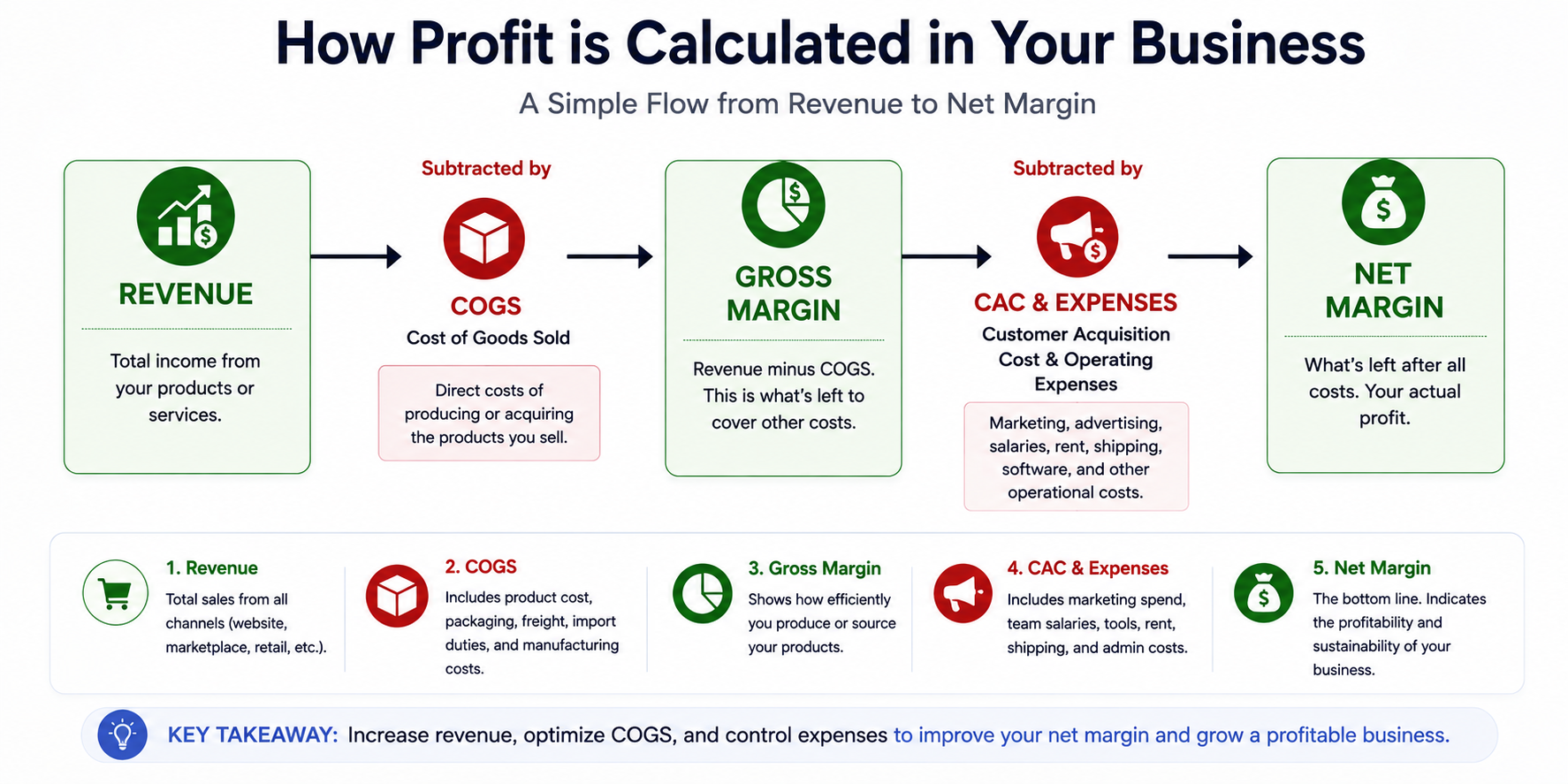
Accurate Financial Reporting: Knowing your gross sales is not enough. You need to know your net profit after accounting for ad spend, merchant fees, and shipping costs.
Selling on your own website along with Amazon and Walmart creates data silos. Each platform reports payouts, fees, and returns differently. Merging these separate streams into one accounting system requires precise categorization.
Payment Gateway Reconciliation
Stripe, PayPal, and Amazon Pay do not deposit gross sales. They deposit net payouts after deducting merchant fees, holds, and refunds. If you record payout deposits directly as revenue, your sales numbers will be incorrect. You must follow strict cash flow management frameworks to handle these payouts correctly.
Inventory Tracking
Inventory is often your largest asset. Tracking stock across multiple fulfilment centres (like Amazon FBA and private warehouses) requires dynamic inventory accounting. Failing to track landed costs such as customs duties, freight, and packaging will warp your profit margins.
Refunds and Chargebacks
Online stores face high return rates. When a customer returns an item, you refund the purchase price, but you might not recover processing fees or return shipping costs. Recording these transactions properly is critical to prevent overstating your revenue.
Sales Tax Compliance
Selling products across state or national borders creates tax obligations (known as sales tax nexus). Tracking destination-based sales tax across thousands of jurisdictions can quickly become overwhelming without clear systems. Follow the latest small business tax deduction guidelines to stay compliant.
Foreign Currency Transactions
International sales bring currency exchange fees and fluctuating conversion rates. Recording these transactions accurately requires multi-currency bookkeeping tools that update rates in real time.
Essential Bookkeeping Tasks Every Ecommerce Business Should Perform
Consistency is key to clean financial records. Grouping tasks into daily, weekly, monthly, and yearly schedules keeps your books organized.
Daily Tasks
Log gross sales and payouts across all channels.
Record incoming receipts and bills.
Track daily cash flow positions.
Weekly Tasks
Review advertising spend against real sales performance.
Reconcile merchant platform payouts against bank deposits.
Pay vendor invoices to keep supply chains moving smoothly.
Monthly Tasks
Reconcile all bank, credit card, and payment processor accounts.
Calculate exact Cost of Goods Sold (COGS) based on actual stock movements.
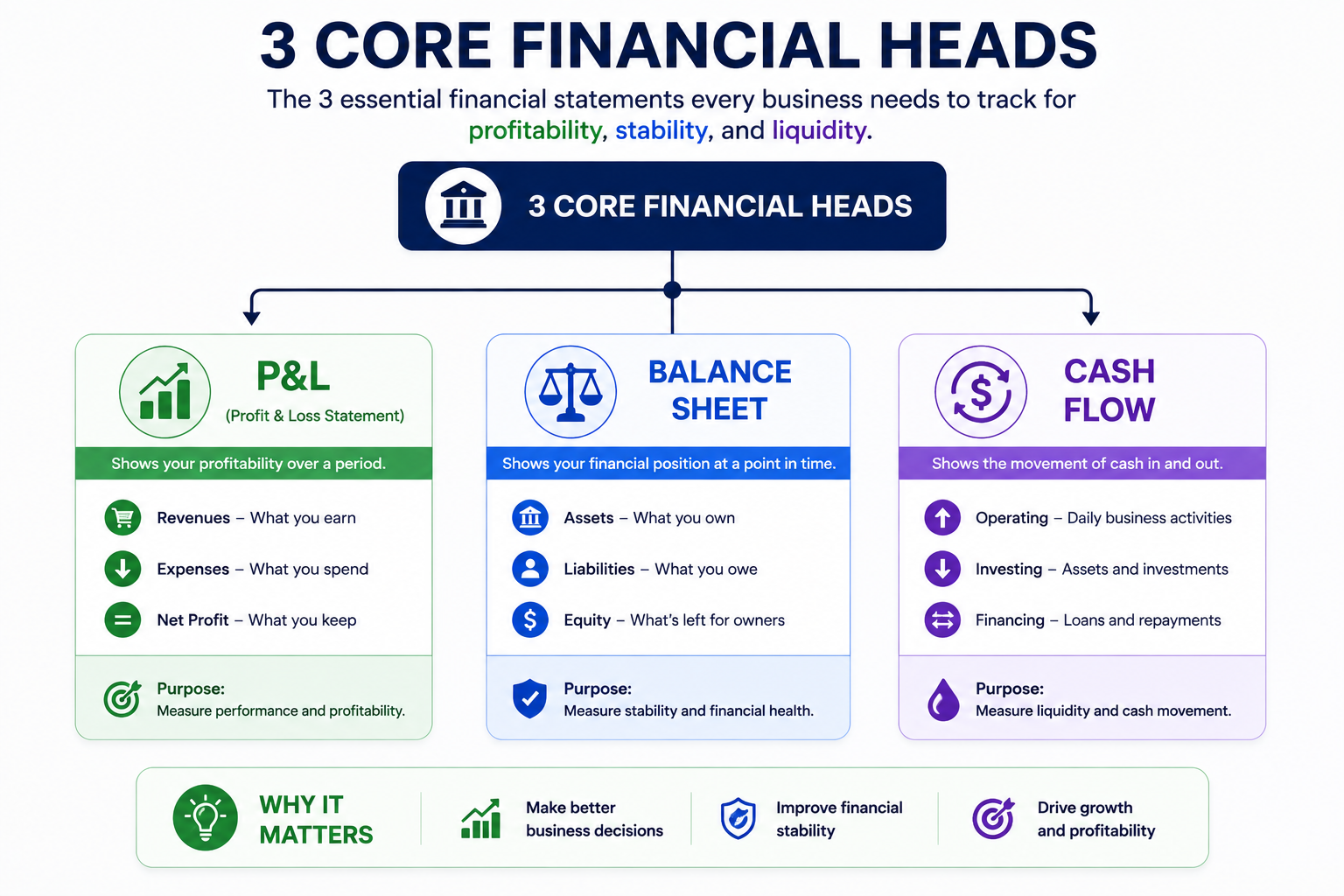
Prepare Profit & Loss, Balance Sheet, and Cash Flow statements.
File and remit collected state and local sales taxes.
Quarterly Tasks
Review estimated quarterly tax payments.
Evaluate product margin trends and cut low-performing stock-keeping units (SKUs).
Update financial projections against targets.
Year-End Tasks
Perform a physical inventory audit and adjust stock valuations.
Issue 1099 forms to independent contractors.
Provide clean year-end financial files to your tax accountant.
Bookkeeping for Small Business Ecommerce Stores
Bootstrapped startups and small ecommerce stores often start by managing their own books. While this saves money early on, manual entry error rates rise quickly as order volume grows.
Key Strategies for Growing Stores
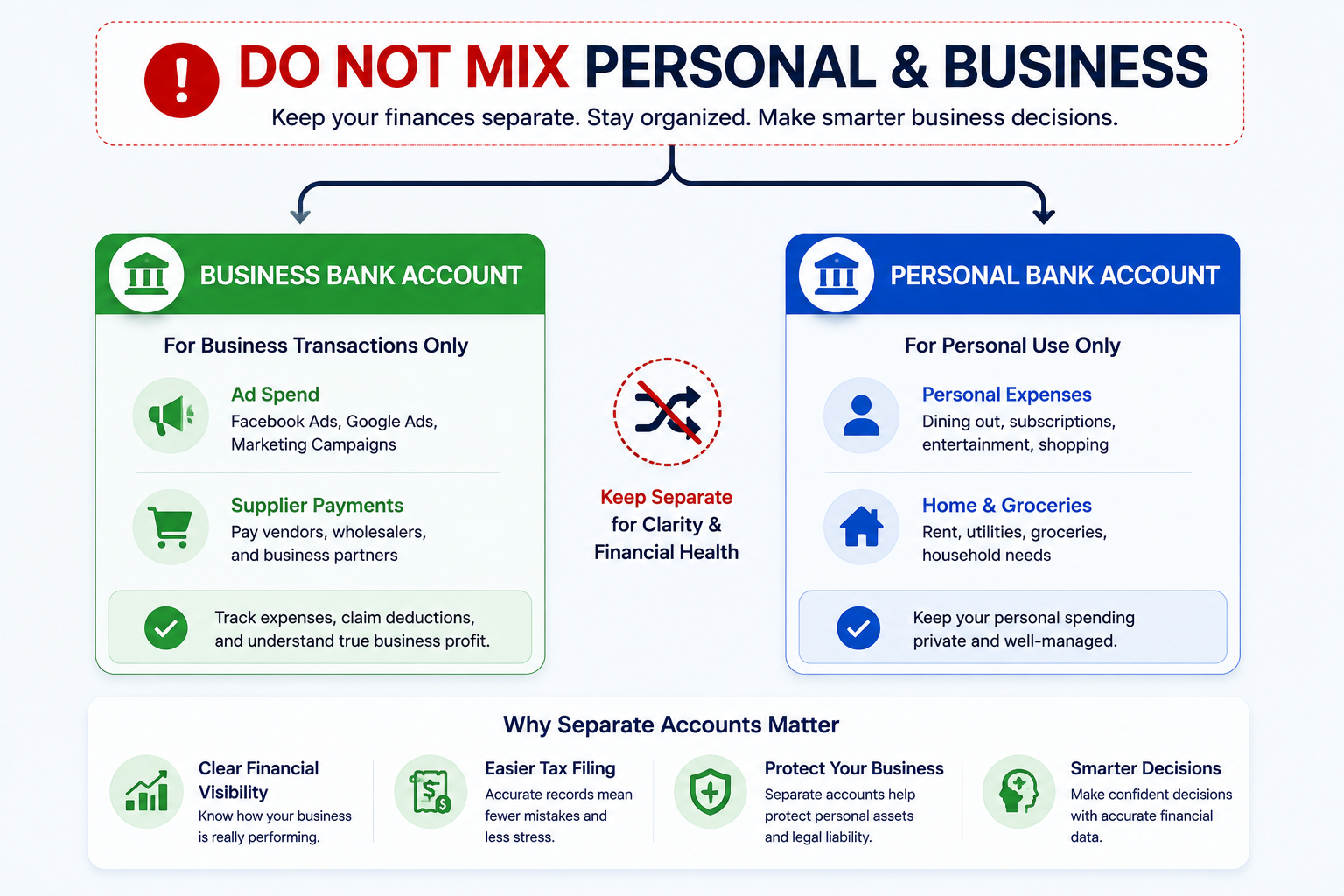
Separate Business and Personal Finances: Open a dedicated business checking account and credit card immediately. Mixing funds creates tax complications and makes tracking real profit difficult.
Automate Data Entry: Connect your store platforms directly to your accounting software using integration tools like A2X or Synder. Manual data entry invites human error.
Focus on Landed Cost: Include ocean freight, customs duties, and local shipping into your product cost. Pricing items based only on factory purchase price shrinks real margins.
Build Scalable Systems Early: Setting up structured accounts from day one makes transitioning to outsourced bookkeeping servicessmooth and painless as your business grows.
Ecommerce Bookkeeping Process (Step-by-Step)
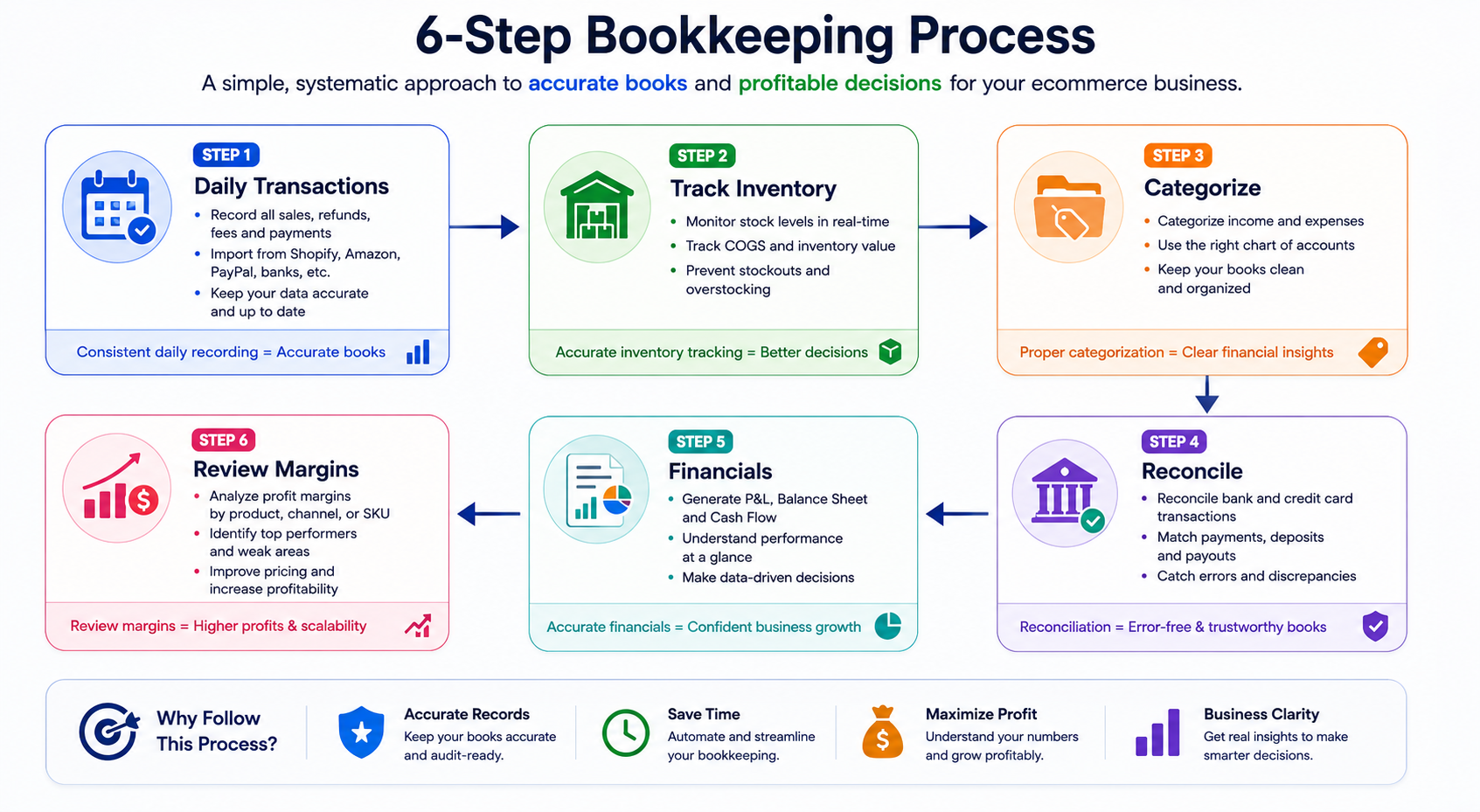
Follow this 6-step workflow to keep your store's finances organized and accurate:
Record Daily Transactions: Fetch sales totals, returns, and sales taxes directly from platforms like Shopify, Amazon, or WooCommerce.
Track Inventory and COGS: Record inventory purchases as assets on your Balance Sheet. Move costs to Cost of Goods Sold on your Profit & Loss statement only when the items actually sell.
Categorize Operating Expenses: Group costs clearly: ad spend, software subscriptions, shipping labels, and packaging supplies.
Reconcile Accounts: Match payment processor payout reports against actual bank deposits to account for every dollar in fees and holds.
Prepare Core Financial Statements: Generate your Profit & Loss Statement, Balance Sheet, and Cash Flow Statement monthly.
Review Product Margins: Analyze gross margin by sales channel to ensure marketing costs aren't eating up profits.
Best Ecommerce Bookkeeping Software
Choosing the right software stack saves dozens of hours every month. The table below compares the top accounting platforms for online stores:
Software
Best For
Standout Features
Starting Price Range
QuickBooks Online
Small-to-Mid Stores
Deep ecosystem, robust integrations, widely supported
Integration Tools: A2X, Synder, Webgility (these bridge the gap between store sales data and accounting software).
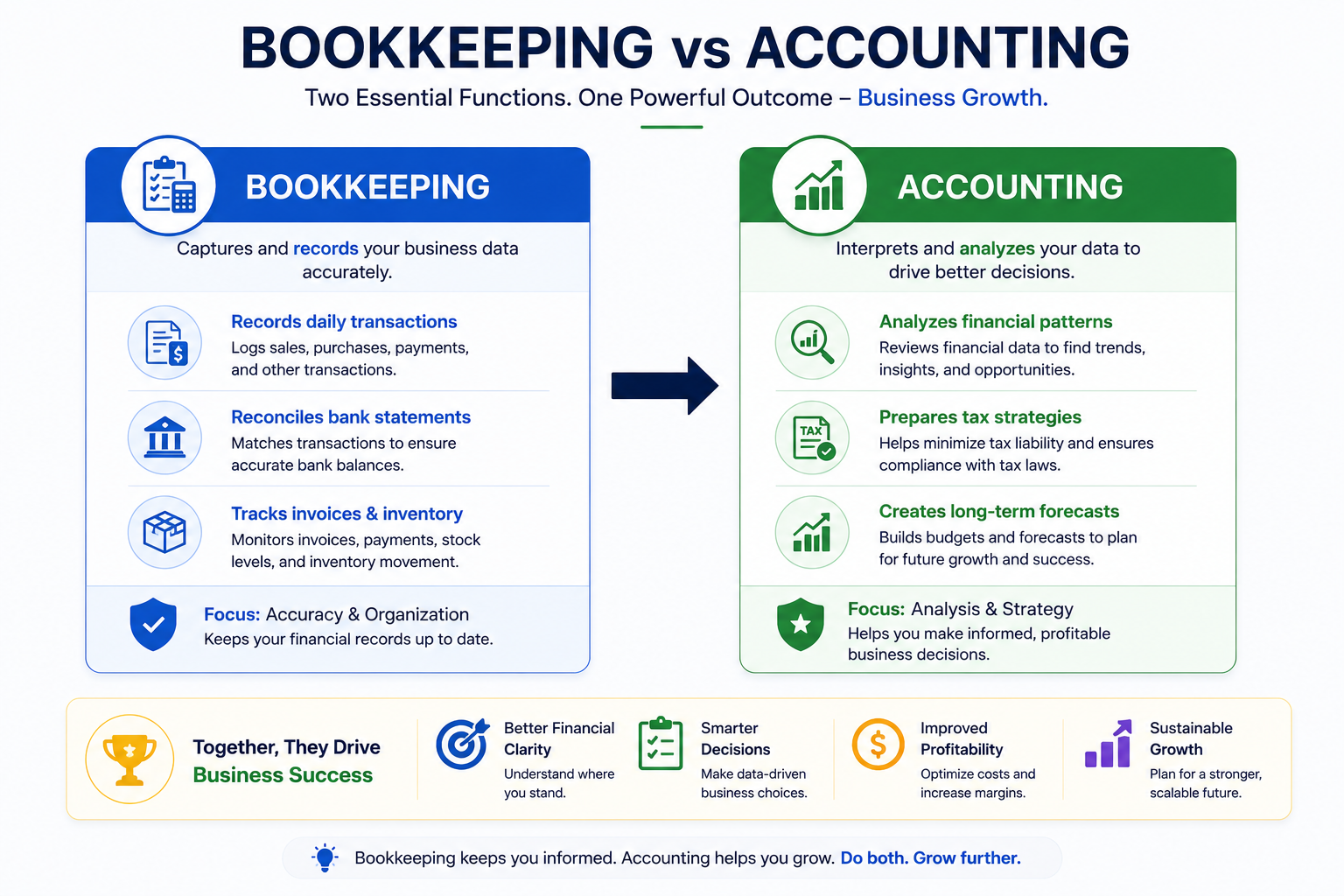
Ecommerce Bookkeeping vs. Ecommerce Accounting
Many business owners treat bookkeeping and accounting as the same thing. While closely linked, they serve distinct purposes in your financial workflow.
Key Financial Reports Every Ecommerce Business Should Monitor
Profit & Loss (P&L) Statement
Shows total revenue, Cost of Goods Sold, operating expenses, and net profit over a specific period. It answers the simple question: Is my business making money?
Balance Sheet
Provides a snapshot of your assets (cash, stock), liabilities (supplier debts, loans), and owner's equity at a single point in time. It shows what your business owns versus what it owes.
Cash Flow Statement
Tracks cash entering and leaving your business across operating, investing, and financing activities. High net profit on a P&L doesn't matter if all your cash is tied up in unsold inventory.
Inventory Report
Tracks stock levels, dead stock, fast-moving items, and reorder points to prevent tie-ups in slow-moving goods.
Accounts Payable & Receivable
Tracks vendor payments due and pending payouts from retail partners or wholesale accounts.
Key Performance Indicators (KPIs) to Track
Monitoring KPIs helps you make smart, data-driven decisions:
Net Profit Margin: Percentage of revenue left after paying all operating expenses, marketing costs, and taxes.
Customer Acquisition Cost (CAC): Total ad spend divided by the number of new customers acquired.
Average Order Value (AOV): Average dollar amount spent every time a customer places an order.
Inventory Turnover Ratio: How many times your store sells and replaces its stock over a year.
Return Rate: Percentage of total orders returned by customers.
Cash Conversion Cycle (CCC): The time it takes to convert inventory investments back into cash from sales. Learn more about optimizing this through standard cash flow management frameworks.
Bookkeeping Best Practices for Ecommerce Businesses
Automate Data Flows: Connect store platforms directly to your accounting software to cut manual entry errors.
Separate Finances: Keep dedicated bank accounts and credit cards for business transactions.
Reconcile Monthly: Match payment gateway reports to bank statements every month without fail.
Track Landed Costs: Factor freight, tariffs, and handling fees directly into inventory valuation.
Store Receipts Digitally: Keep cloud backups of supplier invoices and receipts for smooth tax audits.
Review Reports Routinely: Schedule monthly reviews of P&L and cash flow statements to catch margin slips early.
Signs It's Time to Outsource Ecommerce Bookkeeping
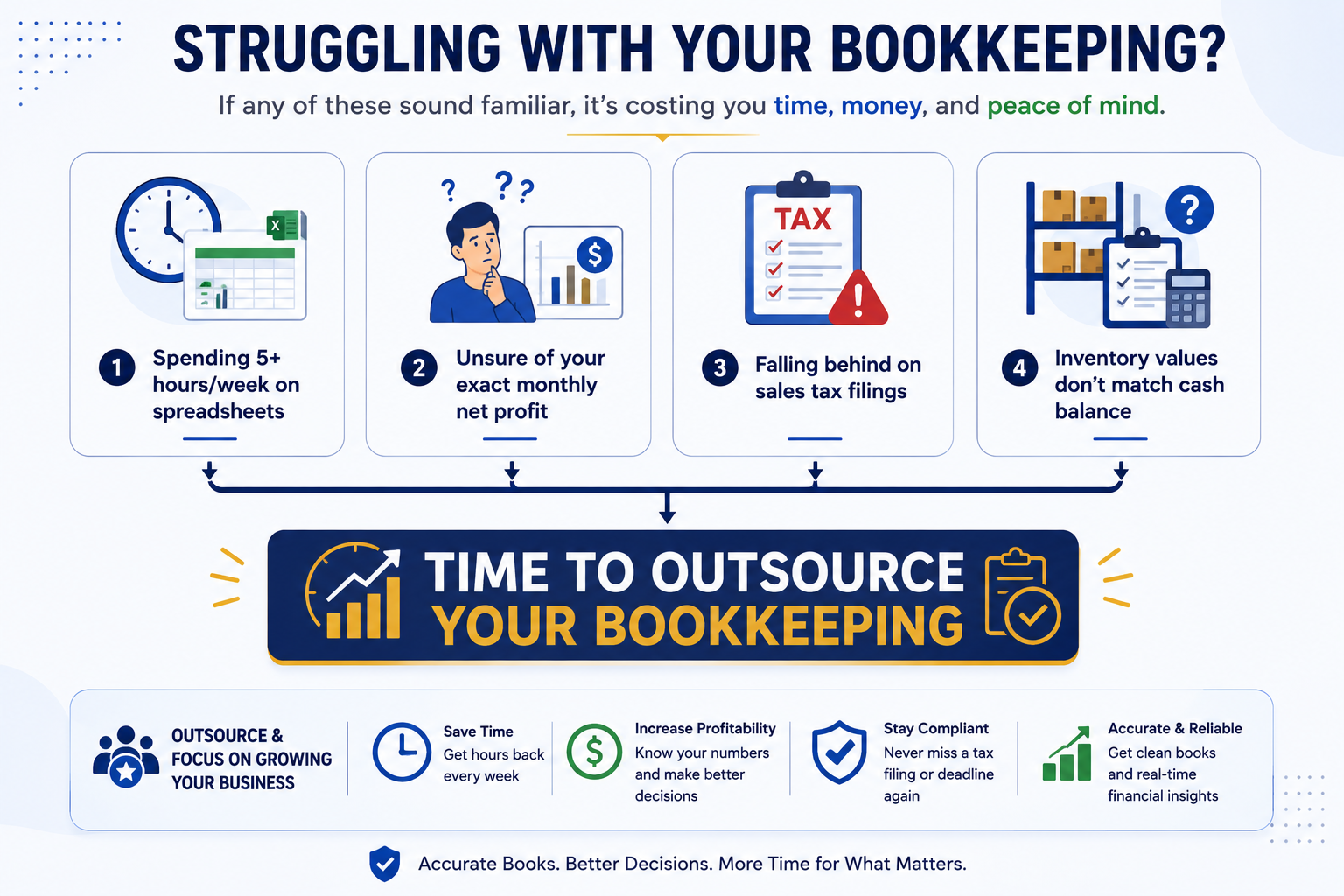
Managing your own books becomes inefficient as sales volume grows. Consider hiring dedicated experts if you experience any of these red flags:
Falling Behind: You are months behind on account reconciliations.
Tax Season Stress: You panic when filing annual taxes or calculating multi-state sales tax.
Unclear Margins: You aren't sure if your ad campaigns are making or losing money after accounting for fees.
Lost Growth Time: You spend hours wrestling with spreadsheets instead of expanding your product catalog.
We build clear financial accounting systems tailored to growing ecommerce brands.
Ecommerce Specialists: We understand payout reconciliations, Amazon FBA fees, and inventory accounting.
Cloud Accounting Stack: We implement seamless setups using QuickBooks Online, Xero, A2X, and modern automation tools.
Dedicated Team: Get direct access to experienced bookkeepers who understand online retail.
Clear Financial Reporting: Receive simple, actionable financial statements every month.
Scalable Support: Flexible service tiers that grow naturally with your business order volume.
Ready to clean up your store's finances? Explore our tailored outsourced accounting firm for startups solutions and focus on growing your store while we handle the numbers.
Industries We Serve
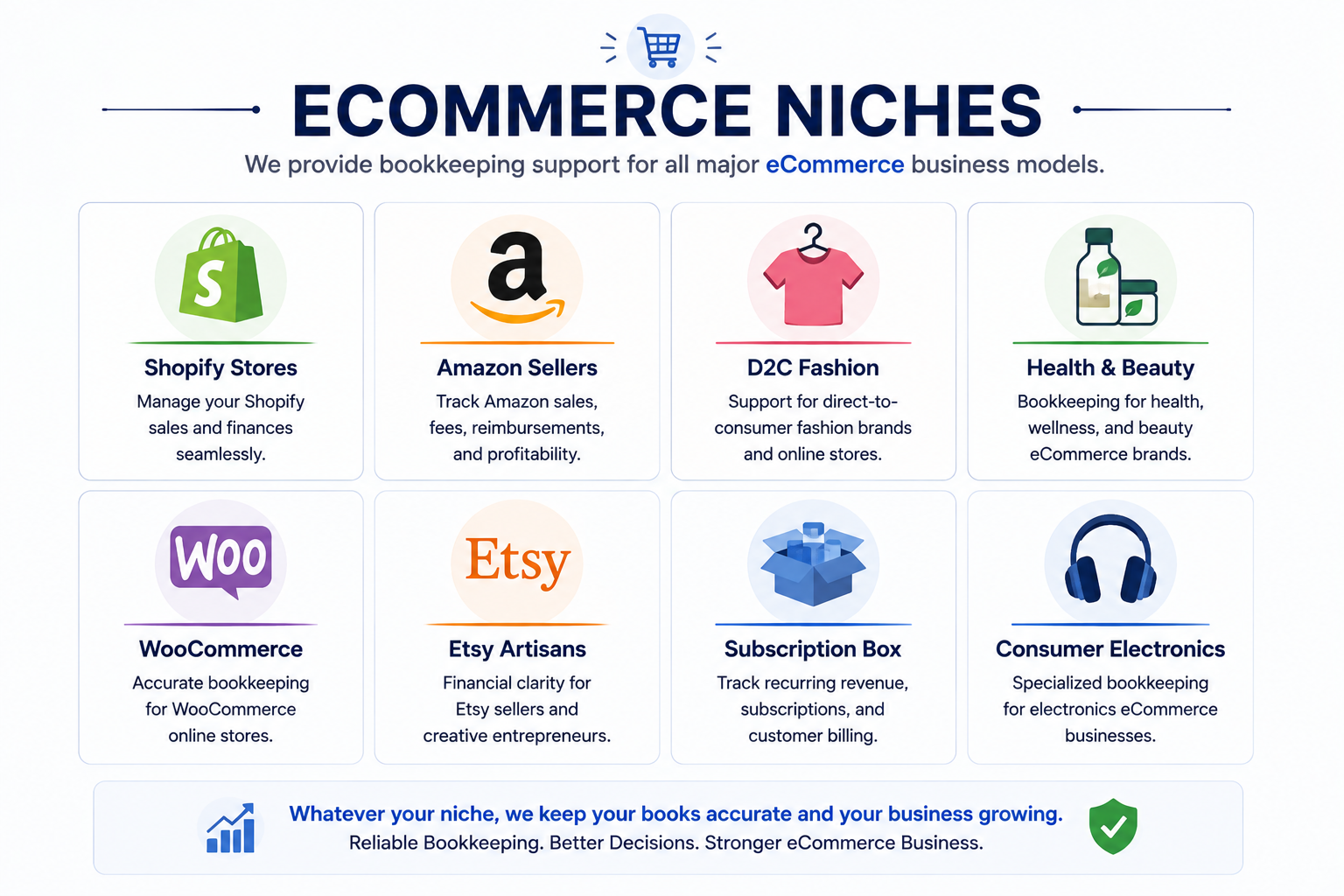
hopify & WooCommerce Stores: Full payout reconciliation and inventory tracking.
Amazon Sellers & FBA Merchants: Accurate handling of Amazon fees, storage costs, and refunds.
Multi-Channel Retailers: Merging multi-platform sales into one clear source of truth.
Frequently Asked Questions
What is bookkeeping for ecommerce businesses?
It is the specialized process of recording sales, managing inventory, tracking processor fees, and reconciling multi-channel payouts for online stores.
How much does ecommerce bookkeeping cost?
Costs usually range from $300 to $1,500+ per month, depending on order volume, sales channels, and inventory complexity.
What bookkeeping software is best for ecommerce?
QuickBooks Online and Xero are industry standards. When paired with integrations like A2X, they automate store payouts and inventory syncs effortlessly.
Can I do ecommerce bookkeeping myself?
Yes, early on. However, as order volumes rise, managing merchant payouts, sales tax, and inventory manually becomes risky and time-consuming.
How often should ecommerce bookkeeping be updated?
Daily logging of sales is ideal, paired with weekly fee tracking and strict monthly bank reconciliations.
Is bookkeeping different for Shopify sellers?
Yes. Shopify deposits net payouts after deducting processing fees. Bookkeepers must record total sales, discounts, and fees separately to maintain accurate records.
Do ecommerce businesses need inventory accounting?
Yes. Unsold stock is an asset, not an immediate expense. Tracking stock value ensures accurate balance sheets and profit calculations.
What financial reports should I review monthly?
Review your Profit & Loss Statement, Balance Sheet, Cash Flow Statement, and Inventory Turnover Report every month.
Should I outsource ecommerce bookkeeping?
Outsourcing saves time, reduces costly tax errors, and provides clear financial reports without the cost of a full-time internal hire.
How does professional bookkeeping improve profitability?
It highlights hidden expenses, flags low-margin items, prevents stockouts, and gives you clear data to spend ad dollars wisely.
Conclusion
Mastering bookkeeping for ecommerce businesses is not just about keeping the tax authorities happy; it is the single most effective strategic tool for scaling your online store. When you clean up your multi-channel reconciliations, accurately track your landed inventory costs, and monitor real-time profit margins, you turn complex financial data into a clear roadmap for long-term growth.
Whether you choose to automate your internal systems or partner with specialized professionals, accurate books give you the clarity and confidence to make smarter business decisions. Don't let hidden merchant fees, uncollected chargebacks, or cash flow gaps slow down your momentum.
Ready to Streamline Your Ecommerce Finances?
Stop spending hours wrestling with spreadsheets, payout delays, and payment gateway statements. Let our team of financial experts optimize your books so you can focus on expanding your product line and growing sales.