
Tangible and intangible assets in every business rely on assets to generate revenue, scale operations, and build long-term value. For business owners, tracking these items accurately is the foundation of clean financial reporting. For investors, looking beyond the raw numbers on a balance sheet reveals a company’s true competitive edge.
Understanding the balance between physical property and intellectual worth is critical. Whether you are reviewing corporate financial health or mapping out the foundational steps to financial independence, your journey starts with a clear understanding of what a business actually owns.
This guide simplifies the core concepts of tangible and intangible assets. You will learn how to identify them, how they impact company valuation, and how accountants track them over time.
Key Takeaways
Tangible assets have a physical form you can see and touch, like equipment or buildings.
Intangible assets lack physical substance but provide immense economic value, like patents or brand recognition.
Both asset types sit on the balance sheet and directly dictate a company's total market value.
What Are Assets?
In simple terms, an asset is any resource with economic value that an individual or corporation owns or controls. Think of assets as the economic engines of a business. They are bought or created to increase the value of a enterprise or directly benefit operations.
Assets matter because they drive cash flow, secure financing, and provide a clear picture of financial health. When a business looks to scale, having a strong mix of resources makes it easier to secure strategic financial oversight trends from lenders or venture partners.
To keep financial tracking clean, accountants classify these resources into four primary buckets.
The Four Main Types of Assets
Current Assets: Short-term resources that a business expects to convert into cash within one year. This includes cash on hand and accounts receivable.
Fixed Assets: Long-term resources used to keep operations running smoothly over multiple years, such as manufacturing plants or office space.
Tangible Assets: Physical property used in daily operations or held for long-term value.
Intangible Assets: Non-physical intellectual or conceptual property that gives a business a competitive advantage.
What are the 4 types of assets?
The four main types of assets are current assets, fixed assets, tangible assets, and intangible assets. They are categorized based on their convertibility to cash and their physical presence.
What Are Tangible Assets?
Tangible assets are the physical backbone of an enterprise. If you can walk up to an item and physically touch it, it falls into this category. These resources form the foundation of a company’s production capacity and logistical infrastructure.
Characteristics of Tangible Assets
They possess a clear physical form and occupy space.
They are easily destroyed by physical damage or natural wear and tear.
They carry a clear market value that is relatively straightforward to appraise.
These assets generate value by enabling production or distribution. For example, a delivery truck helps an e-commerce platform move products to customers, directly turning an investment into operational revenue. Knowing how to manage these assets keeps your overall bookkeeping cost for small businesses predictable and manageable.
Common Tangible Assets
Buildings: Warehouses, corporate offices, and retail spaces.
Machinery: Production lines and specialized assembly tools.
Vehicles: Delivery vans, corporate cars, and transport trucks.
Equipment: Computers, servers, and office furniture.
Inventory: Raw materials and finished goods waiting for sale.
People Also Ask: Which example is a tangible asset?
A piece of machinery, a corporate vehicle, or a commercial building are all classic examples of tangible assets because they exist in the physical world.
What Are Intangible Assets?
In the modern digital economy, a company’s most valuable resources are often invisible. Intangible assets lack physical substance, yet they provide long-term financial value. They represent intellectual property, brand equity, and legal protections that keep competitors from cloning a successful product line.
Characteristics of Intangible Assets
They have no physical presence or material form.
They grant exclusive legal rights or operational advantages to the owner.
They are often difficult to value accurately on day one.
These resources matter because they allow businesses to charge premium prices. A consumer might pay double for a smartphone simply because of the logo printed on the back. That is the raw power of an intangible asset at work. It is also why modern startups prioritize secure intellectual property before seeking out specialized virtual cfo for services consultations.
Common Intangible Assets
Patents: Legal protections that give a company exclusive rights to an invention or unique process.
Trademarks: Recognizable symbols, logos, or phrases that distinguish a brand from its competitors.
Copyrights: Legal rights that protect original creative works, like code, music, or written material.
Goodwill: The premium value created when one company acquires another for more than its bare asset value.
Brand Value: The market reputation and consumer trust built by a company over time.
What are intangible assets?
Intangible assets are non-physical, long-term resources owned by a company, such as intellectual property, patents, trademarks, and corporate goodwill.
What does intangible mean?
In finance and accounting, intangible means an asset has no physical or material presence, but still holds significant monetary value for the business.
Tangible and Intangible Assets Examples
To understand how these concepts function in real-world scenarios, it helps to look at a comprehensive list. Businesses utilize a vast array of resources to maintain daily operations and drive long-term revenue growth.
10 Tangible Asset Examples
Manufacturing plants and factories
Company vehicles and delivery trucks
Computer hardware and servers
Office furniture and desks
Raw materials in production warehouses
Finished goods inventory is ready for retail
Land and corporate real estate
Cash reserves and physical currency
Heavy construction equipment
Retail store display fixtures
10 Intangible Asset Examples
Proprietary software code
Registered design patents
Corporate logos and trademarks
Product copyrights and publications
Customer databases and mailing lists
Secret recipes or manufacturing formulas
Franchise agreements and operational licenses
Corporate goodwill from business acquisitions
Brand recognition and market reputation
Employment contracts with specialized talent
Quick Asset Categorization
Tangible Asset | Intangible Asset |
Corporate Building | Product Patent |
Delivery Vehicle | Brand Trademark |
Manufacturing Equipment | Software Copyright |
Office Laptop | Franchise License |
Difference Between Tangible and Intangible Assets
The primary differences between these two groups lie in how they exist, how they lose value, and how easily they can be turned into quick cash. Understanding these variations is vital for accurate tracking, helping management keep the overall cost of bookkeeping services for small businesss stable.
Physical Presence: Tangible assets occupy physical space and can be seen or touched. Intangible assets exist purely as conceptual value or legal rights.
Valuation Method: Valuing physical goods is simple. You check the purchase receipt or look up current market rates. Intangible goods require specialized, data-driven forecasting methods to value accurately.
Depreciation vs Amortization: Physical property wears down over time, a process called depreciation. Intellectual property simply loses its legal or market relevance over time, which is called amortization.
Liquidity: Physical items like inventory or surplus equipment can often be liquidated quickly for cash. Intellectual assets take a long time to sell because finding a buyer for a custom patent or trademark is highly complex.
Side-by-Side Comparison
Feature | Tangible Assets | Intangible Assets |
Physical Form | Yes (Physical Substance) | No (Abstract/Legal Right) |
Value Loss | Depreciates over time | Amortizes over time |
Risk of Damage | High (Fire, Theft, Wear) | Low (Only Intellectual Theft) |
Ease of Valuation | Simple (Market Price) | Complex (Future Cash Models) |
Balance Sheet Location | Under Property, Plant & Equipment | Under Long-term Intangible Assets |
Tangible and Intangible Assets in Accounting
Tracking resources requires strict adherence to standardized financial frameworks. When an accountant looks at a business, they follow specific steps to record these items on the official books.
To keep your records clean, the accounting lifecycle focuses on four distinct areas:
Recognition Criteria: An item only becomes an asset if the business controls it, if it stems from past events, and if it will bring verified economic value in the future.
Initial Measurement: When first acquired, both resource types are recorded at their actual historical cost. This includes the purchase price and any fees required to get the asset ready for operational use.
Subsequent Measurement: Over time, the value must be updated on the books. This means subtracting accumulated depreciation for physical items or legal amortization for abstract ones.
Financial Reporting Requirements: Businesses must clearly separate these resources on their official financial statements. This structural clarity makes it simple for investors to analyze the core balance sheet metrics.
When building a firm from scratch, mapping out these financial frameworks early ensures your calculations remain clean. If your internal team lacks the time to handle these complex steps, outsourcing the setup to structured fractional executive management models can save thousands in long-term regulatory mistakes.
Tangible and Intangible Assets on the Balance Sheet
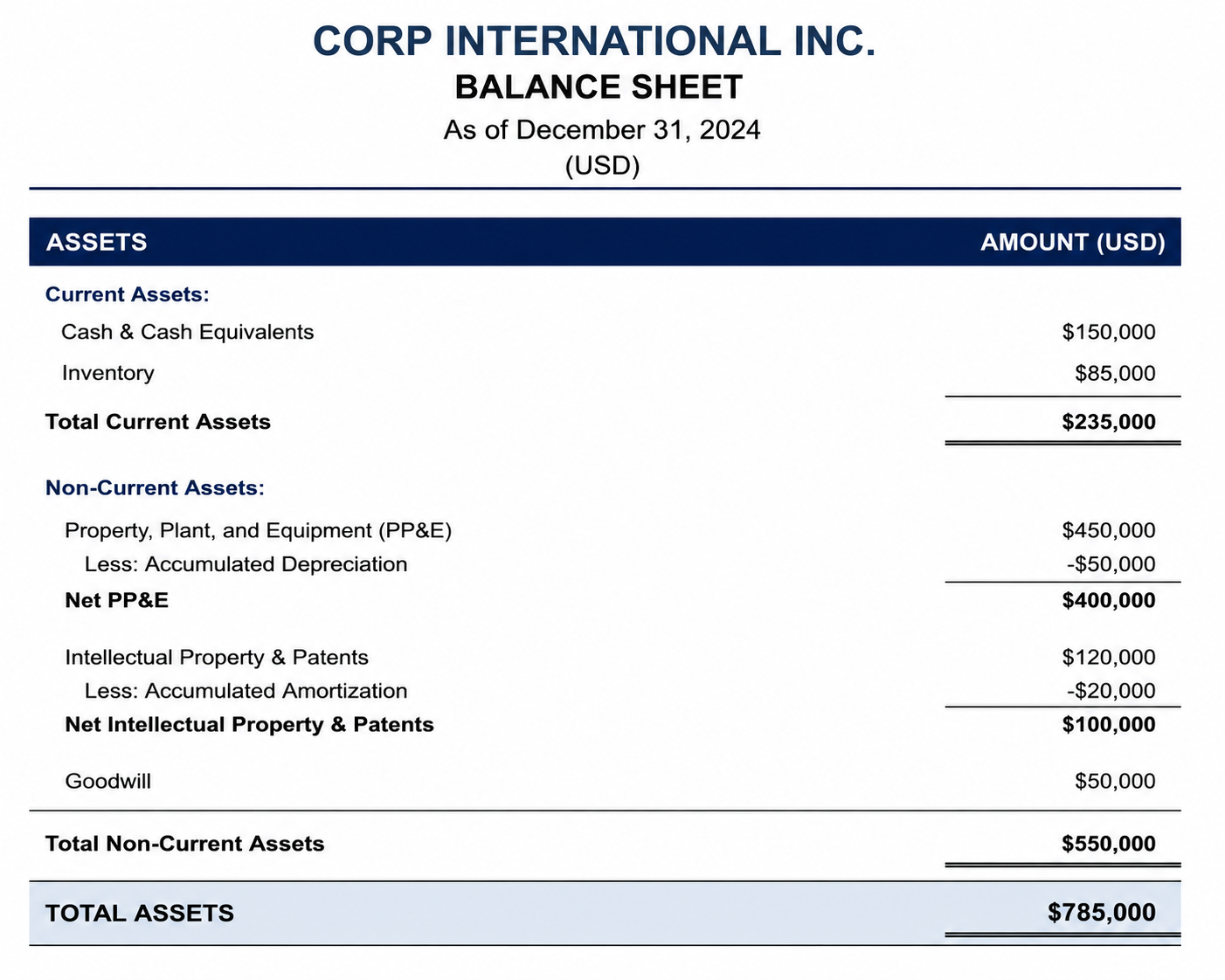
A balance sheet is a financial snapshot showing what a company owns and what it owes at a specific point in time. Both types of resources sit on the left-hand side of the ledger under the "Assets" column, but they are categorized differently based on how long they will remain with the business.
Where Tangible Assets Appear: Short-term items like inventory sit under Current Assets. Long-term physical resources, like corporate property or factory machinery, are placed under Non-Current Assets, usually labelled as Property, Plant, and Equipment (PP&E).
Where Intangible Assets Appear: Long-term intellectual property always sits under Non-Current Assets. They are listed in their own distinct line item right below the physical property sections.
Real Balance Sheet Layout Example
To understand this structure in a practical framework, consider this simplified structural layout of a corporate balance sheet:
Tangible Asset Valuation
Determining the exact dollar value of physical items is a straightforward process because tangible goods have an active marketplace. Accountants use a few key appraisal methodologies depending on the goals of the financial report.
Historical Cost Method: This records the asset at its original purchase price. It is the most common method used in everyday accounting because it relies on hard, unchangeable receipt data rather than speculation.
Market Value Method: This evaluates what the item would sell for on the open market today. It is highly useful for a company planning to sell off surplus machinery or real estate to boost cash liquidity.
Replacement Cost Method: This estimates the cost of replacing an asset with an identical one at current market prices if the existing one were destroyed. Insurance companies rely heavily on this metric.
Regardless of the tracking method you use, physical items lose value as they age. This natural wear and tear is tracked using Depreciation Basics. By using formulas like the Straight-Line Method, companies evenly distribute the expense of a physical asset over its expected operational lifetime.
Intangible Asset Valuation
Valuing non-physical property is significantly more complex. Because you cannot easily look up the market value of a custom software patent on an open exchange, financial experts must use specialized forecasting models.
The Cost Approach: This looks backward. It calculates the total amount of cash a business spent to create or purchase the asset from scratch. For example, if a brand spent $100,000 on engineering labour to build a proprietary application, that cost forms the baseline valuation.
The Market Approach: This compares the asset to similar intellectual property that was recently bought or sold in corporate acquisitions. This works well for common items like domain names or standard operating licenses.
The Income Approach: This looks forward. It projects the exact amount of future revenue the asset is expected to generate for the business. This number is then discounted back to present-day cash value. This model is vital when founders are prepping how to build a dynamic financial model to present to outside investors.
To track this value reduction over time, accountants use Amortization Explained. Amortization is identical to depreciation, but it applies exclusively to non-physical items with a set lifespan, like a 15-year legal design patent.
Tangible and Intangible Assets Formula
When building financial projections or organizing corporate balance sheets, relying on clear math ensures accuracy. Two primary formulas form the foundation of asset tracking.
Total Assets Formula
To calculate the total resource footprint of a business, combine all physical and abstract holdings:
Total Assets = Total Tangible Assets + Total Intangible Assets
Net Tangible Assets Formula
Investors often look exclusively at physical net worth to understand what a company would be worth if it had to shut down tomorrow and liquidate everything. This calculation strips away all abstract resources and liabilities:
Net Tangible Assets = Total Tangible Assets - Total Liabilities
Understanding these core calculations is vital for long-term health. If your cash flow runs tight, knowing how your assets convert into liquid capital makes it easy to calculate operating cash flow accurately using standard accounting software.
The 7 Major Intangible Assets Businesses Own
While physical items are easy to count, non-physical wealth typically drops into seven distinct buckets. These resources drive the majority of modern corporate valuations:
Patents: Government-granted monopolies over a brand-new technological invention or processing method.
Trademarks: Unique, legally protected brand logos, catchphrases, and distinct colour schemes.
Copyrights: Legal protections for original creative works, covering software source code, written text, and visual designs.
Goodwill: The surplus value premium established when an acquiring company purchases a business for more than its fair market asset value.
Brand Recognition: The public awareness and market reputation a company commands across its target industry.
Trade Secrets: Non-public, internal business systems, algorithms, or custom manufacturing processes that provide a clear competitive edge.
Software Licenses: Explicit legal permissions and operational rights required to deploy proprietary digital applications across corporate networks.
People Also Ask: What are the 7 intangible assets?
The seven primary intangible assets are patents, trademarks, copyrights, goodwill, brand recognition, trade secrets, and software licenses.
Intangible Assets Under IAS 38
When tracking digital or intellectual property on a global scale, businesses must comply with International Accounting Standard 38 (IAS 38). This standard establishes strict global rules to prevent companies from artificially inflating their corporate value on paper.
Recognition Criteria Under IAS 38
According to IAS 38, an item can only be recognized as an intangible asset if it meets three definitive criteria:
Identifiability: The asset must be separable, meaning it can be cleanly divided from the business and sold, rented, or transferred independently.
Control: The company must hold the legal power to secure the economic benefits flowing from the resource and restrict outside access to it.
Future Economic Benefits: The resource must generate clear future revenues or significantly lower the business's current operating costs.
The R&D Capitalization Rule: A major trap under IAS 38 is the treatment of Research and Development (R&D) costs.
All Research costs must be expensed immediately on your income statement (you cannot count them as an asset).
Development costs can only be capitalized (turned into a balance sheet asset) once technical and commercial feasibility are fully proven.
What are IAS 38 intangible assets?
IAS 38 is an international accounting standard that outlines the strict definition, recognition criteria, and amortization guidelines for non-monetary assets that lack physical substance.
Real-World Examples of Tangible and Intangible Assets
To truly understand how these assets interact, let’s look at how the world's most successful corporations balance their physical footprints with intellectual property.
Apple: On the physical side, Apple owns massive corporate offices, highly advanced manufacturing equipment, and retail stores globally. However, its true market premium lies in its non-physical properties. The iOS source code, a massive vault of utility patents, and the iconic Apple logo are what allow the company to command massive profit margins.
Coca-Cola: This corporate giant owns bottling factories, delivery trucks, and land. Yet, if you stripped away its most famous assets the secret merchandise formula and the globally recognized trademark name it would just be another soda company. Its brand value is worth billions on its own.
Microsoft: While Microsoft produces physical goods like Xbox consoles and Surface tablets, its financial empire is built on intangible assets. The software licenses for Windows and Azure cloud architecture create massive recurring revenues with incredibly low overhead costs.
Is Apple tangible or intangible?
Apple owns both tangible and intangible assets. While its physical inventory, stores, and buildings are tangible, the vast majority of Apple's multi-trillion-dollar market value comes from its intangible assets, like its brand reputation, iOS software, and design patents.
Asset Management for Businesses
To keep an enterprise scaling smoothly, corporate leaders must build structured processes to track, protect, and optimize everything they own.
Tracking Tangible Assets
Physical equipment requires active logistics management. Businesses use automated asset-tagging systems, barcode scans, and routine physical inventory counts. This tracking ensures that your equipment stays operational, minimizes internal theft, and provides clear financial metrics to help keep your overall bookkeeping cost for small businesses fully predictable.
Managing Intangible Assets
Protecting intellectual property requires a proactive legal strategy. This includes filing timely patent renewals, monitoring the market for trademark infringements, and securing user access logs to protect trade secrets.
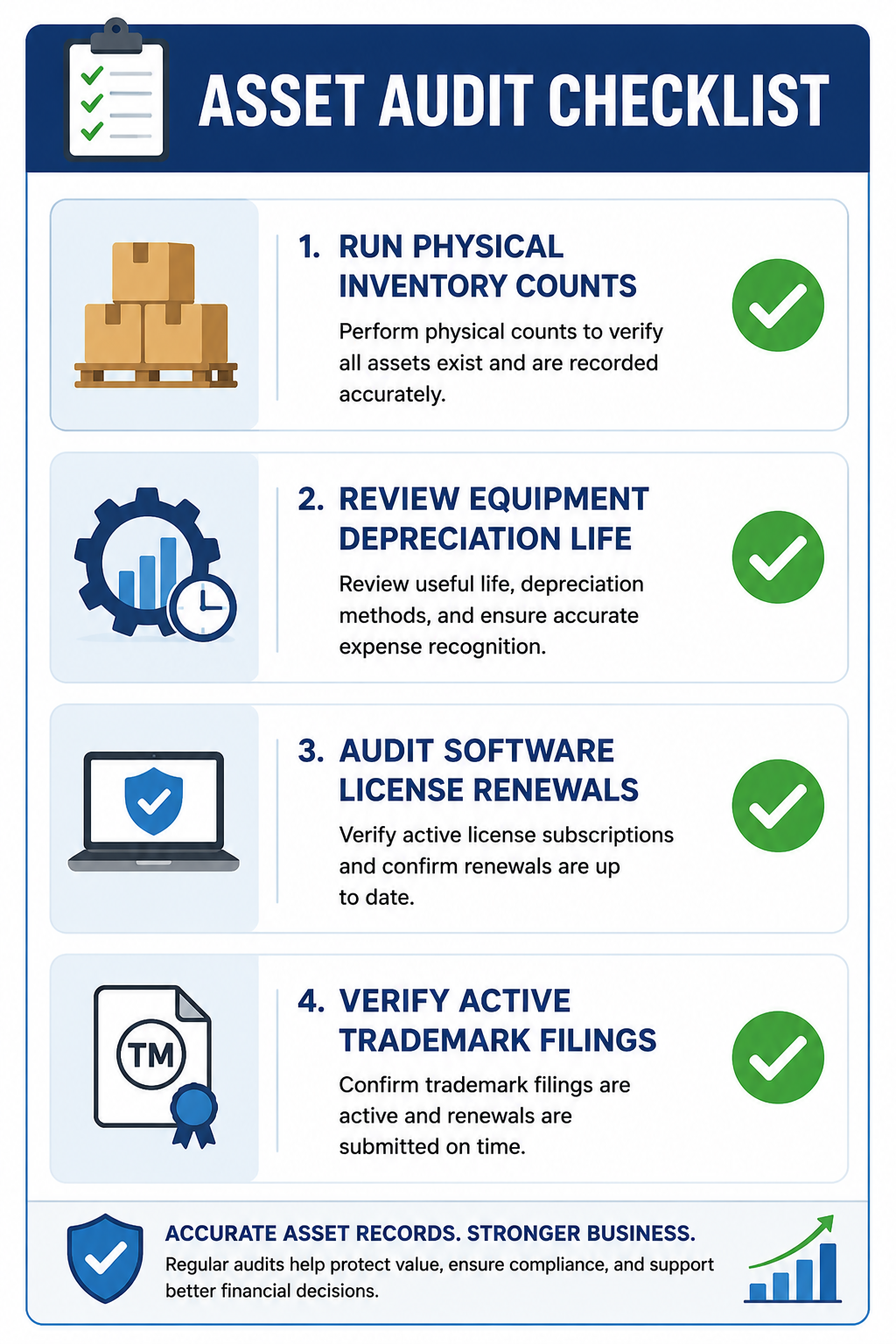
Conducting systematic internal audits protects the enterprise from unforeseen operational risk. If managing these intersecting layers of physical tracking and intellectual property law becomes too time-consuming for your core team, outsourcing the strategy to professional virtual cfo services for small business can give you the institutional guardrails needed to scale safely.
Investor Perspective: Why Intangible Assets Matter More Today
In the traditional industrial economy, a company's power was measured by its physical infrastructure, the size of its factories, the weight of its steel mills, and the volume of its rail cars. Today, that model has completely flipped.
In the modern digital economy, intellectual property drives long-term stock performance. Technology, software, and biotech firms frequently trade at massive premiums compared to their physical book value.
Investors look closely at intangible metrics because software can be copied and scaled instantly to millions of users worldwide with zero manufacturing friction. A business that secures deep intellectual property barriers and high customer loyalty can easily outperform competitors that only focus on physical expansion.
Common Mistakes When Evaluating Assets
Even experienced financial analysts can miscalculate a company's true value by overlooking specific balance sheet rules. Avoiding these common traps protects your business from serious reporting errors.
Ignoring Brand Value: Many business owners focus entirely on physical inventory and equipment. If you ignore consumer trust and digital presence, you dramatically undervalue your operation.
Overvaluing Physical Assets: Recording heavy machinery at its historical purchase price without adjusting for real-world wear and tear inflates your paper wealth. Regular depreciation updates are critical.
Incorrect Amortization: Applying the wrong operational lifespan to an intellectual property asset—like a short-term software license—distorts your net income metrics over time.
Poor Asset Classification: Mixing up current and non-current items throws off your liquidity calculations.
Frequently Asked Questions
What are examples of tangible and intangible assets?
Tangible assets include physical items like delivery trucks, corporate buildings, and retail inventory. Intangible assets include abstract properties like software code, design patents, and brand trademarks.
What are the 7 intangible assets?
The seven primary intangible assets recognized in business are patents, trademarks, copyrights, goodwill, brand recognition, trade secrets, and corporate software licenses.
What are 5 examples of intangible assets?
Five common examples are a company logo (trademark), an invention protection (patent), proprietary computer programs (copyrights), a secure customer list, and business goodwill.
What are intangible assets?
Intangible assets are long-term, non-physical resources owned by an organization that hold measurable economic value and provide a clear marketplace advantage.
Which example is a tangible asset?
A warehouse building is a classic example of a tangible asset because it occupies physical space and is recorded under Property, Plant, and Equipment (PP&E).
What are two types of intangible assets?
Intangible assets are split into identifiable intangibles (like separate patents or trademarks) and unidentifiable intangibles (like overall business goodwill).
What are 20 examples of assets?
Tangible: Cash, inventory, land, office laptops, company cars, machinery, office desks, buildings, manufacturing tools, raw materials.
Intangible: Patents, trademarks, code copyrights, brand names, trade secrets, domain names, customer lists, franchise rights, employment contracts, corporate goodwill.
What is the most common intangible asset?
Goodwill and proprietary software systems are the most common intangible assets found on modern corporate balance sheets.
What does intangible mean?
In finance, intangible means an asset has no physical or material substance but still holds clear, legally enforceable financial value.
Conclusion
Balancing physical infrastructure with intellectual property is the defining challenge of modern business management. Tangible assets provide the structural framework needed to run everyday operations, while intangible assets supply the competitive edge and brand leverage required to scale profit margins.
For accountants, tracking these assets accurately ensures regulatory compliance under global standards like IAS 38. For investors, looking past physical equipment to evaluate intellectual property reveals a firm's true potential in today's digital landscape.
By utilizing clear formulas and modern evaluation methods, businesses protect their holdings, maximize their overall market valuation, and establish a bulletproof path toward long-term operational success.