Introduction
Many small business owners start their day reacting. A key employee calls in sick. A supplier raises prices. A competitor launches a promotion. Cash flow management tightens at the worst moment. Priorities shift weekly, and growth feels inconsistent or accidental. This reactive cycle is common when resources are limited and the founder wears multiple hats, and it is exactly why small business strategic planning matters.
Small business strategic planning gives you a clear direction, helps you decide what matters most, and turns limited time, money, and people into focused progress.
In this guide, you will learn what strategic planning means for small businesses, why it matters, the key elements of a practical plan, a simple framework you can use, a step-by-step process, real-world examples, a ready-to-use template, useful tools, common mistakes to avoid, and how often to review your plan. By the end, you will have a system you can apply immediately.
What Is Small Business Strategic Planning?
Strategic planning is the process of defining where your business is going, deciding how you will get there, and allocating resources so the plan becomes reality. It answers three core questions: Where are we now? Where do we want to be? How will we close the gap?
Strategic planning definition
Strategic planning creates a long-term roadmap (usually 1–3 years for small businesses) that aligns daily actions with bigger goals. It connects mission, vision, goals, strategies, actions, and measurement.
What makes strategic planning different for small businesses?
Large companies often have strategy teams, detailed data, and multi-year budgets. Small businesses face tighter constraints:
Limited cash and people
Founder-driven decisions
Need for speed and flexibility
Changing local or niche markets
Less room for expensive mistakes
A small-business plan must stay practical, concise, and adaptable rather than rigid or overly formal.
Related: Why Strategic is Essential for Business Success
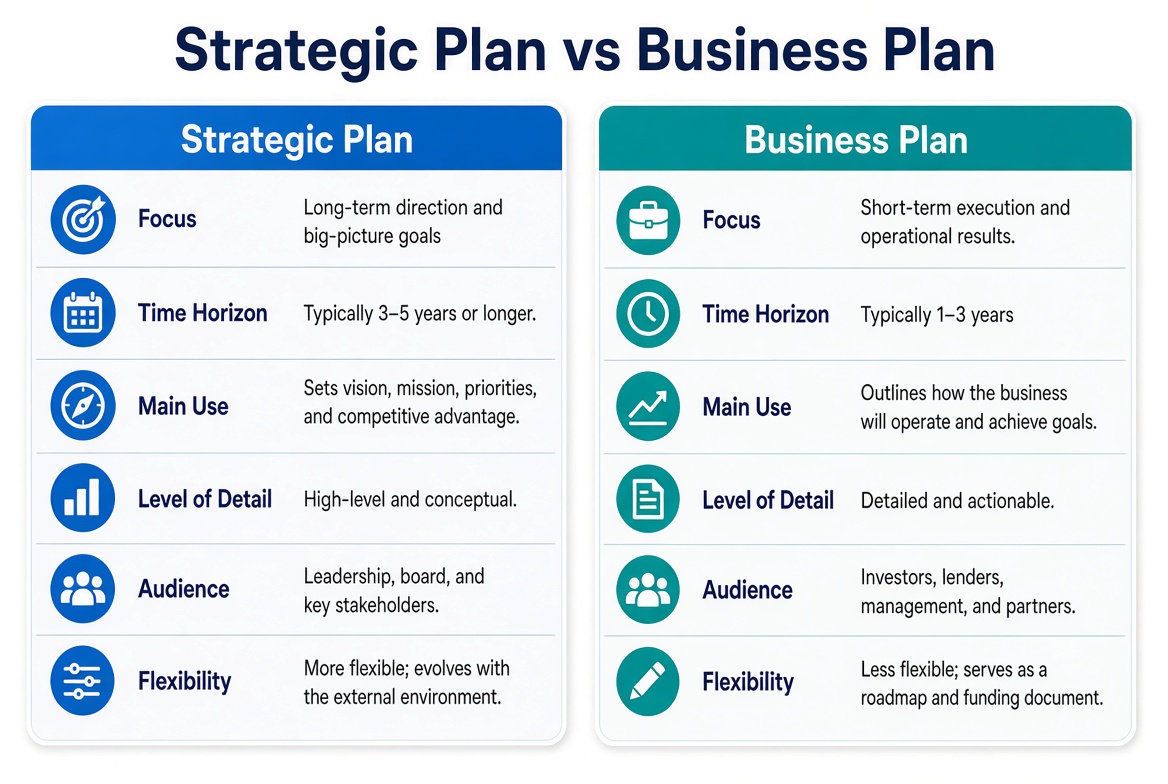
Strategic planning vs. business planning
Aspect | Strategic Plan | Business Plan |
|---|---|---|
Focus | Long-term direction and priorities | Viability, operations, and funding |
Time horizon | 1–3 years (sometimes longer) | Often 1 year or startup stage |
Main use | Guide decisions and growth | Secure funding, launch, or manage day-to-day |
Level of detail | Higher-level goals and strategies | Detailed financials, marketing, operations |
Audience | Internal team and owners | Investors, lenders, or internal |
Flexibility | Reviewed and adjusted regularly | More static once written |
A business plan often includes elements of strategy, but a strategic plan focuses on choices and direction. SCORE offers practical guidance on both in its resources for small business owners.
Why Is Small Businesses Strategic Planning Important for US?
Without a plan, effort scatters. With one, limited resources produce clearer results.
Creates clear business direction — Everyone knows the priorities instead of guessing.
Helps prioritize limited resources — Time, money, and people go to the highest-impact activities.
Improves decision-making — Choices become easier when measured against the plan.
Identifies opportunities and threats — You spot market shifts or competitive moves earlier.
Creates measurable goals — Progress becomes visible instead of vague.
Improves competitive positioning — You define what makes your business different.
Helps manage business risks — Cash flow, market, and operational risks are addressed proactively.
Aligns employees with business objectives — Team members understand how their work contributes.
Supports sustainable growth — Growth becomes intentional rather than accidental.
The U.S. Small Business Administration emphasizes planning as a foundation for running and growing a business.
Key Elements of Small Business Strategic Planning
A practical plan includes these building blocks. For each one: what it is, why it matters, and what a small business should do.
Mission statement — Why the business exists. Keep it short and customer-focused.
Vision statement — Where you want the business to be in 3–5 years. Make it ambitious yet realistic.
Core values — Guiding principles for decisions and culture. Limit to 3–5.
Current business assessment — Honest look at revenue, customers, operations, and finances.
SWOT analysis — Strengths, Weaknesses, Opportunities, Threats. Base it on data, not opinion.
Target customers — Clear description of ideal buyers and their needs.
Competitive advantage — What you do better or differently that customers value.
Strategic goals — 3–5 major outcomes (use SMART criteria).
Strategies — High-level approaches to reach the goals.
Action plans — Specific tasks, owners, and deadlines.
Financial objectives: revenue, margin, cash flow, and investment targets.
KPIs — Metrics that show whether the plan is working.
Review process — Scheduled check-ins and update rules.
Each element should stay simple enough that a busy owner can maintain it.
Small Business Strategic Planning Framework
Use this memorable sequence:
Assess → Define → Analyze → Set Goals → Develop Strategies → Allocate Resources → Execute → Measure → Improve
Stage | What to Do | Key Output |
|---|---|---|
Assess | Review current performance and position | Honest baseline |
Define | Clarify mission, vision, values | Direction statements |
Analyze | Study market, customers, competitors, SWOT | Insights and priorities |
Set Goals | Choose 3–5 SMART strategic goals | Clear targets |
Develop Strategies | Decide how to achieve the goals | Chosen approaches |
Allocate Resources | Assign people, budget, tools | Resource plan |
Execute | Turn strategies into actions with owners | Implementation plan |
Measure | Track KPIs and milestones | Performance data |
Improve | Review results and adjust | Updated plan |
How to Create a Strategic Plan for a Small Business
Follow these actionable steps.
Step 1: Assess your current business position
Review the last 12 months of financials, customer feedback, operational bottlenecks, and team capacity. Note what is working and what is not.
Step 2: Define your mission and vision
Write a short mission (purpose) and a 3–5 year vision. Share them with key people for feedback.
Step 3: Identify your target customers
Describe ideal customers by need, behavior, and value—not just demographics. Talk to real customers.
Step 4: Analyze competitors and the market
List direct and indirect competitors. Note their strengths, pricing, and gaps you can fill. Watch industry trends.
Step 5: Conduct a SWOT analysis
Fill the four quadrants with evidence. Prioritize the most important items.
Step 6: Set SMART strategic goals
Choose a small number of goals that are Specific, Measurable, Achievable, Relevant, and Time-bound. Example: “Increase repeat customer revenue 20% within 12 months.”
Step 7: Choose strategies to achieve your goals
For each goal, select 1–3 practical strategies (e.g., improve retention, expand a profitable service line, tighten cost control).
Step 8: Allocate people, money and technology
Decide who owns each strategy, what budget is needed, and which tools or systems support it. Protect cash flow.
Step 9: Create an implementation plan
Break strategies into action items with deadlines and responsible people. Keep the list realistic.
Step 10: Establish KPIs and milestones
Pick a handful of leading and lagging indicators. Set quarterly milestones.
Step 11: Review and update the strategy
Schedule regular reviews (details later). Treat the plan as a living document.
Related: Harvard Business Review strategy articles
Small Business Strategic Planning Examples
These are hypothetical illustrations based on common small-business situations.
Example 1: Local restaurant
Current situation: Steady lunch traffic but slow dinners and high food waste.
Strategic goal: Raise dinner revenue 25% in 12 months while keeping food cost under 30%.
Strategy: Introduce limited evening specials and a loyalty program for regulars.
Action: Test two new dinner items, train staff on upselling, launch simple punch-card loyalty.
KPI: Dinner covers per week, food cost %, repeat dinner visits.
Expected outcome: Higher evening utilization and better margins.
Example 2: E-commerce business
Current situation: Growing traffic but low conversion and high return rates.
Strategic goal: Improve conversion rate from 1.8% to 2.8% and cut returns 15% in 9 months.
Strategy: Improve product pages, sizing guides, and post-purchase communication.
Action: A/B test images and descriptions, add detailed size charts, send follow-up care emails.
KPI: Conversion rate, return rate, average order value.
Expected outcome: More efficient growth from existing traffic.
Example 3: Accounting or bookkeeping firm
Current situation: Owner does most client work; growth limited by capacity.
Strategic goal: Free 15 hours per week of owner time and add 8 new clients in 12 months.
Strategy: Productize services, hire or train a junior bookkeeper, and systematize onboarding.
Action: Create standard service packages, document processes, recruit and train one team member.
KPI: Owner billable hours, client acquisition, process completion rates.
Expected outcome: Scalable capacity without burnout.
Example 4: Service-based small business (home services)
Current situation: Strong reputation but inconsistent lead flow and seasonal dips.
Strategic goal: Stabilize monthly revenue and grow 20% year-over-year.
Strategy: Build a simple referral system and add one complementary service.
Action: Formalize referral incentives, train technicians to ask for reviews, pilot the new service in one area.
KPI: Monthly booked jobs, referral percentage, revenue per job.
Expected outcome: More predictable pipeline and higher average revenue.
Small Business Strategic Planning Template
Copy and adapt this one-page style template.
Section | Your Content |
|---|---|
Mission | |
Vision | |
Core values | |
Current situation | |
Target customers | |
SWOT (key points) | Strengths / Weaknesses / Opportunities / Threats |
Strategic goals (SMART) | 1. 2. 3. |
Strategies | For each goal |
Action items | Task / Owner / Deadline / Budget |
KPIs | |
Review date |
A useful strategic planning PDF or PPT should contain the same sections plus space for notes, a simple timeline, and a review checklist. Keep it to a few pages so it stays usable.
Strategic Planning Tools and Frameworks for Small Businesses
SWOT Analysis — Best for quick situational assessment. Useful before setting goals. SCORE and many advisors recommend it as a starting point.
SMART Goals — Turns vague wishes into trackable targets. Essential for every plan.
5 Cs of Strategic Planning
Company — Internal capabilities and resources
Customers — Needs and segments
Competitors — Direct and indirect rivals
Collaborators — Partners and suppliers
Context/Climate — External economic, regulatory, and technology forces
Use the 5 Cs when you need a structured market and internal scan.
5 Ps of Strategy (Mintzberg)
Plan — Intended course of action
Ploy — Specific competitive moves
Pattern — Consistent behaviour over time
Position — Place in the market relative to competitors
Perspective — Overall worldview and culture of the organization
Helpful when strategy feels one-dimensional.
Related: Mintzberg 5 Ps explanations from reputable management sources
PESTLE Analysis — Political, Economic, Social, Technological, Legal, Environmental factors. Useful for external context.
OKRs — Objectives and Key Results. Good for quarterly focus once the bigger strategy is set.
Balanced Scorecard — Looks at financial, customer, internal process, and learning perspectives. Valuable when you want balanced measurement.
Choose tools based on your stage and time available. Most small businesses start with SWOT + SMART goals and add others as needed.
What Are the 7 Steps of Strategic Planning?
The seven common steps are:
Define mission and vision
Assess the current position
Analyze the market and competition
Set strategic objectives
Develop strategies
Create an implementation plan
Monitor and adjust
These steps map closely to the framework and detailed process above.
What Are the 5 Stages of Strategic Planning?
A simplified five-stage view is:
Assessment
Strategy formulation
Goal setting
Implementation
Monitoring and evaluation
Frameworks use different numbers and labels; the underlying logic of assess–choose–act–learn remains the same.
Common Strategic Planning Mistakes Small Businesses Should Avoid
Setting too many goals → Limit to 3–5 priorities.
Creating unrealistic goals → Ground them in current capacity and cash flow.
Ignoring cash flow → Tie every major initiative to funding and timing.
Ignoring competitors → Include competitive analysis in every plan.
Making the plan unnecessarily complicated → Keep it short and usable.
Failing to assign responsibility → Every action needs an owner.
Not tracking KPIs → What gets measured gets managed.
Failing to review the plan → Schedule reviews in advance.
Creating a plan that never reaches implementation → Start with a few high-impact actions and build momentum.
How Often Should a Small Business Review Its Strategic Plan?
Weekly — Operational check on key actions and immediate issues.
Monthly — KPI review and short-term adjustments.
Quarterly — Strategic progress review and course correction.
Annually — Full strategic planning refresh.
Markets change. Update the plan when significant shifts occur rather than waiting for the calendar.
Small Business Strategic Planning Notes
Definition — Process of setting direction, priorities, and resource allocation.
Purpose — Move from reactive to intentional growth.
Importance — Focuses limited resources, improves decisions, supports sustainability.
Key elements — Mission, vision, values, assessment, SWOT, goals, strategies, actions, KPIs, review.
Framework — Assess → Define → Analyze → Set Goals → Develop Strategies → Allocate → Execute → Measure → Improve.
Steps — 11 practical steps from assessment to ongoing review.
Tools — SWOT, SMART, 5 Cs, 5 Ps, PESTLE, OKRs, Balanced Scorecard.
Benefits — Clarity, prioritization, better decisions, risk management, alignment, growth.
KPIs — Choose a few that link directly to goals.
Review process — Weekly / monthly / quarterly / annual cadence.
Frequently Asked Questions About Small Business Strategic Planning
What are the 5 C's of strategic planning?
Company, Customers, Competitors, Collaborators, and Context (or Climate). They provide a structured way to examine internal capabilities and the external environment before setting strategy.
What are the 5 P's of strategic planning?
Plan, Ploy, Pattern, Position, and Perspective (Henry Mintzberg). They offer multiple lenses for understanding and developing strategy beyond a simple document.
What are the 7 steps of strategic planning?
Define mission and vision, assess current position, analyze market and competition, set strategic objectives, develop strategies, create an implementation plan, and monitor and adjust.
What are the 5 stages of strategic planning?
Assessment, strategy formulation, goal setting, implementation, and monitoring and evaluation. Terminology varies across frameworks.
What is the 5 C's model?
A situation-analysis framework covering Company, Customers, Competitors, Collaborators, and Context to guide strategic choices.
What is the importance of strategic planning in business?
It creates direction, prioritizes scarce resources, improves decision quality, surfaces opportunities and risks, sets measurable goals, strengthens competitive position, and supports sustainable growth.
What is a strategic planning framework?
A structured sequence (such as Assess → Define → Analyze → Set Goals → Develop Strategies → Allocate → Execute → Measure → Improve) that organizes the planning process.
What is the difference between a strategic plan and a business plan?
A strategic plan focuses on long-term direction and priorities. A business plan is broader and often more detailed on operations, marketing, and financial projections, especially for startups or funding.
How often should a small business update its strategic plan?
Conduct full reviews annually, strategic check-ins quarterly, KPI reviews monthly, and operational reviews weekly. Adjust sooner when major changes occur.
Can a small business create a strategic plan without a consultant?
Yes. Many owners successfully create practical plans using the steps and template in this guide. External advisors can add value for complex situations or when objectivity is needed.
Conclusion
Small business strategic planning does not require a thick binder or a large consulting budget. Follow a simple cycle: Assess → Define → Analyze → Set Goals → Choose Strategies → Execute → Measure → Improve. Keep the plan short, assign clear ownership, track a few meaningful KPIs, and review it regularly.
Start with an honest assessment of where you stand today, write three to five SMART goals, and turn the highest-priority strategies into concrete actions this month. That is how strategic planning becomes a practical system rather than a theoretical exercise.
If your next step involves financial forecasting, cash-flow management, or turning the plan into numbers that support growth, professional advisory support can help refine the financial side of the strategy.