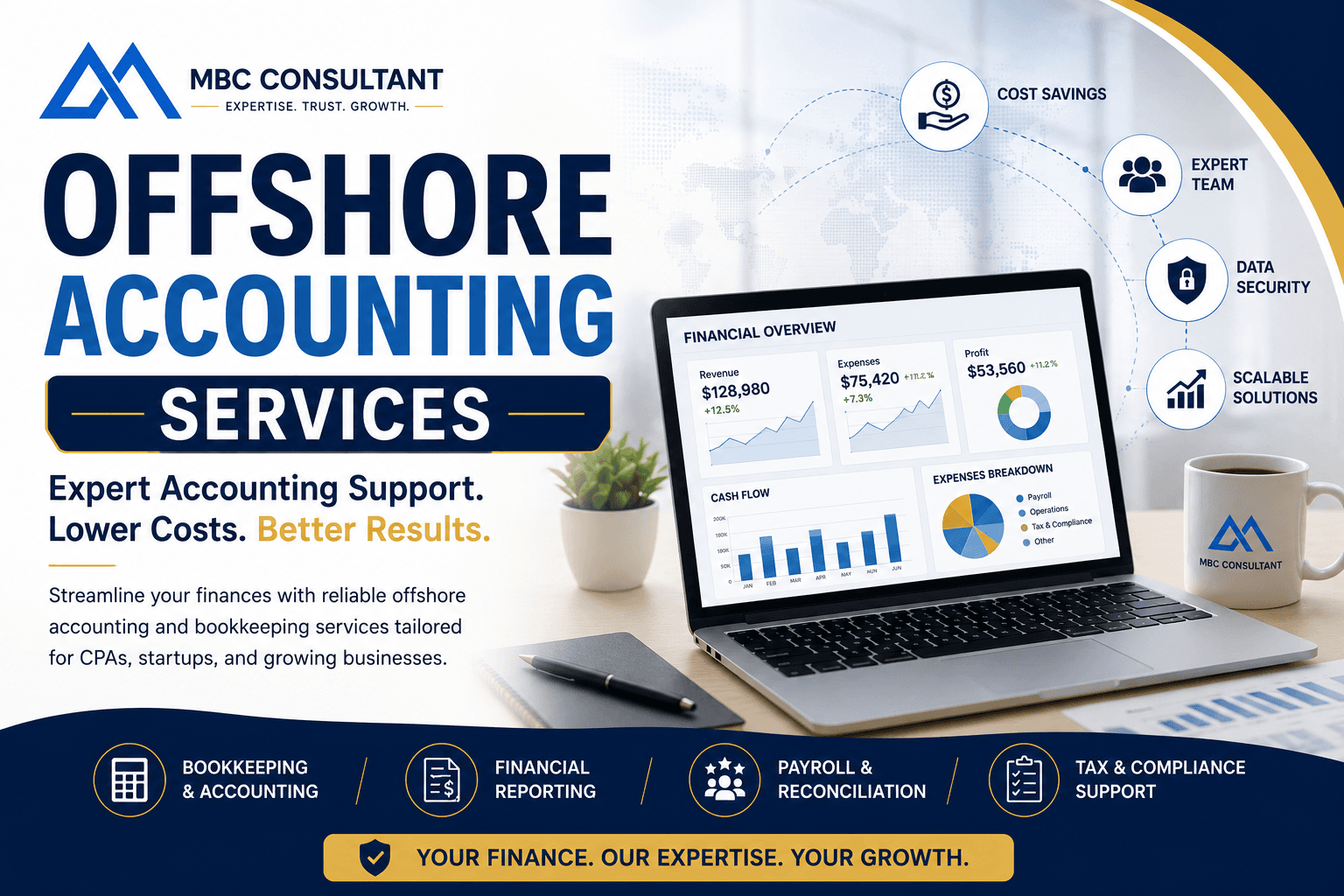
Offshore Accounting Services: Complete Guide to Benefits, Process, Costs & Choosing the Right Partner in 2026
Managing financial records in-house gets expensive fast. You must pay high salaries, buy software licenses, and provide office space. Because of these rising costs, companies worldwide are changing how they run their finance teams. Many growing businesses now use offshore accounting services to build flexible finance operations. Partnering with an offshore team gives you access to qualified financial experts at a fraction of the cost.
Whether you run a fast-growing startup, an agency, or a busy CPA firm, this guide covers everything you need to know about offshore finance. You will learn how offshore accounting works, key benefits, pricing models, and how to choose the right partner for your business.
What Are Offshore Accounting Services?
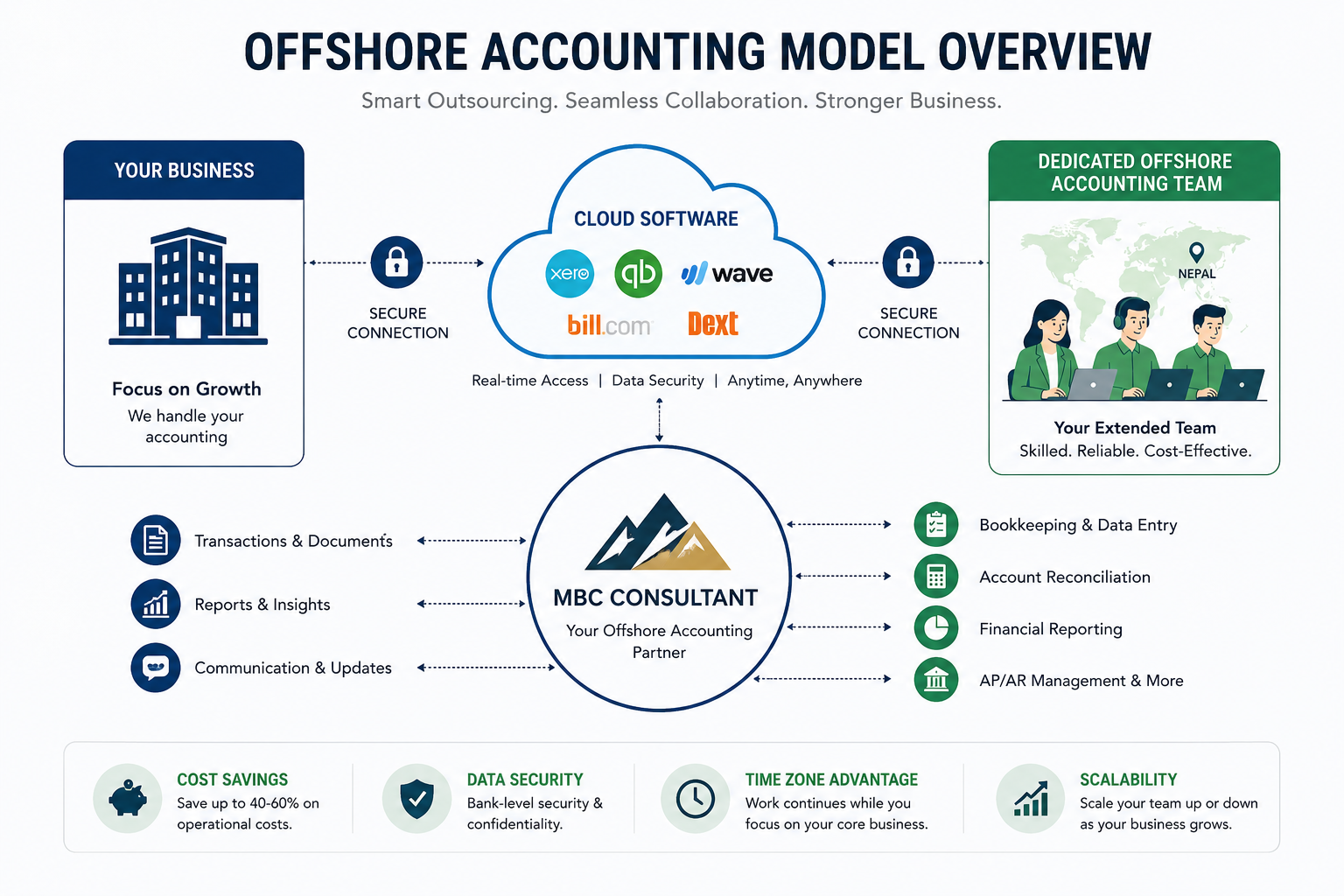
Offshore accounting services involve hiring a dedicated team in another country to handle your financial tasks. These professionals work as a direct extension of your internal team. They manage your daily bookkeeping, financial reports, tax preparation, and payroll from a secure remote location.
Definition of Offshore Accounting
Offshore accounting means delegating accounting tasks to skilled financial specialists located in another country. Unlike simple project outsourcing, an offshore model usually gives you full-time, dedicated staff who follow your custom processes and work during your preferred hours.
How Offshore Accounting Works
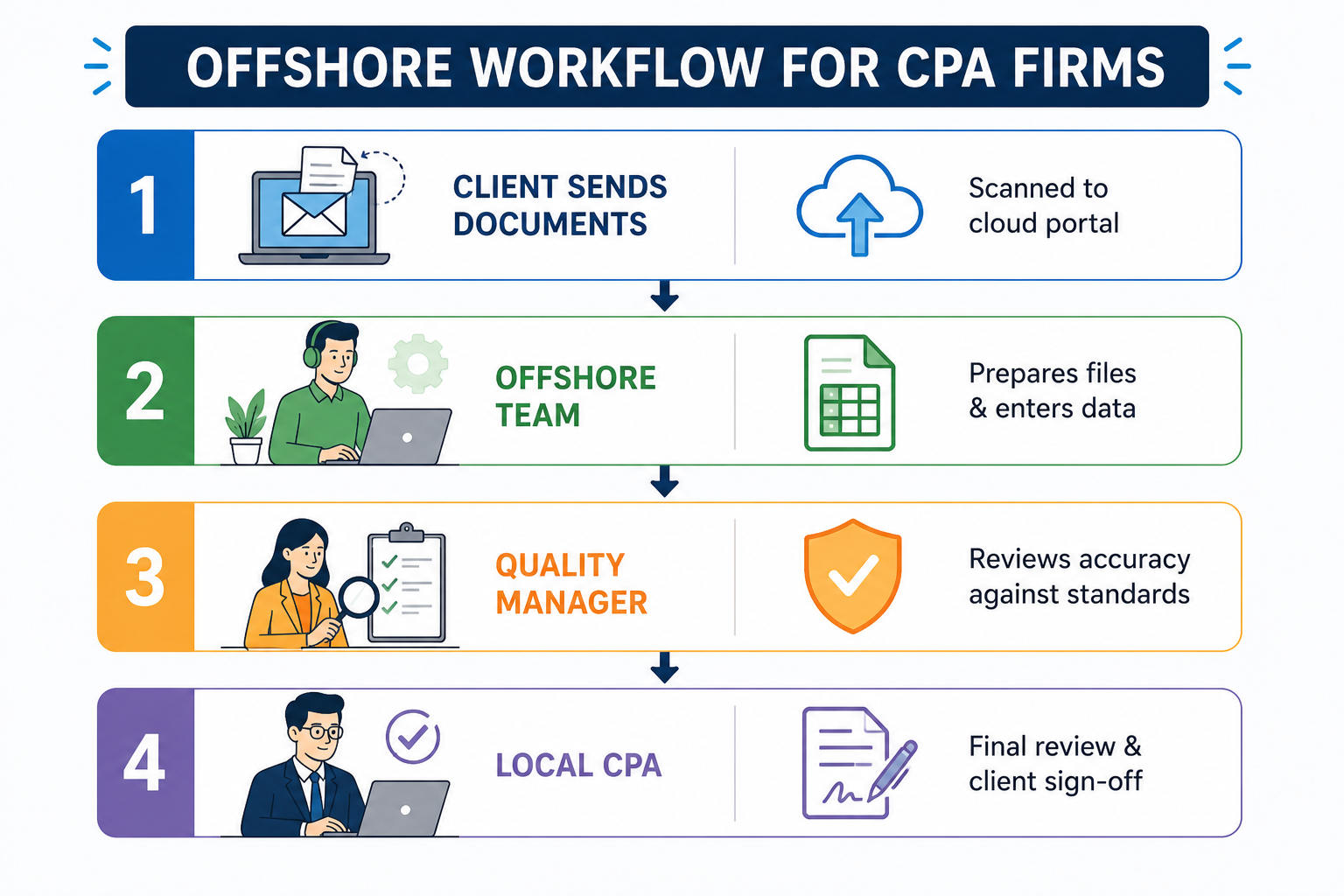
The process relies entirely on secure cloud technology. First, you share digital access to your accounting software and bank feeds. Next, your offshore team reviews transactions, reconciles accounts, and prepares reports. Finally, your internal managers review the finished work and make strategic business decisions.
Why Businesses Outsource Accounting Overseas
Many businesses adopt offshore accounting services because hiring local accounting staff has become difficult and costly. High salary demands and local talent shortages make hiring slow. So, companies look overseas to find experienced accountants quickly. This allows managers to stop worrying about staffing gaps and focus on core growth.
Offshore Accounting vs Traditional Accounting
Traditional accounting relies on local, in-house employees sitting in your office. It comes with high
overhead costs like health benefits, hardware, and training. On the other hand, offshore accounting delivers the same output through cloud platforms at a lower overall operational cost.
What Is Offshore Bookkeeping?
Bookkeeping forms the foundation of every financial system. Before you can generate deep financial insights, you must record every dollar moving in and out of your business accurately.
Offshore Bookkeeping Explained
Offshore bookkeeping focuses on recording daily financial transactions. An offshore bookkeeper keeps your general ledger updated, organizes receipts, and ensures every entry matches your bank statements.
Bookkeeping vs Accounting
Bookkeeping is administrative and transactional. It focuses on recording daily data correctly. Accounting is analytical and strategic. Accountants take the bookkeeper's raw data to prepare financial statements, analyze cash flow, and ensure tax compliance.
Daily Tasks Included
An offshore bookkeeper handles routine financial tasks so your core team can focus on client work. Daily responsibilities usually include:
Bank reconciliation: Matching ledger items with bank and credit card feeds.
Accounts payable: Tracking vendor invoices, organizing receipts, and prepping payments.
Accounts receivable: Creating client invoices, tracking unpaid bills, and sending reminders.
Payroll support: Calculating hours, tracking employee benefits, and preparing payroll runs.
Financial reports: Generating weekly profit reports, balance sheets, and cash summaries.
If you need help maintaining accurate daily ledgers, explore our Monthly bookkeeping services to streamline your records.
Types of Offshore Accounting Services
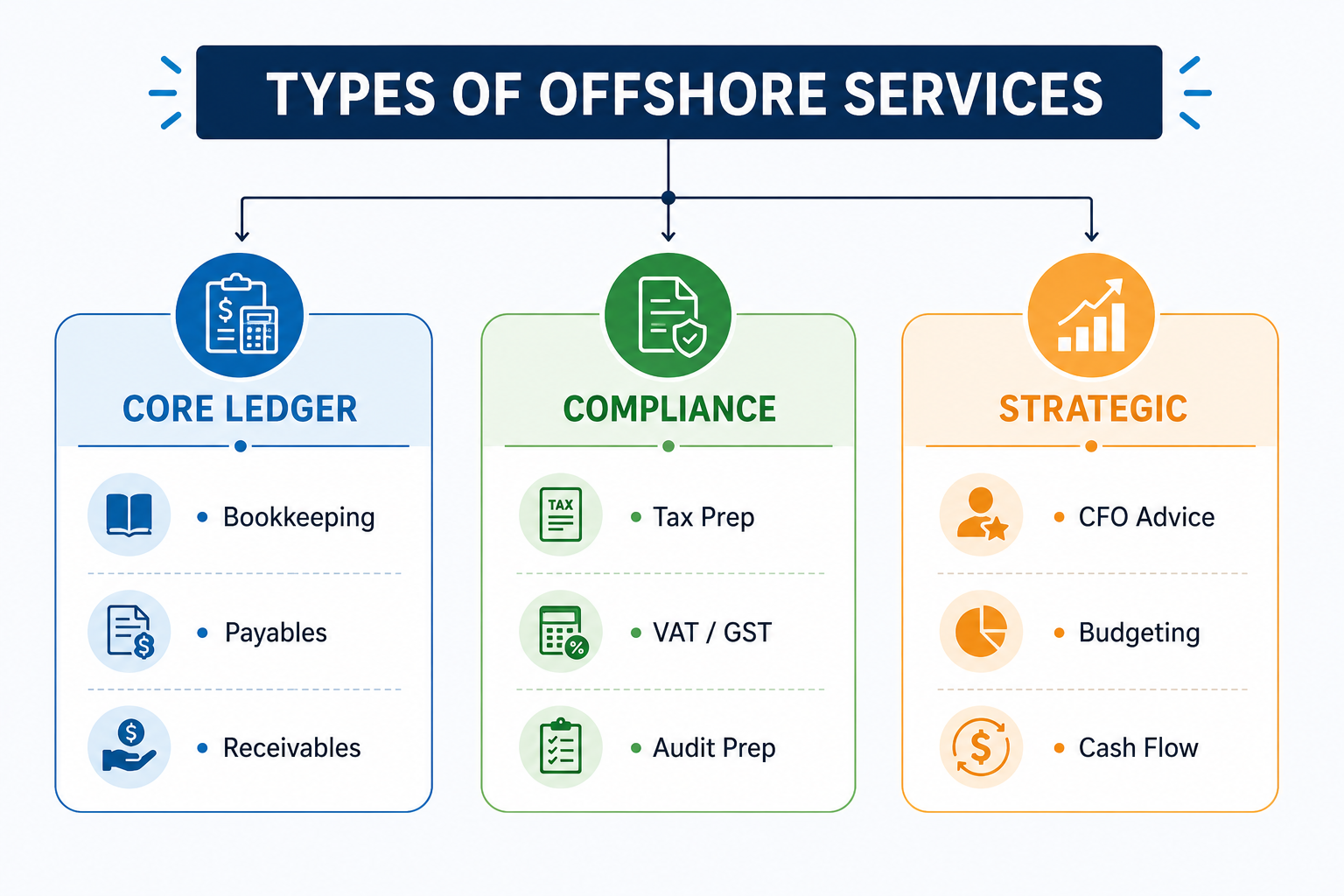
Modern offshore firms offer far more than simple data entry. You can delegate almost every financial function to a remote team.
Bookkeeping & Financial Reporting
Offshore accounting services include recording transactions and preparing accurate monthly financial statements. They deliver balance sheets, income statements, and cash flow reports on time every month.
Accounts Payable & Accounts Receivable
Keeping cash flow healthy requires steady effort. Offshore specialists process vendor bills, prevent duplicate payments, and manage client collections to keep your cash flowing smoothly.
Payroll Processing
Calculating wages, tax withholdings, and employee deductions requires strict precision. Offshore payroll specialists calculate employee pay accurately while ensuring you follow local tax regulations.
Tax Preparation Support
Offshore teams organize tax documents, gather receipts, and prepare tax returns. They help your local certified public accountant (CPA) finish tax returns much faster during busy seasons.
Virtual CFO Services
Many offshore accounting services providers also offer Virtual CFO support for growing companies. Through Virtual cfo services, offshore financial experts provide cash forecasting, budgeting, and growth strategies for a fraction of the cost.
Budgeting & Cash Flow Forecasting
Unpredictable cash flow can harm a growing business. Offshore analysts build forward-looking financial models so you can plan investments safely.
Management Reporting & Process Automation
Offshore experts build custom executive dashboards. They also implement process automation solutions to replace manual data entry with fast, automated software workflows.
Why Companies Are Choosing Offshore Accounting in 2026
The global market for outsourced financial services continues to expand rapidly. Recent research highlighted in Statista financial services research shows that over 60% of mid-sized companies now use remote financial staff.
Reduce Costs
Saving money remains the main driver for offshoring. Hiring an offshore accountant can save you up to 70% compared to local hiring costs. You eliminate expenses like worker insurance, office rent, and expensive software passes.
Access Skilled Accountants
Local accounting talent shortages make hiring qualified staff difficult. Offshoring connects you with seasoned accounting professionals who hold international degrees and certifications.
Scale Faster
When your business grows, your transaction volume increases. Instead of spending months recruiting local employees, you can add offshore accountants to your team in days.
Better Technology
Leading offshore accounting firms use cutting-edge cloud tools and automation platforms. As a result, you get better technology without buying costly software licenses yourself.
Time Zone Advantages
Time zone differences can become a major operational advantage. Because your offshore team works while you sleep, your financial books get updated overnight. You wake up every morning to fresh financial data.
Benefits of Offshore Accounting Services
The benefits extend far beyond direct cost reduction. The table below illustrates how offshoring compares to standard local operations across key business metrics:
Key Feature | Traditional In-House Team | Offshore Accounting Team |
Annual Operating Cost | High (Salaries, Benefits, Rent) | Low (Up to 70% cost savings) |
Scalability | Slow (Months to recruit and train) | Fast (Scale team size in days) |
Turnaround Time | Standard business hours only | Overnight completion available |
Technology Access | Business pays full software costs | Built-in cloud tools & automation |
Staffing Flexibility | Fixed overhead costs | Flexible team scaling on demand |
Expertise Access | Limited by local hiring pool | Access to global specialists |
Offshore vs Outsourced vs Nearshore vs In-house
Choosing the right operating model depends on your budget, communication needs, and business goals.
Feature | Offshore | Nearshore | Onshore | In-house |
Location | Distant country | Neighboring country | Same country | Inside your office |
Cost Savings | Very High (60–70%) | Moderate (30–40%) | Low (0–15%) | Baseline |
Time Zone | 8 to 12 hours difference | Minimal difference | Same time zone | Same time zone |
Communication | Async & scheduled | Real-time alignment | Direct real-time | In-person daily |
Best Used For | Scale & maximum savings | Real-time collaboration | Local filing needs | Core management |
Using remote accounting services allows you to blend these models. For instance, many successful firms keep a local manager in-house while shifting routine ledger work to an offshore team.
Which Accounting Services Should You Offshore?
Not every financial task belongs offshore immediately. Knowing what to delegate first ensures a smooth transition.
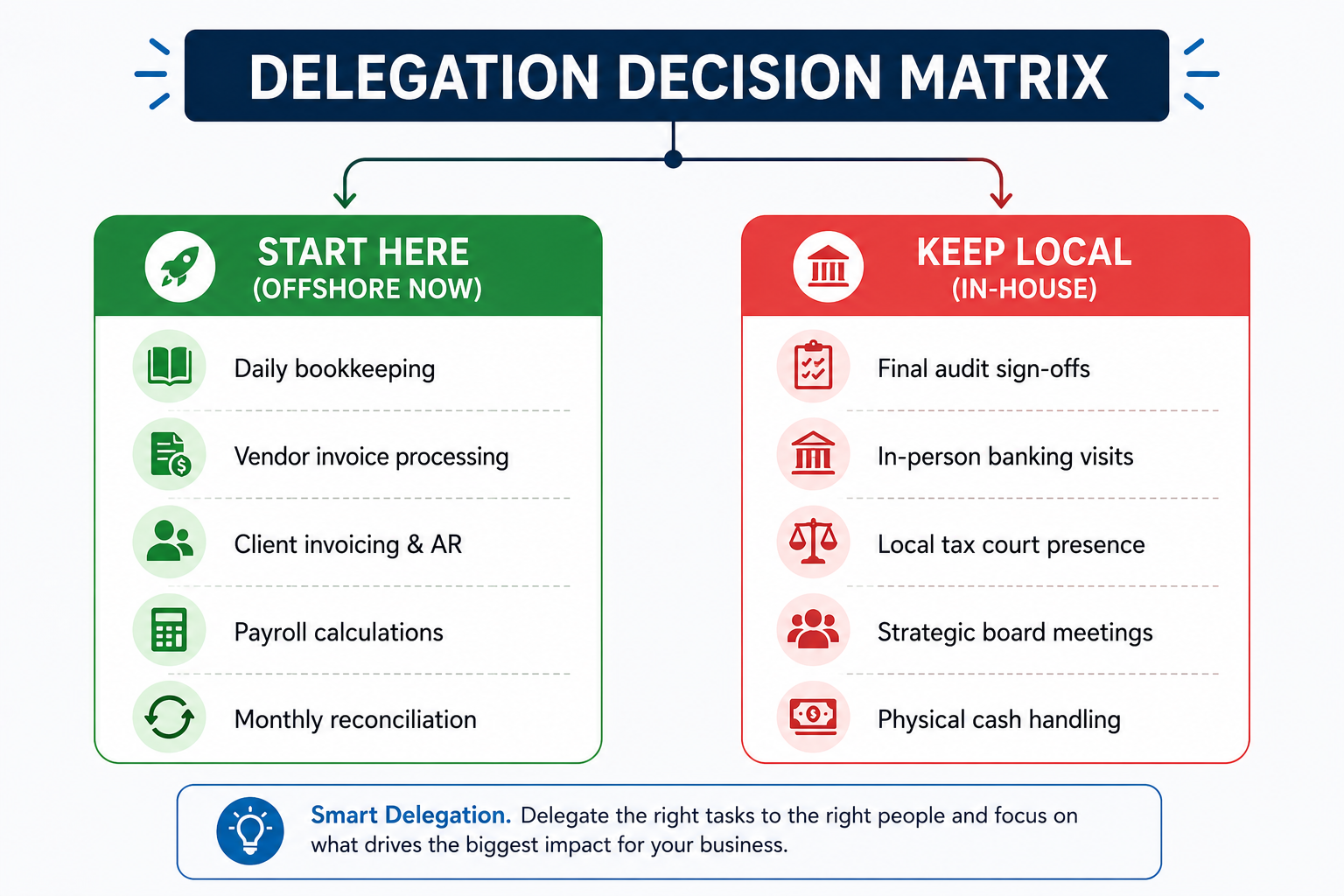
└──────────────────────────────┘ └──────────────────────────────┘
You should start by offshoring structured, repetitive tasks first:
Daily Bookkeeping: Simple ledger maintenance and bank reconciliation.
Accounts Payable & Receivable: Standard bill processing and invoice tracking.
Payroll Calculations: Routine wage calculations and pay-stub creation.
Financial Reporting: Standardized monthly income statements and balance sheets.
Keep high-level local representation, physical cash handling, and final legal audit sign-offs in-house.
Who Should Use Offshore Accounting Services?
Companies of all sizes benefit from remote financial support:
Startups: Early-stage founders must preserve cash. Working with an outsourced accounting firm for startup needs helps extend your runway.
Small & Medium Enterprises (SMEs): Growing businesses get enterprise-grade accounting without hiring full-time local staff.
Ecommerce Stores: Online sellers deal with thousands of micro-transactions. Offshore bookkeepers track multi-channel sales easily.
Agencies & Professional Services: Service businesses can accurately track project margins and staff utilization rates.
CPA & Accounting Firms: CPA firms hire offshore staff to expand firm capacity during peak tax season.
Offshore Accounting for CPA Firms
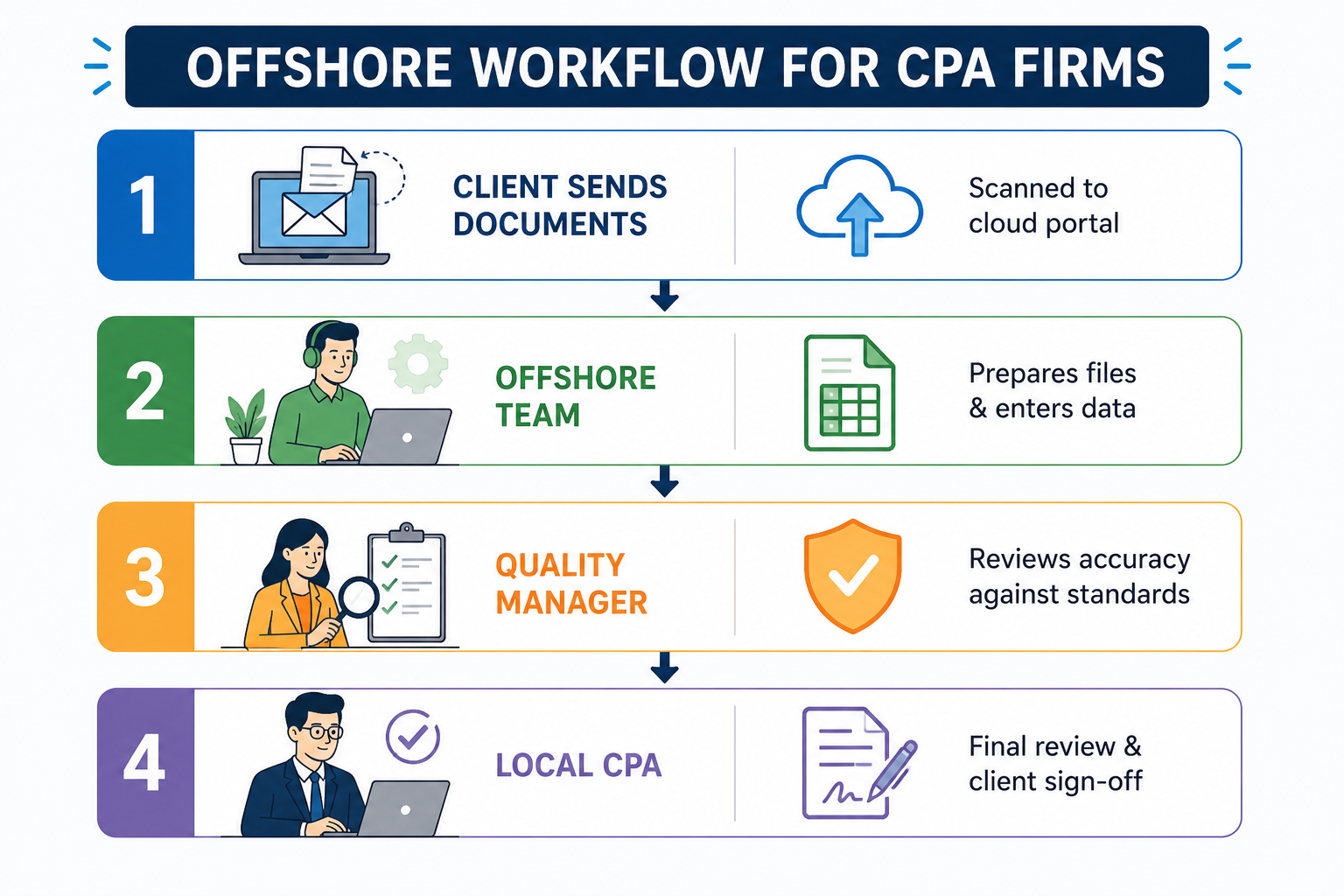
Accounting firms face intense seasonal work spikes. During tax season, local staff often face burnout due to heavy workloads.
By leveraging accounting outsourcing services, American accounting firms can handle more clients without overworking local teams. Offshore accountants handle data collection, tax return drafting, and audit prep. Consequently, local CPAs can spend more time advising clients and growing their revenue.
Offshore Accounting & Taxation Services
Tax laws demand strict precision and compliance. Offshore tax support specialists follow international frameworks like AICPA accounting standards and IFRS global standards.
Key tax services include:
Tax return preparation: Organizing financial data for individual and business filings.
Sales tax / VAT / GST support: Tracking multi-state or international indirect tax obligations.
Payroll tax calculations: Managing tax withholdings and filing documentation accurately.
Compliance checks: Cross-checking records against official regulations like FASB GAAP guidelines and IRS official guidelines.
Common Challenges (And How to Overcome Them)
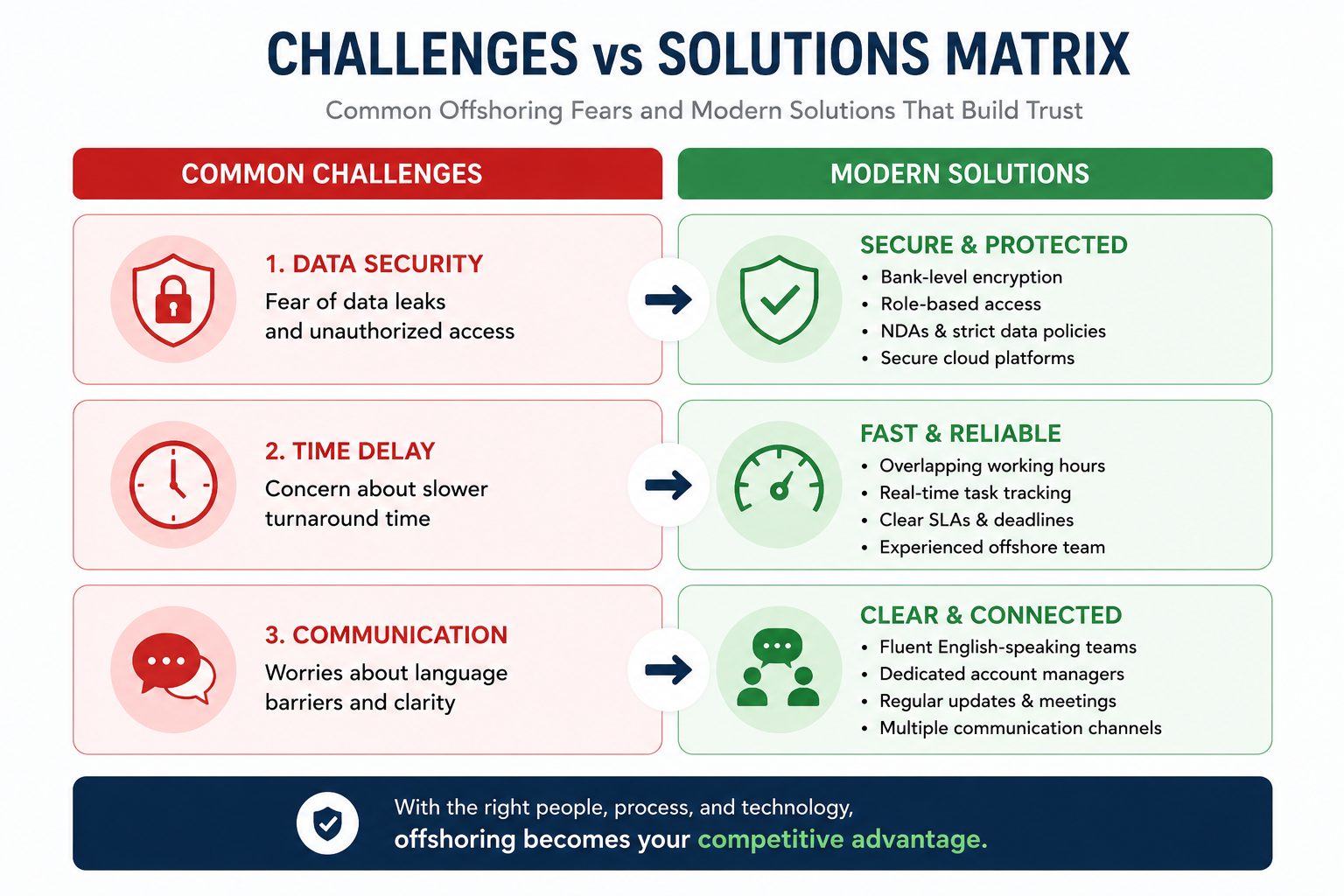
Offshoring offers great value, but it requires thoughtful planning to manage potential risks.
Data Security Risks
Challenge: Sharing sensitive financial data across borders raises security concerns.
Solution: Work with firms that enforce strict encryption, multi-factor authentication, and secure cloud portals.
Communication Barriers
Challenge: Misunderstandings can happen when working across different languages or cultures.
Solution: Assign a dedicated English-fluent account manager and set clear written guidelines.
Time Zone Differences
Challenge: Delayed replies can happen if work schedules do not overlap.
Solution: Create an overlapping work window of 2–3 hours daily for real-time meetings.
Quality Control
Challenge: Output quality might vary if training is insufficient.
Solution: Choose a partner with multi-layer review processes and strong ISO certifications.
How to Choose the Right Offshore Accounting Firm
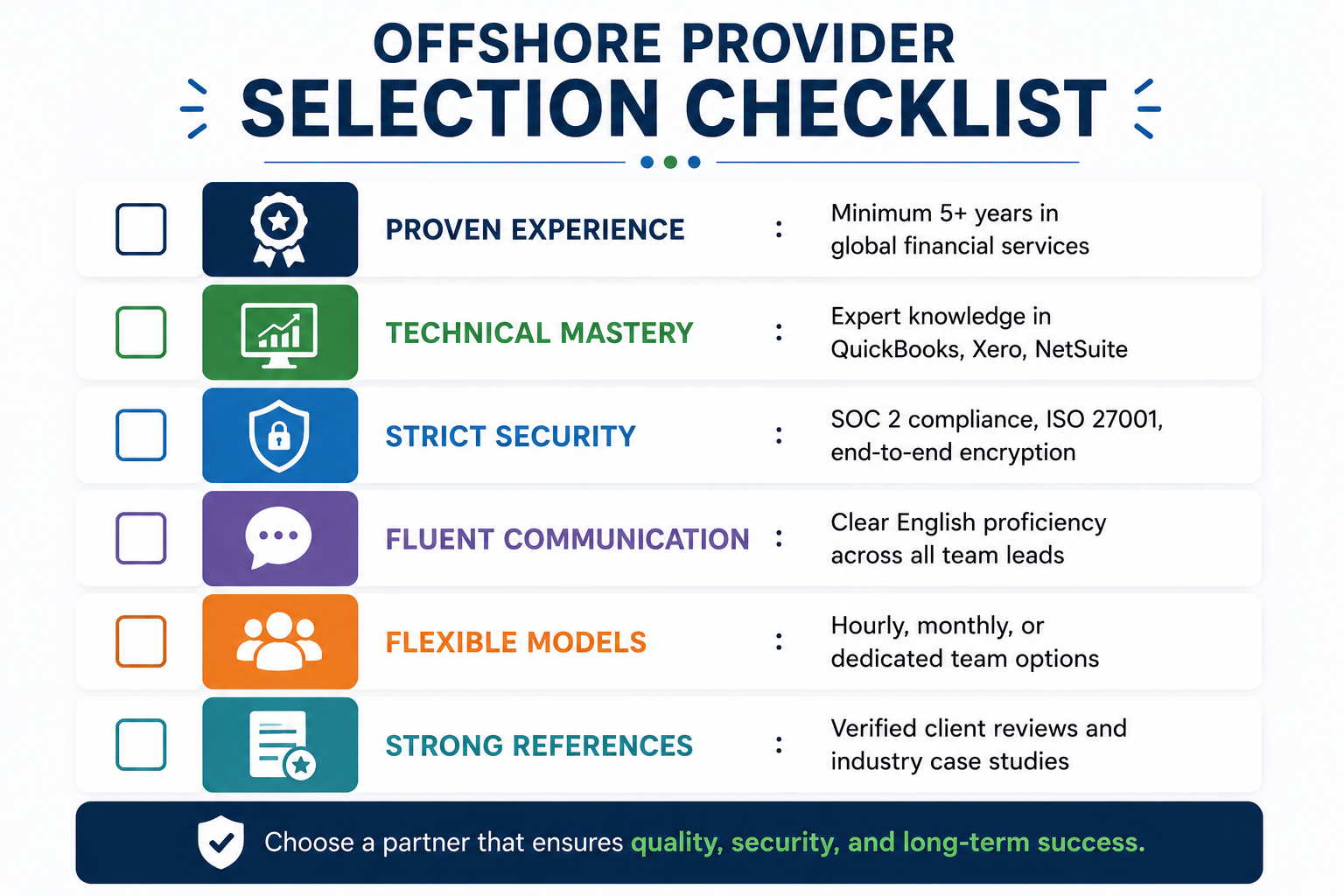
Selecting the right partner requires a clear evaluation framework. Use this checklist to review prospective firms:
12 Questions to Ask Before Hiring an Offshore Partner
Before signing a contract, ask these critical questions:
How do you protect client financial data?
What accounting software certifications do your staff hold?
Will I have a dedicated accountant or a shared resource pool?
How do you handle time zone differences for urgent tasks?
What is your process for quality assurance and review?
Can you scale my team up quickly during peak tax seasons?
What are your standard response times for client emails?
How do you bill for your services (hourly vs fixed monthly fee)?
What notice period do you require if we need to adjust team size?
Do your accountants follow standard GAAP or IFRS guidelines?
How do you onboard new accounts and train staff on custom systems?
Can you provide client references in my specific industry?
Accounting Software Used by Offshore Teams
Modern financial tools make remote collaboration seamless. Leading offshore teams work inside popular cloud applications, including:
QuickBooks Online: Ideal for small to mid-sized businesses needing easy bookkeeping.
Xero: A top choice for fast-growing companies and multi-currency tracking.
Oracle NetSuite: Designed for scaling enterprises needing ERP management.
Zoho Books: Excellent for cost-effective ledger management and invoicing.
Sage & MYOB: Trusted tools for established medium businesses.
Using cloud-based tools keeps your accounting data visible in real time.
Offshore Accounting Process
Transitioning your accounting offshore follows a smooth, step-by-step path.
Discovery & Analysis:
Week 1.
We review your existing financial workflows, software setups, and pain points to design a custom service plan.
Proposal & SLA Agreement:
Week 1.
We define clear scope metrics, turnaround standards, security rules, and team structures in a simple contract.
Secure Onboarding & System Access:
Week 2.
Your team grants restricted, password-protected access to your cloud software and password manager.
Workflow Setup & Parallel Run: Weeks 2-3.
Our offshore accountants complete tasks alongside your internal team to confirm accuracy and refine steps.
Full Delegation & Monthly Reporting:
Ongoing.
Your offshore team assumes full responsibility for daily tasks and delivers clean monthly financial packages.
Offshore Accounting Services Costs & Pricing Models
Offshore accounting services are available through transparent and flexible pricing models.
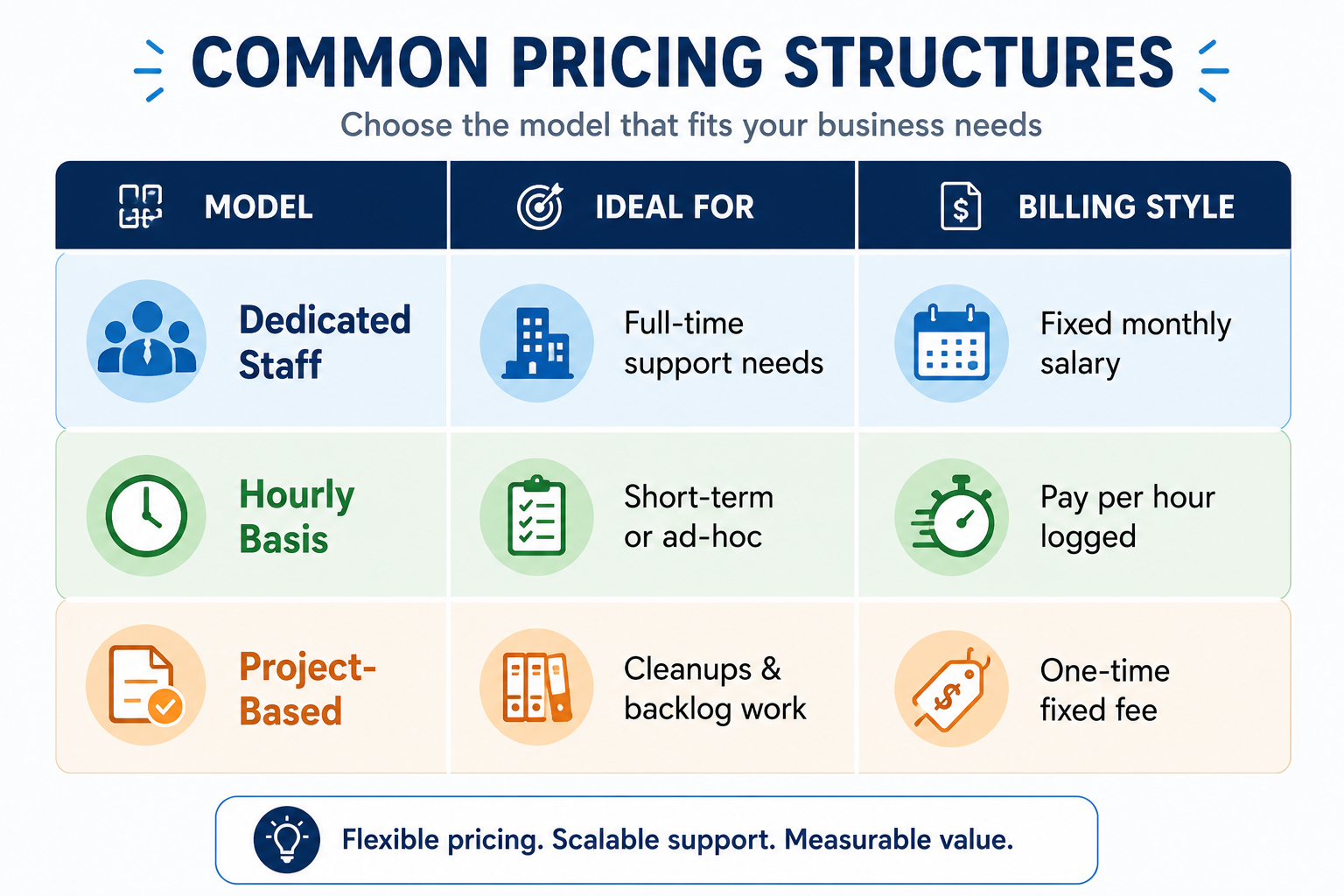
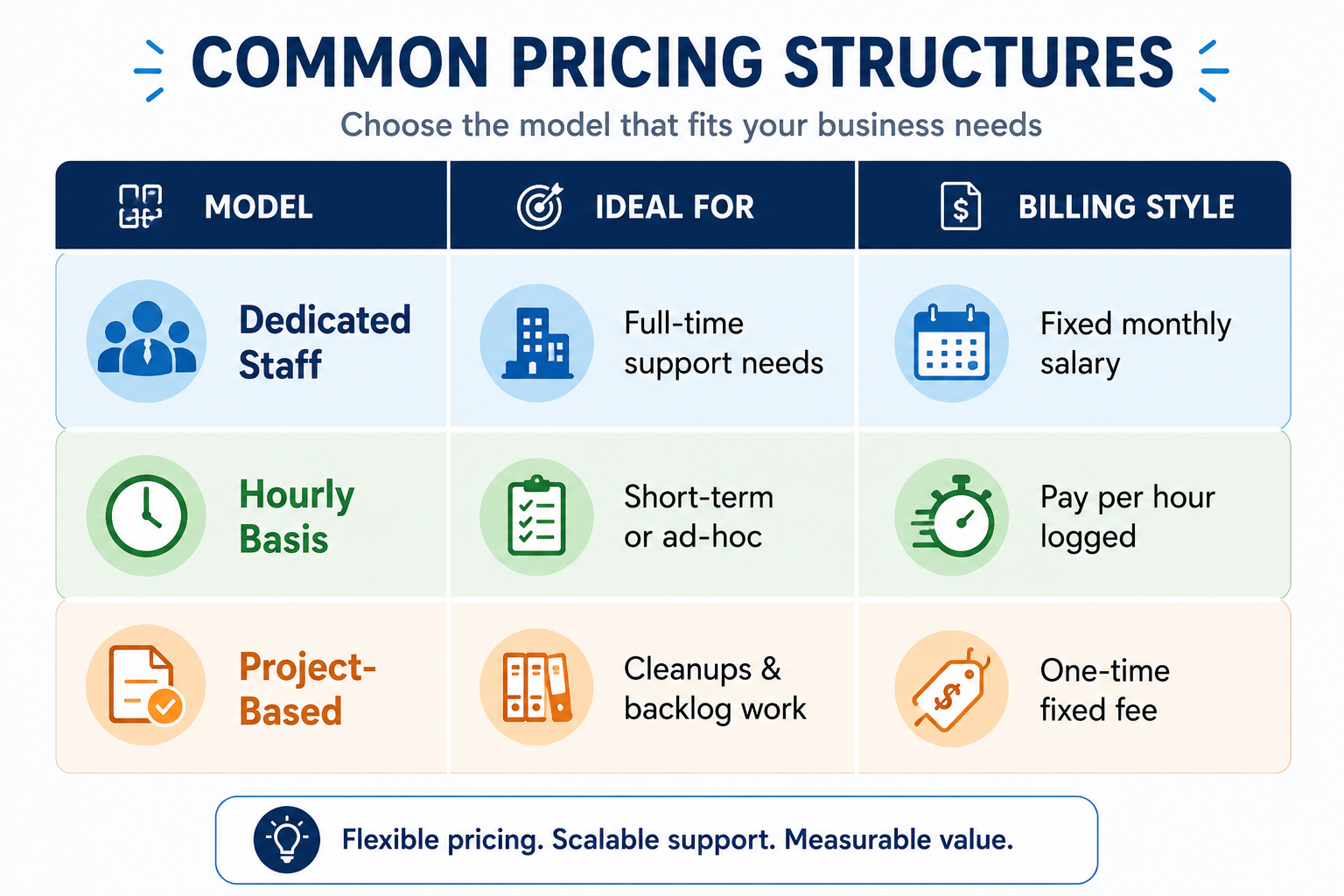
Overall costs depend on required experience levels, transaction volume, and service complexity.
Why Businesses Trust MBC Consultant for Offshore Accounting
At MBC Consultant, we help businesses build efficient, reliable remote finance teams. We combine industry expertise with secure cloud workflows to deliver clear financial clarity.
Here is why client partners choose us:
Dedicated Financial Teams: You work with permanent team members who understand your business.
Comprehensive Financial Support: From bookkeeping to remote virtual cfo services, we cover all your finance needs.
Enterprise Security Protocols: We use strict encryption and cloud portals to keep your financial records safe.
Proactive Risk Management Services: We monitor compliance continuously to protect your business.
Learn more about our mission on our About Us page, or reach out to our team via our Contact Us page today.
Frequently Asked Questions
What is offshore accounting?
Offshore accounting means hiring an overseas team of experts to handle tasks like bookkeeping, payroll, and financial reporting via cloud tools.
What are the four main types of accounting?
The four main types are financial accounting, managerial accounting, tax accounting, and auditing.
Why is it called offshore accounting?
It is called "offshore" because the service provider works in another country, usually across an ocean, to deliver remote financial services.
What is offshore bookkeeping?
Offshore bookkeeping focuses on recording day-to-day transactions, reconciling accounts, and managing bills remotely.
What are outsourced accounting services?
Outsourced accounting services involve delegating financial management tasks to an external team instead of hiring full-time in-house staff.
What accounting services should I offshore first?
Start with repetitive tasks like daily bookkeeping, accounts payable, accounts receivable, and routine payroll processing.
What are the main benefits of offshore accounting?
Key benefits include cost savings up to 70%, access to skilled accountants, overnight processing, and fast scalability.
What is the difference between offshore and onshore accounting?
Offshore accounting uses teams located in another country to cut costs. Onshore accounting relies on local providers in your home country.
How secure is offshore accounting?
It is very secure when providers use encrypted cloud platforms, secure portals, and SOC 2 data protection standards.
Which accounting software is commonly used?
Offshore accountants work with major platforms like QuickBooks Online, Xero, NetSuite, Zoho Books, and Sage.
Why are European companies choosing offshore accounting?
European companies face local talent shortages and high labour costs, making offshore teams an attractive way to maintain profit margins.
Can early-stage startups benefit from offshore accounting?
Yes. Offshoring allows early-stage startups to maintain clean financial records and conserve cash without hiring expensive local staff.
Conclusion
Offshore accounting services offer a proven way to reduce overhead, access top talent, and scale your operations smoothly. By moving routine bookkeeping and reporting to a trusted partner, you free up valuable time to grow your business.
To build a reliable finance operation, choose an offshore partner that prioritizes data security, clear communication, and quality control.
Ready to optimize your financial operations? Contact MBC Consultant today to book a free consultation with our financial specialists.