
Introduction of internal control risk management in 2026
In modern corporate governance, a weak internal control risk management is an immediate threat to business survival.
When corporate risk is left unmanaged, organizations face devastating financial asset losses, severe regulatory penalties, and complete operational failure. Relying on retrofitted fixes after an incident occurs is an expensive mistake. Instead, sustainable market leaders protect their assets through a proactive, risk-aligned internal control program.
This technical guide provides a masterclass in internal control risk management. We will break down global regulatory frameworks, detail the distinct classifications of internal controls, map out real-world accounting and IT control matrices, and outline the exact steps required to implement a robust corporate defence system.
What Are Internal Controls in Risk Management?
An organization cannot manage uncertainty without a structured defence system.
Internal control risk management is the systematic process of designing, implementing, and monitoring specific policies and procedures to mitigate business risks to an acceptable level. Internal controls are the specific mechanisms, rules, and protocols an organization deploys to safeguard its integrity.
The Dynamic Relationship Between Risk and Control
Risk and control exist in a direct, inverse relationship. Risk represents any uncertain event that could prevent your organization from achieving its strategic goals. A control is the specific operational barrier designed to neutralize or minimize that risk.
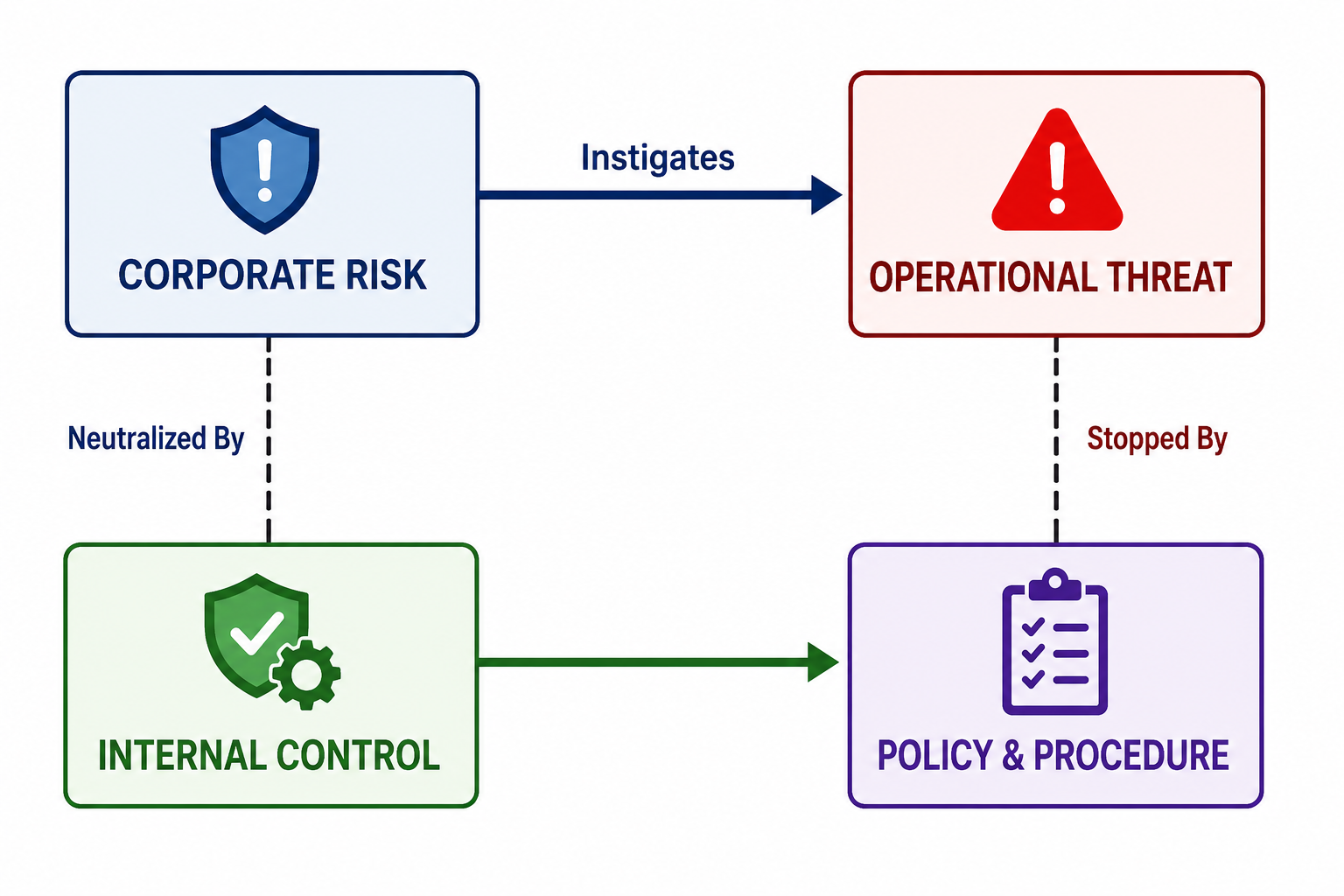
Internal controls do not exist to eliminate risk; that is an operational impossibility. Instead, they exist to establish a reliable environment where management has full visibility over financial, compliance, and structural threats before they impact the balance sheet.
Objectives of Internal Control
A professional internal control system serves four core objectives across an organization. Every policy drafted by an oversight committee must align with one or more of these pillars.
Accuracy of Financial Reporting
Lenders, investors, and regulatory bodies demand completely reliable financial data. Internal controls guarantee that every single transaction is recorded accurately, transparently, and in compliance with established accounting standards. This eliminates the risk of deliberate fraud or accidental material misstatements.
Compliance with Laws and Regulations
Modern enterprises operate within a complex web of strict regulatory mandates. From anti-money laundering (AML) laws to data privacy acts, structured internal controls prevent costly litigation, severe regulatory fines, and the potential loss of operating licenses.
Operational Efficiency
A well-designed control framework actively streamlines internal business actions. By eliminating redundant steps, establishing clear paths of ownership, and protecting physical assets, controls optimize the daily utilization of corporate resources.
Asset Protection
Corporate assets extend far beyond physical cash in a vault. They encompass raw inventory, high-value equipment, proprietary intellectual property, and sensitive customer data. Internal controls shield these vital resources from theft, unauthorized access, misuse, or accidental destruction.
Internal Control Risk Management Framework
An ad-hoc approach to risk management creates dangerous operational blind spots. To achieve complete security, organizations align their programs with a universally recognized blueprint: the COSO Framework.
Developed by the Committee of Sponsoring Organizations of the Treadway Commission, the COSO Enterprise Risk Management Framework establishes a unified model for evaluating control environments.
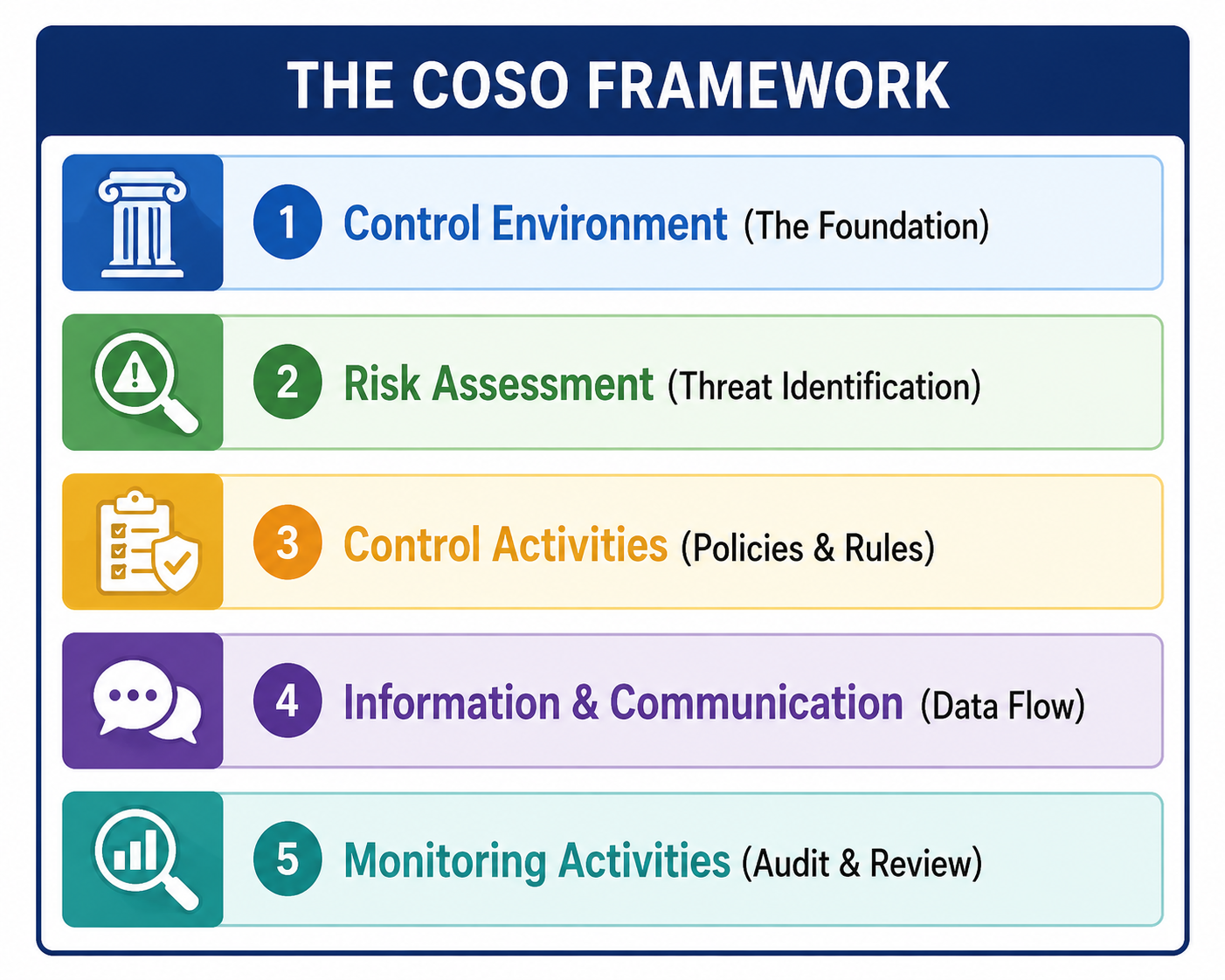
The 5 Core Elements of a Risk-Based Control System
Control Environment: The foundational culture, values, and governance structure of the organization. This sets the overall tone from the top regarding the critical importance of discipline and ethical conduct.
Risk Assessment: The ongoing internal mechanism for identifying, measuring, and analyzing potential operational and financial disruptions.
Control Activities: The actual policies, physical procedures, and automated software workflows designed to ensure management instructions are executed precisely.
Information and Communication: The structured pathways that guarantee vital data is identified, captured, and distributed across the organization promptly.
Monitoring Activities: Continuous or periodic evaluations to verify that all five components of the control framework are functioning as intended. To ensure your oversight systems are fully optimized against these criteria, implementing specialized risk management services provides an independent, objective evaluation of your operational health.
Types of Internal Controls
Internal controls are categorized based on their functional timing and core operational intent. To build an ironclad defence matrix, an organization must deploy a balanced combination of all four types.
1 Preventive Controls
Preventive controls act as the first line of defense. They are designed to proactively stop errors, fraud, or unauthorized activities before they occur.
Examples: Strict password security rules, segregation of core duties, and formal approval requirements for major expenditures.
2 Detective Controls
Detective controls serve as a secondary safety net. They are designed to identify and highlight errors, irregularities, or non-compliance events after they have occurred.
Examples: Monthly bank reconciliations, physical inventory counts, and automated system error log reviews.
3 Corrective Controls
Corrective controls enter the workflow immediately after a detective control flags an anomaly. They focus on fixing the root cause of the error and restoring the operations to a secure state.
Examples: System data backup restorations, software patches, and updated disciplinary policies following a breach.
4 Directive Controls
Directive controls guide organizational behavior toward explicit goals. They focus on fostering an internal culture of compliance and proactive risk awareness.
Examples: Formal employee handbooks, mandatory corporate training modules, and standard operating procedures (SOPs).
10 Types of Internal Control (Detailed Section)
For deep operational auditing, internal controls are broken down into ten specific functional categories. This comprehensive matrix covers both physical business processes and digital system infrastructure.
1. Authorization Controls
These controls ensure that only specifically designated employees can initiate, execute, or modify business transactions.
Implementation: Setting specific spending caps where any purchase invoice over $10,000 automatically triggers a mandatory executive approval sequence.
2. Segregation of Duties (SoD)
A fundamental accounting control that divides critical transaction steps among multiple employees. No single individual should ever have the power to initiate, authorize, record, and execute a financial transaction alone.
Implementation: The employee who maintains the accounts receivable ledger must never be the person who opens incoming physical checks or processes customer cash deposits.
3. Reconciliations
Independent verifications that compare two separate data streams to identify accounting misstatements.
Implementation: Weekly matching of internal ledger transactions against official bank statements to isolate missing checks, unrecorded fees, or unauthorized withdrawals.
4. Physical Controls
Direct physical barriers designed to safeguard tangible assets from theft, vandalism, or environmental damage.
Implementation: Storing raw inventory in restricted-access warehouses monitored by biometric scanners, physical lock keys, and 24/7 security cameras.
5. IT Access Controls
Digital permissions that restrict user access to applications, networks, and databases based on their exact role in the company.
Implementation: Implementing Multi-Factor Authentication (MFA) alongside Role-Based Access Control (RBAC) to block unauthorized users from altering payroll systems.
6. Audit Trails
Unalterable, chronologically ordered records that log every single action taken inside an organization's core enterprise resource planning (ERP) system.
Implementation: Keeping digital system logs that show exactly which user ID modified a supplier payment profile, including the precise date, time, and prior numerical value.
7. Approval Hierarchy
A formal, documented chain of command that determines which management levels are authorized to sign off on specific business operational steps.
Implementation: Expense reports up to $500 require a team manager's signature; reports up to $5,000 require a director's approval; anything higher demands CFO authorization.
8. Budget Controls
Ongoing tracking of actual business spending against pre-approved financial projections to catch operational waste early.
Implementation: Utilizing automated corporate accounting software that blocks a department head from buying new hardware if their quarterly IT budget is exhausted.
9. Risk Assessment Controls
Structured workflows that mandate regular evaluations of evolving threats to prevent corporate stagnation.
Implementation: Holding mandatory bi-annual compliance reviews to evaluate how new state tax laws will impact existing corporate distribution models.
10. Compliance Controls
Explicit cross-checks that map standard business actions directly to local and international legal mandates.
Implementation: Requiring automated data encryption protocols across all customer service channels to comply with global data privacy requirements.
Internal Controls Examples in Real Organizations
To understand how internal controls operate day-to-day, let's look at a concrete operational breakdown across a professional organization.
Control Classification | Real-World Operational Threat | Implemented Internal Control Solution |
Accounting Control | A corrupt employee creates a fake supplier profile and pays themselves through fraudulent invoices. | Mandatory vendor setup verification. A manager must confirm a new supplier's official tax ID before accounting can issue any payments. |
Operational Control | Warehouse inventory tracking is inaccurate, leading to widespread stock theft and sudden shipping delays. | Blind physical inventory counts are conducted by an independent team every month and matched against ERP records. |
IT Control | A disgruntled former worker logs into the company database from home and deletes critical financial data. | Automated termination workflows. When HR processes an exit, the user's network access keys are revoked instantly. |
Internal Control Risk Management Process
Building an internal control matrix requires an iterative, structured approach. Organizations execute this strategy by following a continuous five-step lifecycle.
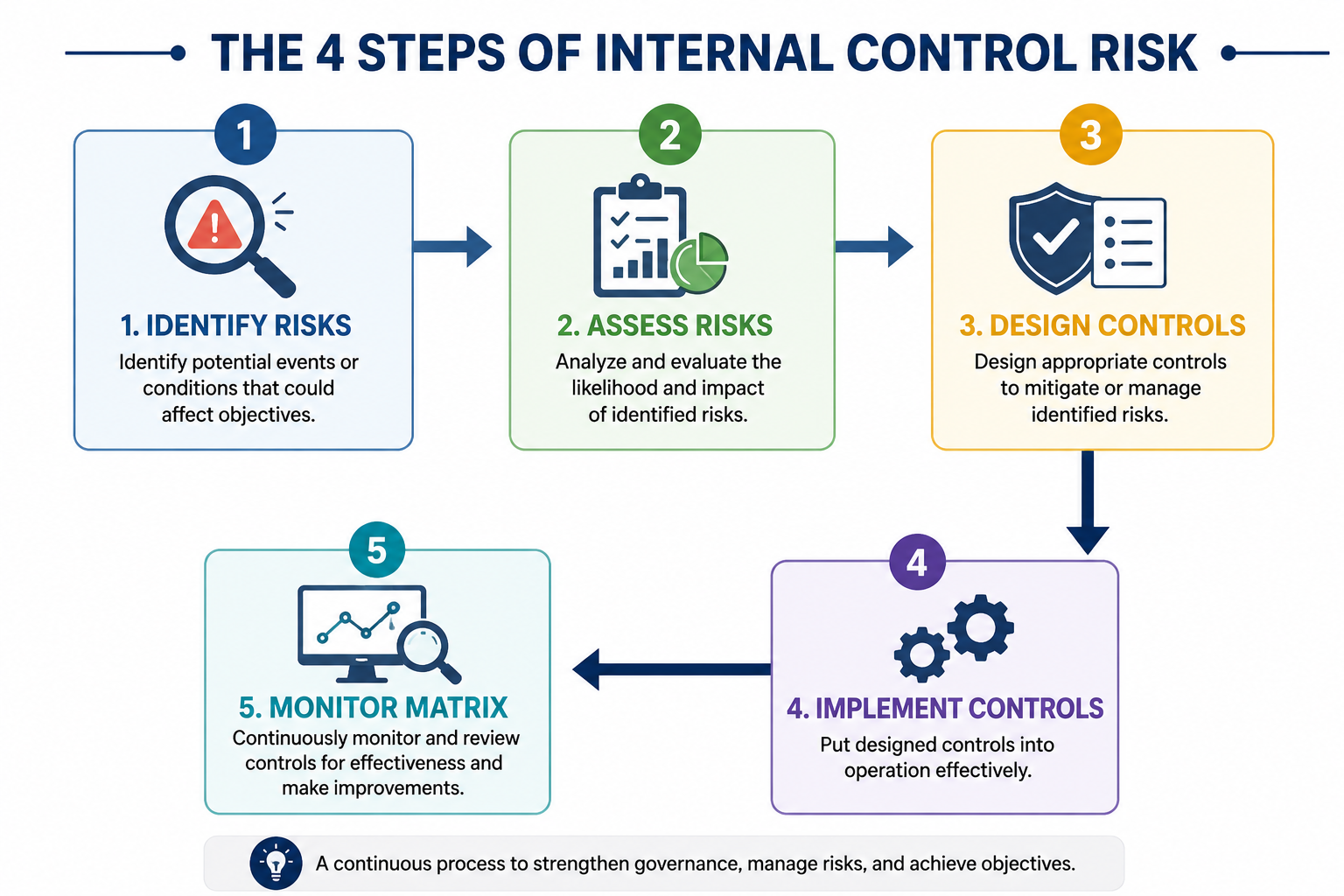
Step 1: Identify Risks
Brainstorm every internal and external event that could damage your organization. Document these variables in a centralized asset profile known as a risk register.
Step 2: Assess Risks
Evaluate each identified threat using two metrics: Likelihood (how probable is the event?) and Impact (how severe is the financial or operational damage?).
To calculate the overall threat priority level, use the standard mathematical risk formula:
Risk Score =Likelihood times Impact
Step 3: Design Controls
For every threat that scores above your organization's risk tolerance, design a specific preventive or detective control to act as an operational barrier.
Step 4: Implement Controls
Deploy the newly designed controls directly into daily workflows. Document the exact procedures in the company's user manuals and train your staff thoroughly on the updated compliance expectations.
Step 5: Monitor Effectiveness
Continuously audit your implemented controls. If a control fails to catch a transactional error, return to the design phase to strengthen the process.
L1, L2, L3 Risk Management Explained
High-performance enterprises assign clear ownership of risk by implementing the classic Three Lines of Defence model. This structural layout eliminates dangerous overlap between operational staff and auditing teams.
First Line: Frontline Operations
This line consists of operational managers and frontline employees who handle daily business transactions. They execute controls directly as part of their standard workflows.
Key Action: A floor manager verifies warehouse shipping Manifests before a truck departs.
Second Line: Risk and Compliance
This line consists of specialized oversight teams that do not manage daily operations directly. Instead, they set the guiding standards, design the control frameworks, and monitor the first line's compliance.
Key Action: A Chief Risk Officer tracking corporate regulatory shifts and updating compliance manuals.
Third Line: Internal Audit
This line is a completely independent team that reports directly to the Board of Directors or Audit Committee. They provide unbiased, objective assurance that both the first and second lines are executing their duties flawlessly.
Key Action: Conducting an unannounced financial audit to verify the integrity of the accounting department's reconciliation logs.
IT General Controls (ITGC) Domains
Modern internal controls rely heavily on digital systems. Without strong IT General Controls (ITGC), your accounting and operational control matrices can be bypassed easily.
Aligned with the official ISACA ITGC guidelines, a comprehensive digital defence strategy covers four core domains:
Access Control
Guarantees that only authorized users can access specific systems and data rooms. This domain governs password strength requirements, user account provisioning workflows, multi-factor authentication mandates, and regular privilege reviews.
Change Management
Prevents developers and IT staff from pushing unauthorized code or software modifications directly into live production environments. Every system upgrade must follow a strict process: formal request $\rightarrow$ sandbox testing $\rightarrow$ manager sign-off $\rightarrow$ scheduled live deployment.
IT Operations
Focuses on the smooth, secure management of daily system infrastructure. This domain covers automated data backups, network firewalls, anti-malware tracking, and formal incident response protocols.
Security Management
The high-level oversight program that shields digital assets from external cyber threats and internal data leaks. This includes running regular vulnerability scans, conducting external network penetration tests, and deploying automated endpoint threat detection systems.
Internal Control Examples in Accounting
When a company's internal accounting controls break down, the financial statements become completely unreliable. To prevent fraud and ensure transparent reporting, look at how professional teams deploy controls across four critical ledger areas.
Accounts Payable (AP) Controls
To block fraudulent payouts, use Three-Way Matching before approving vendor disbursements. The accounting software must verify that the Purchase Order, the Receiving Report, and the Vendor Invoice match perfectly in line items, item quantities, and pricing.
Revenue Recognition Controls
Prevent overstating revenue by requiring clear, signed delivery receipts from third-party shipping carriers before marking any sales invoice as completed. This blocks teams from artificially boosting quarterly sales metrics using unfulfilled orders.
Bank Reconciliation
Mandate that bank statements be pulled and reconciled every single week by an employee who does not have check-signing or wire-transfer authority. This separation ensures unauthorized cash outflows are caught instantly.
Payroll Controls
Integrate automated biometric time-tracking clocks that tie directly into payroll software. This mechanical control eliminates "buddy punching" and stops manual timesheet tampering by supervisors or employees.
Internal Control Risk Management PDF Guide (Lead Magnet)
For corporate risk managers who need an offline framework to evaluate their internal systems, we have compiled a complete, downloadable resource kit.
What is Inside the Comprehensive PDF Blueprint:
An interactive, ready-to-use Internal Control Self-Assessment Checklist.
A pre-formatted Risk Register Matrix template with automated Likelihood and Impact scoring guides.
A step-by-step ITGC compliance evaluation map.
A standard corporate Segregation of Duties (SoD) conflict chart.
If you want to download this full resource kit or set up a comprehensive review of your company's operational governance, visiting our dedicated resource hub for corporate governance consulting connects you directly with expert lead compliance advisors.
Importance of Internal Control in Risk Management
Implementing a comprehensive internal control program requires a serious commitment of corporate time, effort, and financial capital. However, the long-term protection it provides your organization far outweighs the initial setup cost.
Defending Against Corporate Fraud
According to global forensic auditing data, internal control breakdowns account for nearly half of all corporate fraud cases worldwide. Strong controls like segregation of duties and automated audit trails eliminate the opportunity for bad actors to misappropriate company assets.
Ensuring Uncompromised Market Integrity
When your internal accounting numbers are accurate, clean, and fully validated, your organization enjoys a massive competitive advantage. Accurate numbers give banks the confidence to extend lower interest rates, give investors the trust to inject fresh growth capital, and give regulatory bodies no reason to launch invasive structural investigations.
Common Internal Control Failures
Even the most expensive, advanced control frameworks can crash if management fails to address simple operational vulnerabilities.
Weak Segregation of Duties: Small businesses often make the mistake of letting a single trusted accountant handle vendor setups, bank reconciliations, and check signatures simultaneously. This is a massive fraud risk.
Lack of Constant Monitoring: Treating internal controls like a static, one-time project. A control matrix must change dynamically whenever your business expands into new markets or upgrades its software.
Poor Process Documentation: Relying on verbal instructions instead of written standard operating procedures (SOPs). If your control rules aren't explicitly documented, employees will cut corners during busy periods.
Management Override: A major corporate risk where senior executives intentionally bypass established control protocols to rush through an unauthorized transaction or modify a financial statement.
Internal Control vs Risk Management
While these two terms are often used interchangeably in casual business conversation, they operate at completely different levels of corporate governance.
Functional Dimension | Internal Control | Risk Management |
Core Operational Scope | Focused primarily on tactical, operational-level procedures and workflows. | Operates at a broad, macro strategic level across the entire enterprise. |
Primary Intent | Designed to prevent, detect, or correct specific known business transaction errors. | Focuses on identifying and capitalizing on uncertainties and market changes. |
Structural Approach | Reactive and protective, it functions as an internal barrier to safeguard existing assets. | Proactive and predictive; it balances risk against potential growth opportunities. |
Understanding these distinct functional scopes is vital when structuring your enterprise workflows. For scaling entities trying to navigate these corporate layers, outsourcing daily financial mechanics to Monthly bookkeeping solutions keeps your operational data perfectly organized, allowing your executive team to focus entirely on macro-level risk management.
Internal Control Risk Management Best Practices
To ensure your internal control matrix delivers maximum protection with minimal operational friction, implement these four proven architectural rules:
Enforce an Uncompromising Tone from the Top: Corporate compliance starts at the executive level. If senior management regularly ignores security protocols or documentation rules, frontline employees will adopt the same careless habits.
Automate Your Controls Wherever Possible: Human error is a major vulnerability in any manual process. Switch out manual verification steps for automated system controls, like mandatory software fields, biometric access logs, and automated three-way matching.
Run Scheduled, Independent Audits: Never let an operational team grade their own work. Bring in independent internal auditors or specialized external consultants at regular intervals to aggressively stress-test your control environment.
Keep Your Risk Registers Updated: As digital landscapes evolve and your organization grows, new operational threats will emerge. Review and update your risk registers at least once every quarter to ensure your control barriers remain fully optimized.
Frequently Asked Questions
What are internal controls in risk management?
Internal controls are the specific policies, technological protocols, and physical procedures an organization implements to protect its assets, ensure financial statement accuracy, and block fraudulent activity.
What are the 4 domains of ITGC?
The four core domains of IT General Controls (ITGC) are Access Control, Change Management, IT Operations, and Security Management.
What is L1, L2, and L3 in risk management?
This refers to the classic Three Lines of Defence model: the First Line is frontline operational management, the Second Line consists of risk and compliance oversight teams, and the Third Line is independent internal audit teams.
What are the 5 steps of the RM process?
The standard five-step risk management lifecycle consists of: Identifying Risks, Assessing Risk Impact/Likelihood, Designing Specific Controls, Implementing Controls into Workflows, and Continuously Monitoring Effectiveness.
What are the 4 types of risk control?
The four functional classifications of risk control are Preventive Controls, Detective Controls, Corrective Controls, and Directive Controls.
What are the 5 main internal controls?
The five primary types of internal control used to secure corporate workflows are Segregation of Duties, Strict Authorization Hierarchies, Regular Independent Reconciliations, Physical Asset Barriers, and Digital IT Access Restrictions.
Conclusion
Building a professional internal control risk management system is not a luxury choice for scaling enterprises—it is a vital structural anchor required to survive in a highly regulated corporate landscape.
By shifting away from weak, ad-hoc tracking procedures and adopting globally recognized blueprints like the COSO framework, your organization can effectively eliminate the illusion of profitability, block corporate fraud before it hits your accounts, and establish a rock-solid operational foundation for sustainable market growth.