Introduction
Whether you are launching an accounting firm, launching a wealth management practice, or scaling a financial advisory firm, a financial services business plan is your strategic blueprint. It communicates your company’s vision, operational structure, market positioning, and financial outlook to investors, lenders, and internal stakeholders.
Navigating the financial sector requires clarity around revenue models, client acquisition strategies, capital requirements, and regulatory frameworks. In this guide, you will learn to build a comprehensive financial services business plan step by step, complete with actionable financial projection frameworks, an original business plan template, and an illustrative sample.
What Is a Financial Services Business Plan?
A financial services business plan is a structured document describing a firm’s business concept, financial offerings, target client base, market opportunity, operational design, and long-term growth roadmap. It aligns internal strategies with market realities to ensure sustainable profitability and regulatory compliance.
The Key Difference: Business Plan vs. Financial Plan
It is important to distinguish between a full business plan and its financial component:
Financial Services Business Plan: Describes the entire enterprise, including executive leadership, services, target audience, marketing channels, risk management, and competitive differentiation.
Financial Plan: Represents the dedicated financial section of the broader business plan. It details revenue streams, cost structures, cash flow metrics, balance sheets, break-even targets, and capital requirements.
Disclaimer: This article provides general business-planning information and should not be construed as legal, tax, investment, or regulatory advice. Financial services businesses should consult qualified legal counsel and relevant government regulators regarding specific compliance requirements in their jurisdiction.
What Does a Financial Services Business Do?
Financial services businesses provide capital management, risk mitigation, tax strategy, and accounting infrastructure to consumers, small businesses, and enterprise clients.
Common financial services business models include:
Accounting & Bookkeeping Firms: Core financial record-keeping, payroll, and compliance reporting.
Financial Advisory & Wealth Management: Portfolio management, retirement planning, and asset allocation.
Tax Consulting Practices: Individual and corporate tax preparation, strategy, and audit support.
Virtual CFO & Advisory Services: High-level strategic financial leadership, cash flow modelling, and growth forecasting.
Investment & Fintech Companies: Capital raise facilitation, automated advisory platforms, and financial software solutions.
Regulatory and Compliance Considerations
Financial services firms operate within heavily regulated environments. Depending on your jurisdiction and service scope, you may be subject to licensing, registration, professional standards, and consumer protection laws. For example, U.S. investment advisers must review U.S. Securities and Exchange Commission (SEC) guidelines to ensure full compliance before offering public advisory services.
Why Do You Need a Financial Services Business Plan?
Creating a business plan forces founders to rigorously stress-test assumptions before deploying capital.
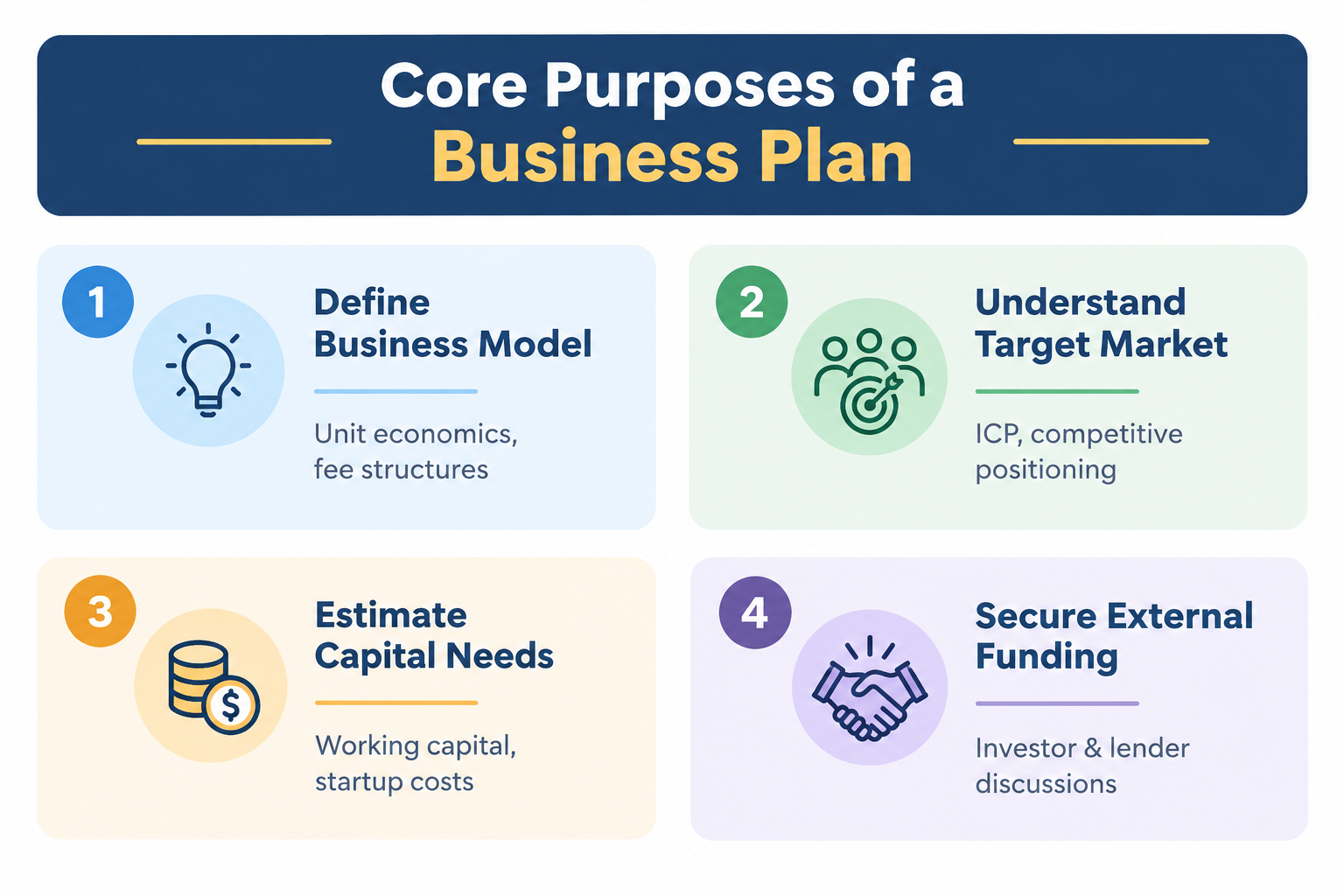
1. Define Your Business Model
Clarify what services you sell, who you serve, and how you charge (e.g., hourly rates, fixed monthly retainers, or percentage of Assets Under Management).
2. Understand Your Target Market
Analyze your customer segments, identify key pain points, evaluate direct competitors, and establish a clear value proposition.
3. Plan Your Capital and Funding Requirements
Calculate initial startup costs, software licensing fees, working capital reserves, payroll expenses, and marketing investments.
4. Support Investor or Lender Discussions
Commercial lenders and private equity partners require clear documentation before committing funds. The U.S. Small Business Administration (SBA) explicitly emphasizes including detailed financial projections alongside funding requests.
10 Types of Business Plans
Business plans vary based on audience, industry context, and strategic intent. The table below outlines ten common planning formats:
Business Plan Type | Primary Purpose | Key Audience |
Startup Business Plan | Establishing a new venture’s core model | Founders, angel investors |
Traditional Business Plan | Comprehensive operational and financial planning | Lenders, institutional investors |
Lean Business Plan | High-level, rapid strategic overview | Internal team, co-founders |
Strategic Business Plan | Long-term high-level goals and execution | Executive leadership, board members |
Operational Business Plan | Day-to-day workflow and resource allocation | Department managers, staff |
Growth Business Plan | Securing expansion capital or opening new markets | Growth equity partners, lenders |
Internal Business Plan | Directing internal operational changes | Internal teams |
Feasibility Business Plan | Testing a new market idea's viability | Founders, market researchers |
One-Page Business Plan | Executive snapshot of the core business model | Strategic partners, advisory boards |
Financial Business Plan | In-depth capital forecasting and risk modelling | Chief Financial Officers, banks |
Key Components of a Financial Services Business Plan
Standard business plan structures typically incorporate eight core structural sections. Below is how to adapt these sections specifically for a financial services practice:
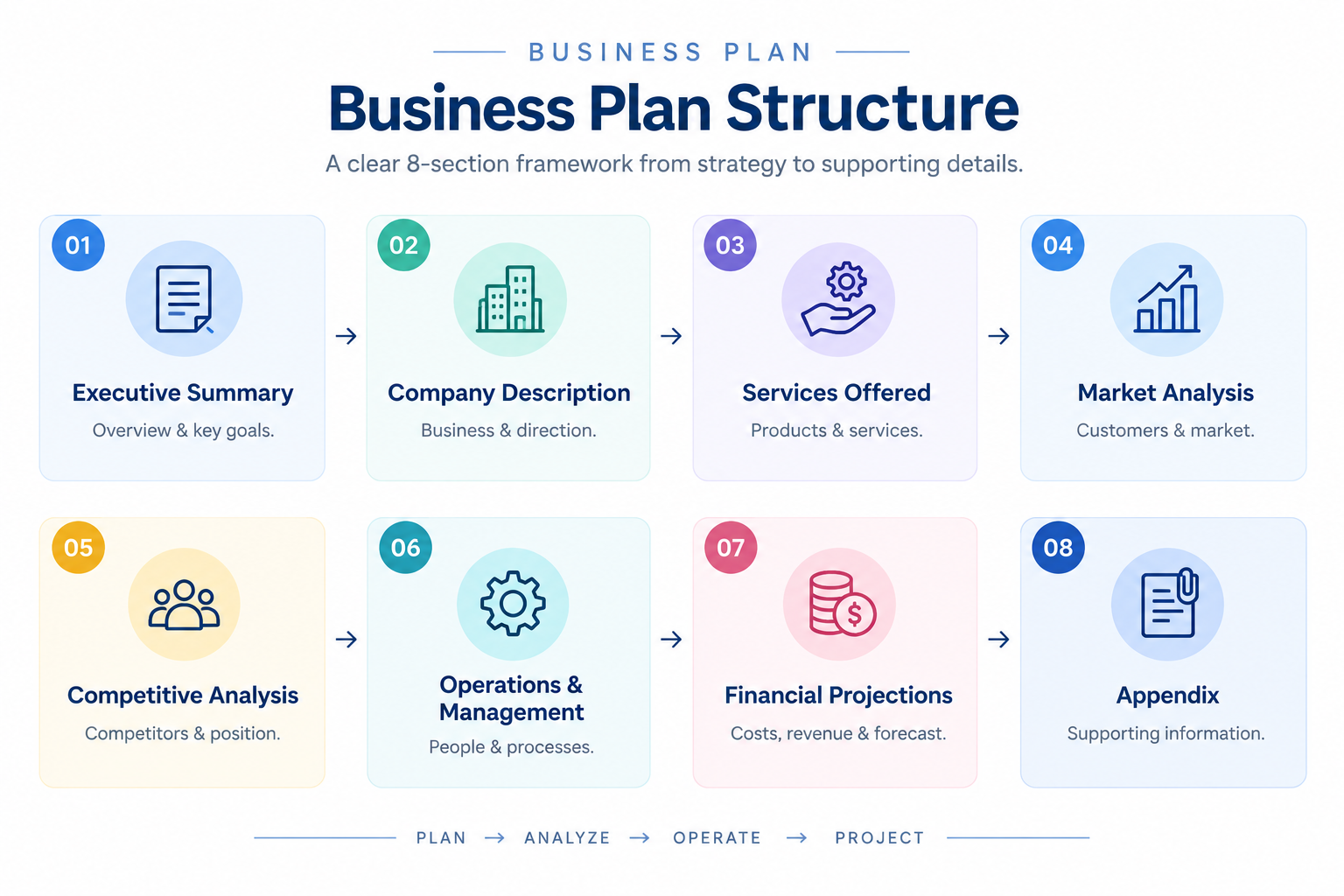
1. Executive Summary
Summarize your business concept, mission, services, target audience, key competitive advantages, and essential financial milestones. Investors should immediately grasp your value proposition within two minutes of reading this section.
2. Company Description
Detail your legal ownership structure (e.g., LLC, C-Corp, Partnership), office location, operational history, mission statement, and high-level corporate objectives.
3. Financial Services Offered
Outline your primary service lines. To ensure operational clarity, categorize your offerings cleanly:
Core accounting and outsourced bookkeeping services
Corporate tax preparation and strategy
High-level virtual CFO services and growth strategy
Financial planning and advisory for high-net-worth clients
4. Target Market Analysis
Define your Ideal Customer Profile (ICP) based on enterprise scale, sector, location, and pain points.
Profile Factor | SMB Accounting Target | Wealth Management Target |
Target Client | Small & mid-sized businesses | High-net-worth individuals (HNWIs) |
Target Industry | SaaS, E-commerce, Professional Services | Executives, business retirees |
Geography | US, UK, Canada, Australia | Regional or national market |
Primary Need | Clean recordkeeping & tax compliance | Asset growth & wealth preservation |
Buying Trigger | Rapid business growth, upcoming audit | Career change, retirement, inheritance |
5. Competitive Analysis
Identify direct competitors (local firms, national agencies) and indirect competitors (DIY software, internal hires). Highlight your specific differentiators such as specialized industry expertise, custom technology integration, or response guarantees rather than making generic claims.
7 Steps to Create a Financial Services Business Plan
Follow this linear sequence to move from concept to execution:
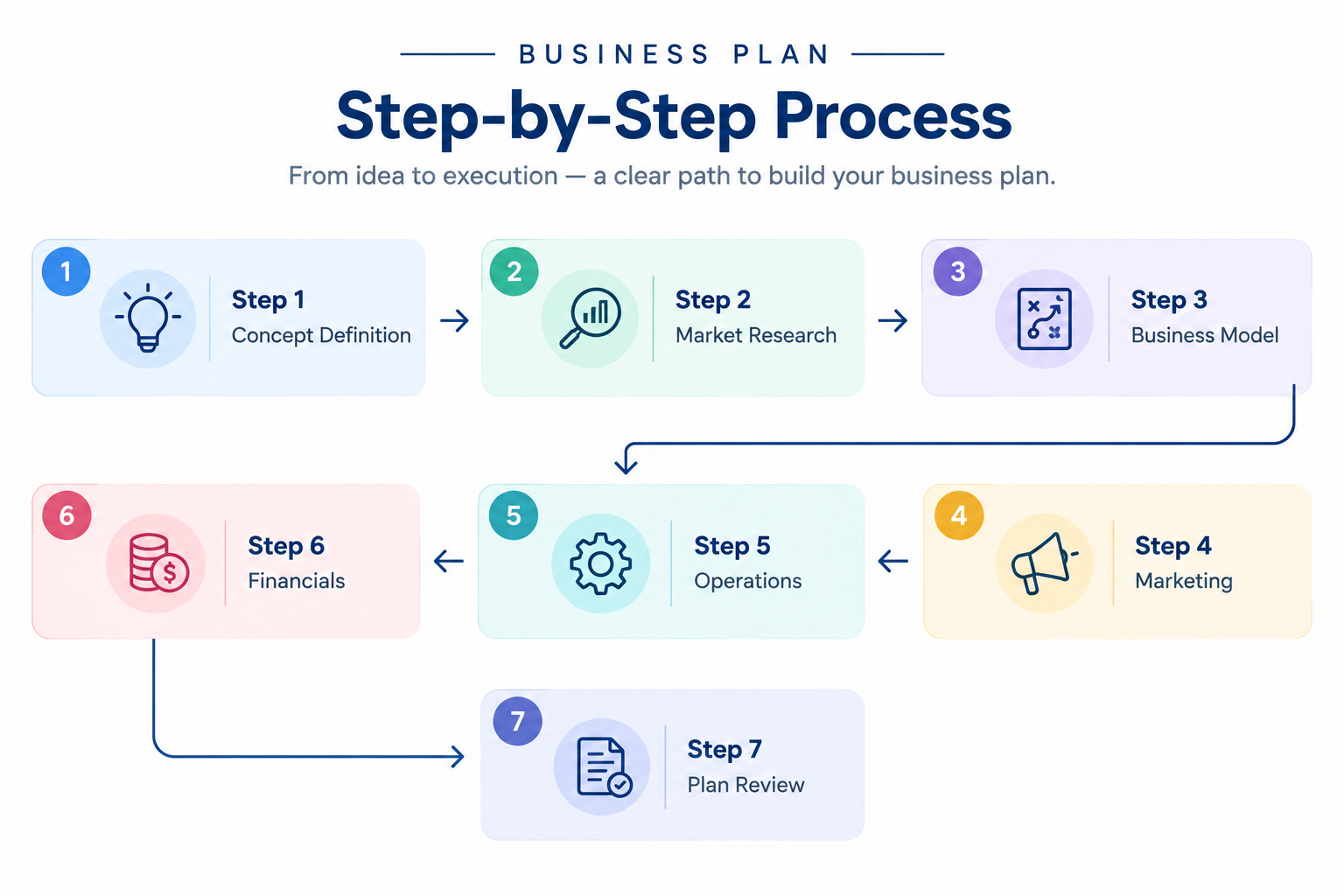
Step 1: Define Your Business Idea
Clarify your core value proposition. Decide whether you will offer broad-spectrum financial solutions or focus on specialized advisory models.
Step 2: Conduct Market Research
Gather market intelligence on industry pricing trends, local demand drivers, competitor coverage, and emerging regulatory requirements.
Step 3: Establish Your Business Model
Define your pricing mechanics clearly. Determine if you will charge hourly rates, fixed monthly fees, project-based milestones, or percentage-based asset management fees.
Step 4: Build Your Marketing and Sales Strategy
Outline client acquisition channels. Outline strategies for digital channels using targeted search optimization, active presence on professional networking platforms, strategic accounting partnerships, and content publishing.
Step 5: Plan Operations and Management
Detail your technology infrastructure, client onboarding protocols, client data security standards, and daily execution pipelines. For modern firms, integrating modern software stacks and business process automation reduces administrative overhead and minimizes manual entry errors.
Step 6: Prepare Financial Projections
Construct your core financial models, including revenue forecasts, expense budgets, profit and loss statements, and balance sheets. Incorporating robust financial modelling services helps stress-test your unit economics under diverse market conditions.
Step 7: Review and Update the Plan
Treat your business plan as a dynamic operational tool. Schedule quarterly reviews to compare actual financial performance against early projections and adjust your growth strategy accordingly.
What Are the 7 Steps of Financial Planning in Business?
Separately from enterprise business planning, corporate financial planning follows a structured seven-step workflow:
Assess Current Financial Position: Gather historical statements, current debts, and working capital balance.
Define Financial Goals: Establish explicit revenue targets, margin thresholds, and liquidity reserve goals.
Identify Key Revenue and Cost Drivers: Pinpoint variable software costs, staff salaries, marketing acquisition costs, and retention metrics.
Prepare Budgets and Forecasts: Build operational expense budgets and revenue expectations.
Develop Cash-Flow Projections: Map cash inflows and outflows to eliminate short-term liquidity shortfalls.
Analyze Risks and Scenarios: Evaluate economic downturns, client churn scenarios, and major cost hikes using financial risk analysis.
Monitor and Update Regularly: Review variance reports monthly to keep internal spending aligned with forecast metrics.
What Are the 7 Components of a Financial Plan?
Every financial section within a business plan must include seven core financial statements and quantitative models:
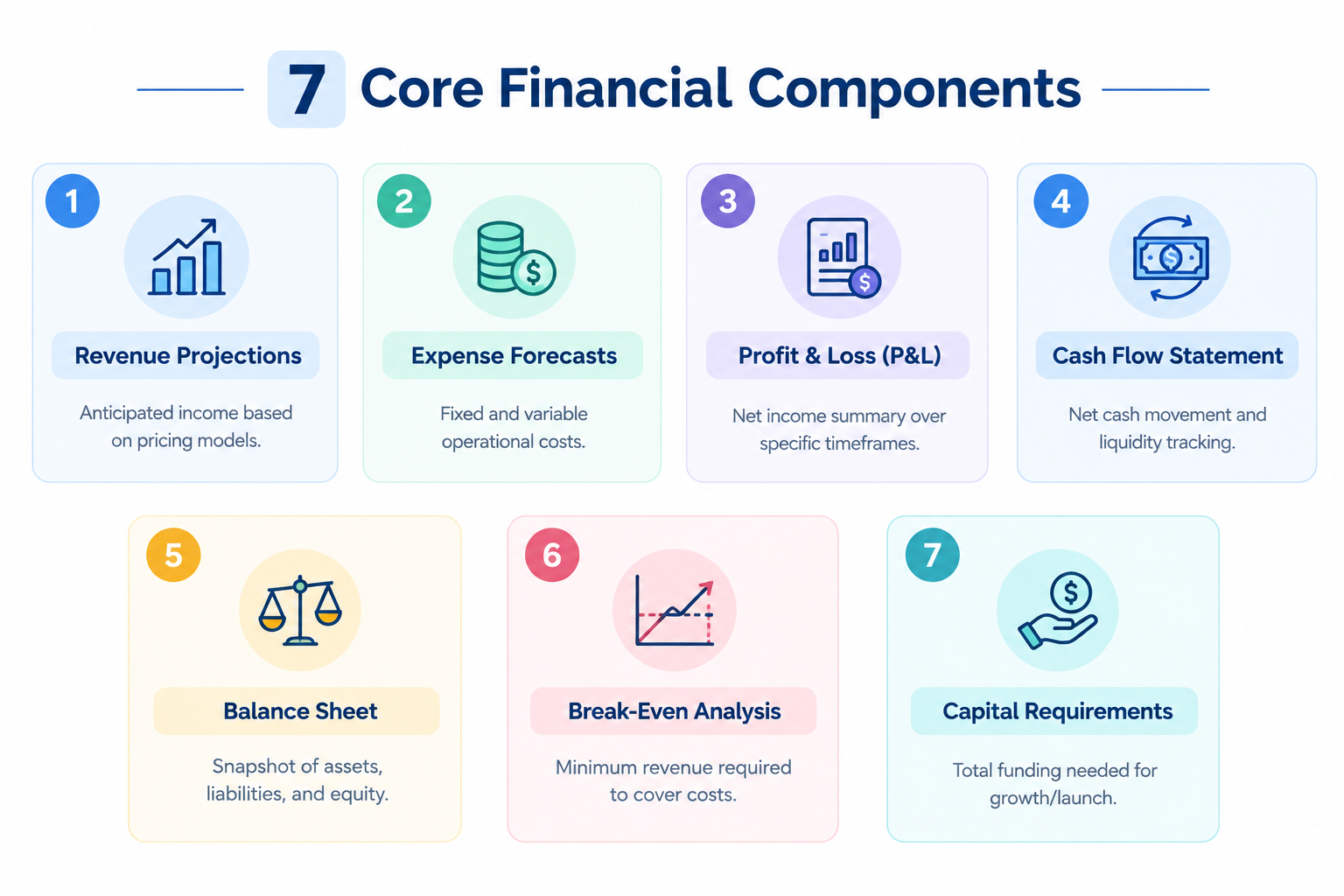
Revenue Projections: Calculated calculations detailing sales targets across service categories.
Expense Forecasts: Itemized breakdown of fixed (rent, software) and variable (commissions, ads) operational costs.
Profit and Loss (P&L) Statement: Summary of revenue, costs, and net income over specific tracking periods.
Cash Flow Statement: Explicit record of cash movement, differentiating realized cash balances from uncollected revenue.
Balance Sheet: Comprehensive statement detailing assets, total liabilities, and owner equity.
Break-Even Analysis: Calculation establishing the exact revenue volume needed to cover operational overhead.
Capital Requirements Statement: Explicit summary detailing the exact funding requested from lenders or investors.
Financial Projections for a Financial Services Business Plan
Developing credible financial models requires clear unit economics and objective assumptions.
Revenue Forecast
Structure your revenue models by multiplying active client metrics by average fees:
Active Clients Multiplied by Average Monthly Retainer =Monthly Recurring Revenue (MRR)
Illustrative Example: If an advisory practice targets 40 retainers at an average price of $1,200 per month:
40 Multiplied by $1,200 = $48,000 MRR ($576,000 Annualized)
Operating Expenses
Map fixed overhead separately from variable client fulfilment costs:
Labor & Payroll: Advisory salaries, admin compensation, payroll taxes.
Technology & Software: Accounting platforms, CRM licenses, compliance tools.
Facility & Operations: Office rent, utilities, general business insurance.
Marketing & Client Acquisition: Ad spend, event sponsorships, digital content creation.
Profit & Loss Forecast
Track top-line revenue minus costs to determine operating margins:
Revenue - Operating Expenses = Net Operating Profit
Cash Flow Forecast
A firm can be profitable on paper but experience cash crunches due to delayed invoicing. Your cash flow statement tracks actual cash timing to ensure payroll and expenses remain covered.
Balance Sheet
Summarize company health at year-end:
Assets (Cash, Accounts Receivable, Equipment)} = Liabilities (Loans, Accounts Payable)} + Equity
Break-Even Analysis
Calculate your required baseline operational volume:
Fixed Costs divided by Gross Margin Index= Break-Even Revenue
Financial Services Business Plan Template
Below is a practical structural outline you can adapt for your own document:
1. Executive Summary
1.1 Business Concept & Value Proposition
1.2 Target Audience & Market Demand
1.3 Funding Requirements & Use of Capital
2. Company & Organizational Overview
2.1 Ownership Structure & Management Team
2.2 Operational Location & Business Stage
3. Service Portfolio
3.1 Advisory & Financial Service Offerings
3.2 Fee Schedules & Pricing Strategy
4. Market & Competitive Analysis
4.1 Target Market Size & ICP Profiles
4.2 Competitive Matrix & Differentiation Strategy
5. Sales & Client Acquisition Plan
5.1 Marketing Channels & SEO Strategy
5.2 Conversion Funnel & Strategic Partnerships
6. Operations & Compliance Plan
6.1 Technology Stack & Software Infrastructure
6.2 Licensing, Regulatory Standards & Quality Controls
7. Financial Strategy & Projections
7.1 3-Year Income Statement, Cash Flow, & Balance Sheet
7.2 Break-Even Metrics & Sensitivity Analysis
8. Appendix
8.1 Executive Resumes, Licenses & Supporting Materials
Financial Services Business Plan Sample
The following fictional baseline example illustrates how to structure key summary tables:
Company Snapshot: Apex Financial Advisory LLC
Core Focus: Virtual CFO, tax planning, and strategic management reporting for mid-sized technology firms.
Revenue Model: Tiered recurring monthly retainers.
Year 1 Strategic Goals: Secure 30 recurring business retainers; reach $360,000 in Annual Recurring Revenue (ARR).
Year 1 Illustrative Financial Target
Financial Metric | Year 1 Baseline Example |
|---|---|
Gross Revenue | $360,000 |
Operating Expenses | $240,000 |
Net Operating Income | $120,000 |
Target Profit Margin | 33.3% |
Initial Capital Raised | $85,000 |
(Note: Data shown above represents a simplified model for structural reference only).
Free Financial Services Business Plan Template Resources
Many online resources offer downloadable business plan outlines. When sourcing templates:
Avoid Outdated Generic Samples: Ensure any sample plan you evaluate reflects modern pricing strategies, recurring retainer structures, and cloud-native software costs.
Adapt to Your Firm: Tailor sample outlines to align with your specific service lines, jurisdictional compliance requirements, and target markets.
Use Standard Financial Frameworks: Ensure your financial modelling templates generate standard balance sheets, income statements, and cash flow forecasts that align with lender and SBA standards.
General Business Plan vs. Financial Services Business Plan
Financial services companies face operational considerations that set them apart from standard retail or service businesses:
Feature | General Business Plan | Financial Services Business Plan |
|---|---|---|
Primary Value Metric | Product delivery or standard services | Financial performance, compliance, & trust |
Revenue Mechanics | One-off transactions or subscriptions | Retainers, AUM fees, hourly consulting, or project fees |
Regulatory Scope | Standard business registration | Specific licensing, SEC/FINRA compliance, data security mandates |
Key Cost Drivers | Cost of Goods Sold (COGS), inventory, logistics | Specialized talent, compliance software, liability insurance |
Risk Factors | Supply chain, foot traffic, product defects | Regulatory changes, fiduciary risks, market volatility |
Common Mistakes When Creating a Financial Services Business Plan
Avoid these common strategic errors when compiling your plan:
Overestimating Client Acquisition Speeds: Assuming new clients will sign on instantly without factoring in long B2B sales cycles.
Ignoring Cash Flow Dynamics: Confusing accrued revenues with available bank cash.
Vague Competitive Positioning: Claiming you provide "better service" without citing concrete market differentiators.
Underestimating Regulatory and Software Costs: Failing to budget for compliance fees, professional liability insurance, or enterprise software tools.
Static Financial Assumptions: Building a single rigid forecast rather than running best-case, expected-case, and worst-case scenarios.
Frequently Asked Questions
What is a financial plan for a business plan?
A financial plan is the quantitative module of a business plan. It translates strategic goals into concrete financial projections, including revenue models, expense budgets, profit statements, and cash flow analyses.
What does a financial services business do?
A financial services business manages capital, mitigates risk, optimizes tax positions, and provides financial reporting for individuals and corporate entities.
What are the 7 types of business plans?
Common formats include startup, traditional, lean, strategic, operational, growth, and financial business plans.
What are the 7 steps of financial planning in business?
The process involves evaluating financial health, establishing goals, identifying cost drivers, creating forecasts, projecting cash flows, assessing risks, and regularly monitoring variance performance.
What are the 7 steps of a business plan?
The business plan lifecycle moves from concept definition, market research, business model creation, and marketing strategy to operational design, financial modelling, and ongoing plan updates.
What are the 7 components of a financial plan?
A financial plan includes revenue forecasts, expense budgets, profit and loss statements, cash flow statements, balance sheets, break-even analyses, and capital requirement statements.
Build Your Financial Strategy
A structured financial services business plan gives your leadership team a clear roadmap while providing lenders and investors with the data they need to support your growth.
If you are expanding your firm or refining your growth strategy, working with experienced financial advisors can simplify the planning process. Explore how dedicated business planning services, advanced financial forecasting services, and strategic management reporting services can help you build an investment-ready business plan tailored to your financial services firm.
Author Profile
Written by the Financial Advisory Team at MBC Consulting. Our advisors assist growing firms with structured financial modelling, virtual CFO support, outsourced accounting, and long-term capital strategy.