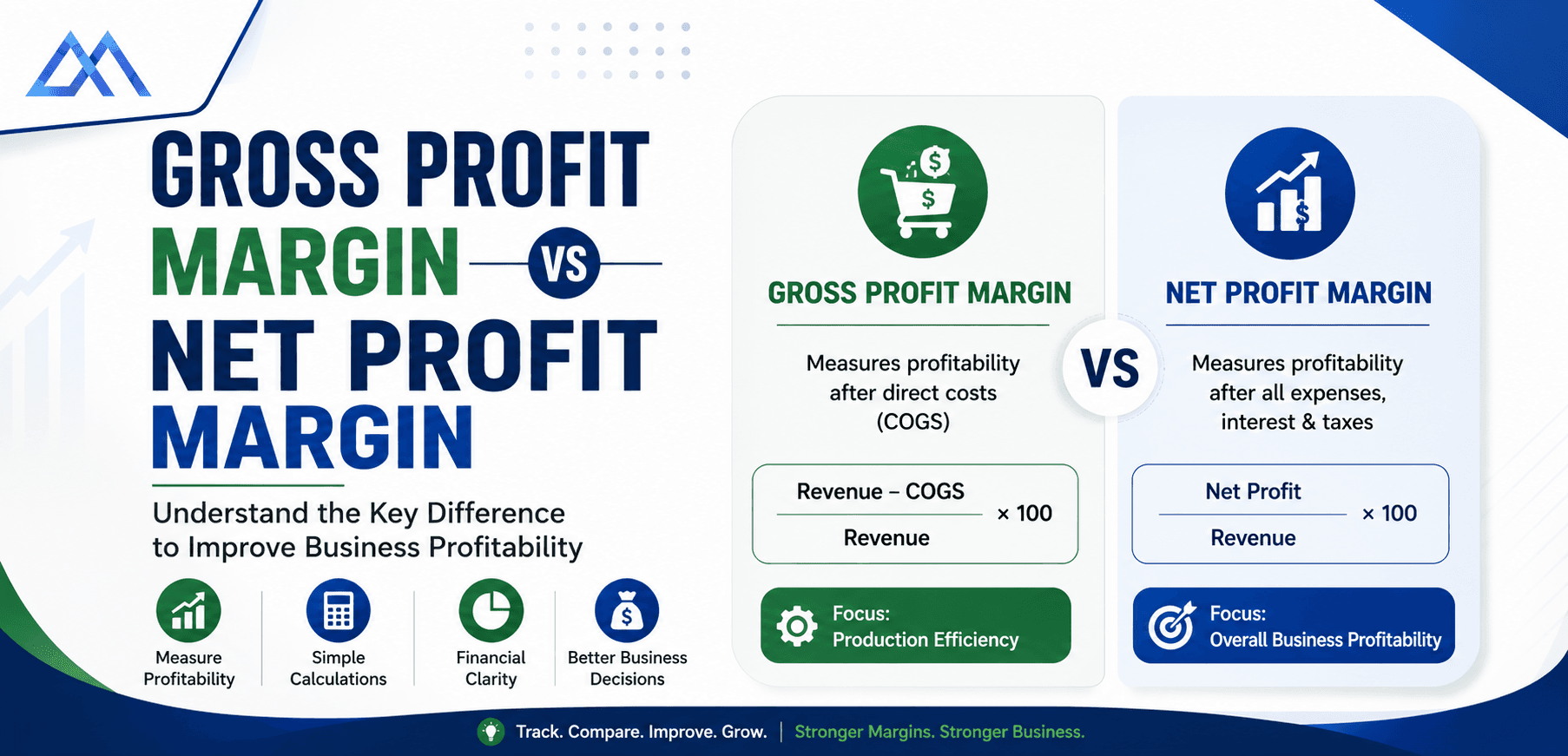
Gross Profit Margin vs Net Profit Margin
Every dollar your business brings in tells a story. But if you only look at the total sales figure at the top of your page, you are missing the most important chapters. To truly understand if your business is thriving or just surviving, you need to dive deep into a core financial comparison: gross profit margin vs net profit margin.
When it comes to tracking business performance, two financial metrics matter more than any other: gross profit margin and net profit margin. While they both measure financial health, they tell completely different stories about your company's efficiency.
Understanding the relationship between these two figures is the ultimate key to unlocking true 7-step financial freedom for any business owner. Let's break down exactly how they work, how to calculate them, and how to use them to drive better business decisions.
Key Takeaways
Gross margin measures production profitability by tracking how efficiently you produce or source your core products and services.
Net margin measures overall profitability by accounting for every single dollar that leaves your business, including overhead, interest, and taxes.
Both are vital profitability metrics that paint a complete picture of your financial analysis on an income statement.
Higher margins generally indicate better business efficiency, giving you more cash to reinvest into growth.
What Is Gross Profit Margin?
Gross profit margin is the percentage of revenue your business retains after paying for the direct costs of producing your goods or services. It shows you how profitable your core products are before you factor in overhead costs like rent, office supplies, or marketing.
Why Gross Profit Margin Matters
If your gross margin is too low, it means your production costs are too high, or your prices are too low. No matter how many sales you make, a weak gross margin makes it nearly impossible to cover your daily operating expenses.
Gross Profit Margin Formula
To find this percentage, you use a straightforward formula:
Gross Profit Margin = Revenue - COGS\ Revenue right) * 100

Components Explained
Revenue: The total amount of money your business brings in from sales before any deductions.
Cost of Goods Sold (COGS): The direct costs tied to production. This includes raw materials, manufacturing inventory, and direct labour used to build the product or deliver the service.
What Is Net Profit Margin?
Net profit margin is the ultimate bottom-line metric. It represents the percentage of revenue left over after absolutely all business expenses, interest payments, taxes, and operating costs have been subtracted from your total sales.
Why Net Profit Margin Matters
Net margin shows you the true reality of your business performance. A company could have a massive gross profit margin but still lose money overall if its office rent, marketing budgets, and administrative salaries are out of control.
Net Profit Margin Formula
The formula for net profit margin is:
Net Profit Margin = Net Profit /Revenue) *100
To find your net profit for the calculation, use this step:
Net Profit = Revenue - COGS - Operating Expenses - Interest - Taxes

Components Explained
Operating Expenses: Fixed overhead costs like rent, utilities, insurance, marketing, and corporate salaries.
Taxes: State, federal, or local government tax liabilities.
Interest: The cost of servicing business loans or lines of credit.
Gross Profit Margin vs Net Profit Margin: Key Differences
To see how these two metrics contrast side by side, let’s look at the core factors that separate them:
Factor | Gross Profit Margin | Net Profit Margin |
What it Measures | Direct production efficiency. | Absolute bottom-line business profitability. |
Expenses Included | Cost of Goods Sold (COGS) only. | COGS, overhead, interest, and taxes. |
Core Purpose | Evaluates pricing and manufacturing costs. | Evaluates overall business management and health. |
Investor Use | Shows if the product has a viable, scalable market. | Shows if the company is actually generating a return. |
Which Margin Is More Important?
Neither metric wins in a vacuum; they must be viewed together.
Use Gross Margin when you want to audit your supply chain, negotiate with suppliers, optimize product pricing, or look into manufacturing efficiency.
Use Net Margin when you are building long-term growth strategies, evaluating your total overhead, or pitching your business to outside investors.
Gross Profit Margin vs Net Profit Margin Example
Let’s look at a gross profit margin vs net profit margin example using a real business scenario to see how the math plays out.
Imagine a local retail brand with the following financial data for the month:
Total Revenue: $100,000
Cost of Goods Sold (COGS): $40,000
Operating Expenses (Rent, Payroll, Marketing): $35,000
Taxes & Interest: $5,000
Step 1: Calculate Gross Profit Margin
First, we find the gross profit by subtracting COGS from revenue ($100,000 - $40,000 = $60,000).
Gross Margin = $60,000 \ $100,000 ) * 100 = 60 %
Step 2: Calculate Net Profit Margin
Next, we perform the net profit calculation by subtracting all remaining expenses from our gross profit ($60,000 - $35,000 - $5,000 = $20,000).
Net Margin = $20,000 \ $100,000) * 100 = 20%
Interpretation of Results
This business features a strong 60% gross margin, proving its products are highly profitable to make. However, its net margin drops to 20%. This tells the owner that 40% of their total revenue is consumed entirely by overhead and operating expenses, which is a key area they need to manage closely.
The Difference Between Profit and Margin
It is incredibly common for business owners to confuse the terms profit and margin, often using them interchangeably. However, keeping them clear is critical for your financial tracking.
Profit is always expressed as a specific currency amount (dollars, euros, rupees). It represents the actual cash left over.
Margin is always expressed as a percentage. It represents the ratio of profit to total revenue.
Difference between profit and margin with an example: If you buy an item for $70 and sell it for $100, your profit is a flat $30. Your profit margin, however, is 30% (the $30 profit divided by the $100 retail price).
Businesses often confuse these because of the profit margin vs profit percentage trap—assuming that a $30 markup on a $70 item means a 30% margin. In reality, that is a 42.8% markup, but only a 30% profit margin.
Operating Margin vs Net Margin
While gross and net margins are the most famous metrics, there is a third middle step on your income statement: operating margin.
Operating Margin measures a company's profit after paying for both production costs (COGS) and regular operating expenses (like administrative overhead and sales costs), but before deducting interest and taxes.
The Operating Margin Formula: (Operating Profit / Revenue) * 100
Operating Margin vs Net Margin Comparison
Operating margin strictly looks at how well your day-to-day business operations run. Net margin goes a step further by including external financial realities like corporate tax rates and loan interest.
Which Metric Investors Prefer?
Many institutional investors prefer looking closely at operating margins because it reveals the true earning power of the core business operation without the distorting effects of tax strategies or unique debt structures.
Profit Margin vs Markup
Another massive point of confusion for small business owners is mixing up margin and markup. Using the wrong term here can severely damage your pricing strategy.
Margin is calculated as profit divided by the selling price.
Markup is calculated as profit divided by the cost of production.

Why They Are Not the Same
Because markup is divided by a smaller number (the cost), the markup percentage will always be higher than the profit margin percentage for the same item.
PAA Target: Is 20% margin the same as 25% markup?
Yes, exactly. If an item costs $80 to make and you apply a 25% markup ($20), your final retail price is $100. That $20 profit represents exactly a 20% profit margin on your $100 sale. If you mistake a 25% markup for a 25% margin, you will consistently underprice your products and lose out on valuable revenue.
How to Convert Gross Profit to Net Profit
Moving from your top-level gross figures down to your final bottom line is a simple step-by-step process of deduction.
Start with Gross Profit: This is your Revenue minus your COGS.
Deduct Operating Overhead: Subtract your marketing, sales, payroll, rent, utilities, and insurance costs.
Deduct Financial & Legal Costs: Subtract your interest payments on loans and your calculated local or federal taxes.
Arrive at Net Profit: The final number left on the table is your true net profit.
PAA Target: How to convert gross profit to net profit?
To put it into a clean mathematical sequence:
Net Profit = Gross Profit - (Operating Expenses + Interest + Taxes)
For example, if a firm has a gross profit of $50,000, overhead of $25,000, and pays $5,000 in taxes, the net profit is $20,000 ($50,000 - $25,000 - $5,000).
Profit vs Margin Calculator (Calculation Guide)
To easily visualize how your revenue, costs, and overhead alter your final profitability, use this interactive profit vs margin calculator. You can adjust the sliders below to see how shifts in production costs or overhead instantly impact both your gross and net margins.

What Is a Good Gross Profit Margin?
A "good" margin depends heavily on your specific business sector. Comparing a software firm's financials to a grocery store's layout will lead to highly inaccurate conclusions. According to financial data from NYU Stern School of Business, benchmarks vary widely across major business models:
Retail: Generally runs on tighter margins between 20% and 40% due to high inventory costs.
Manufacturing: Usually lands between 30% and 50%.
SaaS (Software as a Service): Boasts massive margins often hitting 70% to 90% because copying software costs virtually nothing.
E-commerce: Typically averages around 40% to 60%, varying by shipping and supply complexity.
PAA Targets
Is 70% GP good? Yes, a 70% gross profit margin is exceptional in almost any field, indicating strong pricing power or ultra-low production costs.
Is 80% gross profit margin good? Yes, this is elite tier, standard for highly profitable SaaS platforms and premium digital services.
Is 15% gross margin good? No, 15% is dangerously low. It leaves virtually no room to absorb everyday operational errors or rising supply costs.
What Is a Good Net Profit Margin?
Net margins are naturally lower because they represent the money that survives after every single expense is paid.
Small Businesses: Generally aim for a net margin between 7% and 15%.
Large Corporations: Often average around 10% to 20%, though retail giants like Walmart operate successfully on ultra-lean net margins of 1% to 3% by focusing entirely on massive sales volume.
PAA Targets
What is a good net profit margin? For most standard business models, a 10% net margin is considered healthy and sustainable, while 20% is excellent.
Is 40% profit margin good? A 40% net profit margin is phenomenal. It shows a highly efficient corporate structure with incredibly low overhead expenses.
Understanding Gross Margin Percentages
To give you a clear reference for your own business planning, here is exactly what your calculated gross profit percentages mean in practice:
What Does a 20% Gross Profit Margin Mean? For every $100 in sales, $20 is left over to cover your overhead and taxes, while $80 goes entirely to creating the item.
What Does a 25% GP Mean? You keep $25 out of every $100 earned, meaning production takes up 75% of your cash.
What Does a 30% Gross Margin Mean? A standard baseline for healthy physical product retail: $70 out of every $100 covers production.
What Does a 60% Gross Profit Margin Mean? A strong, highly healthy position typical of boutique brands or premium products.
What Does a 90% Margin Profit Mean? The absolute peak of digital leverage is when your product costs almost nothing to replicate and deliver.
What is a 35% Margin on $100? It means your product costs exactly $65 to make, leaving you with $35 of gross profit.
GP% vs GM%
Are GP% (Gross Profit Percentage) and GM% (Gross Margin Percentage) the same thing?
Common Accounting Usage
Yes. In modern financial analysis and everyday business accounting, GP% and GM% are completely identical. Both represent your gross profit divided by your total revenue.
PAA Target: What is the difference between GP% and GM%?
There is no functional mathematical difference between the two terms. Different corporate accounting teams simply prefer one acronym over the other. Furthermore, to answer the common question: Is GP% the same as margin? Not quite—GP% refers specifically to gross margin. It should never be confused with net margin or operating margin.
Common Mistakes When Analyzing Profit Margins
When business owners run their own internal reviews or seek out professional financial guidance, a few classic errors constantly skew the results:
Ignoring Operating Expenses: Getting excited by a huge gross profit margin while ignoring a bloated corporate payroll that is actively draining your bank accounts.
Confusing Margin With Profit: Telling investors you have a "30% profit" when you actually mean a 30% margin.
Using Wrong Revenue Figures: Using projected or uncollected invoices instead of true, recognized top-line revenue for your calculations.
Comparing Different Industries: Judging your local boutique's financial health by comparing its numbers directly to a tech giant's software margins.
For expanding companies trying to safely manage these complex figures across multiple departments, utilizing dedicated monthly bookkeeping services for small business can prevent these exact accounting errors before they impact your yearly taxes.
Frequently Asked Questions
What is the difference between gross margin and net margin?
Gross margin only subtracts the direct costs of building your product (COGS). Net margin subtracts absolutely everything: COGS, rent, payroll, marketing, loan interest, and corporate taxes.
What is the difference between net profit and gross profit?
Gross profit is a dollar amount showing revenue minus direct production costs. Net profit is the final dollar amount left over after subtracting every business expense in existence.
What does a 20% gross profit margin mean?
It means that for every $100 your company pulls in from a customer, $80 goes directly toward producing that specific item, leaving $20 to help pay for your general office overhead.
Conclusion
Mastering your margins is the difference between guessing your way through business and steering it with absolute clarity. Gross profit margin tells you if your product is viable, while net profit margin tells you if your entire business structure is sustainable.
If you run a rapidly growing operation and need to scale your financial planning without hiring a full-time executive team, bringing on specialized virtual cfo services for small business can give you the deep corporate insights required to optimize both metrics. Keep a close eye on your data, run your calculations monthly, and always prioritize long-term profitability over vanity sales numbers.