Financial Accounting in 2026
Every modern business operations engine runs on data. While management looks at internal forecasts to make immediate decisions, external stakeholders, like investors, banks, tax authorities, and audit firms, need a standardized, completely verified reflection of a company's past performance.
This tracking is managed through financial accounting.
Whether you are a Semester 1 university student preparing for an academic exam, an entrepreneur trying to decipher your corporate balance sheet, or a professional accountant revising standard compliance protocols, this comprehensive guide serves as your master study hub.
We will break down the foundational rules of double-entry bookkeeping, detail the core principles of financial reporting, walk through step-by-step journal entries, and explore the complete accounting cycle with clear, real-world examples.
What is Financial Accounting?
Financial Accounting is a specialized branch of accounting that involves the systematic process of identifying, measuring, recording, classifying, summarizing, and reporting a company's historical financial transactions over a specific period.
The primary output of this process is a standardized set of financial statements distributed to external users.
Financial vs. Managerial vs. Cost Accounting
Understanding the exact boundaries between these three accounting categories is a frequent target for university exam questions.
Structural Dimension | Financial Accounting | Managerial Accounting | Cost Accounting |
Primary Audience | External users (Investors, lenders, tax agencies, auditors). | Internal users (Department heads, executives, operational managers). | Internal operational teams and manufacturing floor supervisors. |
Core Viewpoint | Historical: Focuses entirely on transactions that have already occurred. | Future-Oriented: Focuses on forward forecasts, budgets, and projections. | Present/Process-Oriented: Focuses on current production expenses. |
Regulatory Framework | Strictly governed by GAAP or IFRS compliance mandates. | No official legal rules or structural frameworks required. | Aligned with internal pricing and operational efficiency models. |
Reporting Frequency | Periodically (Quarterly, semi-annually, or annually). | Continuous, ad-hoc, or daily, based on executive demand. | Ongoing based on manufacturing run rates and inventory cycles. |
Objectives of Financial Accounting
A professional financial accounting system does not exist simply to track receipts. It serves five distinct operational objectives across the economic landscape.
Systematic Recording of Transactions: Eliminating the risk of memory errors or messy record-keeping by registering every single money movement using a structured, chronological double-entry framework.
True Determination of Financial Performance: Calculating exact profitability metrics over a specified timeframe via a structured Income Statement.
Depiction of True Financial Position: Revealing exactly what a business owns (assets), what it owes (liabilities), and what belongs to the owners (equity) on a specific date via a Balance Sheet.
Providing Actionable Information to Decision Makers: Arming external capital providers with reliable data to determine whether to buy, hold, sell, or lend to an enterprise.
Satisfying Legal and Statutory Compliance: Meeting tax calculation, corporate filing, and mandatory independent audit requirements set by local laws.
Principles of Financial Accounting
To ensure a financial statement from an enterprise in New York reads exactly like one from London or Kathmandu, accountants follow standardized blueprints. These are built on the 5 Basic Accounting Principles.
1. Going Concern Principle
This principle assumes that a business will continue to operate indefinitely into the foreseeable future. It validates why companies can spread asset depreciation over decades rather than writing off the entire value of a machine in the year it was purchased.
2. Accrual Concept
Revenue and expenses must be recorded in the exact period they occur, regardless of when the actual physical cash changes hands.
Example: If you deliver services to a client in December, you record the revenue in December, even if the client pays the invoice in February.
3. Consistency Principle
An organization must utilize the same accounting methods, rules, and tracking treatments across consecutive accounting periods. If a company changes its inventory valuation method every year, comparing year-over-year financial performance becomes impossible.
4. Prudence (Conservatism) Principle
When choosing between two valid accounting treatments, an accountant must always err on the side of caution. Anticipate all possible future losses immediately, but never record a gain until it is fully realized. This prevents companies from artificially overstating their financial health.
5. Matching Principle
Every dollar of revenue recognized in a specific period must be directly paired with the exact operational expenses incurred to generate that specific revenue. This principle is the operational baseline of the accrual method.
4. Golden Rules of Accounting
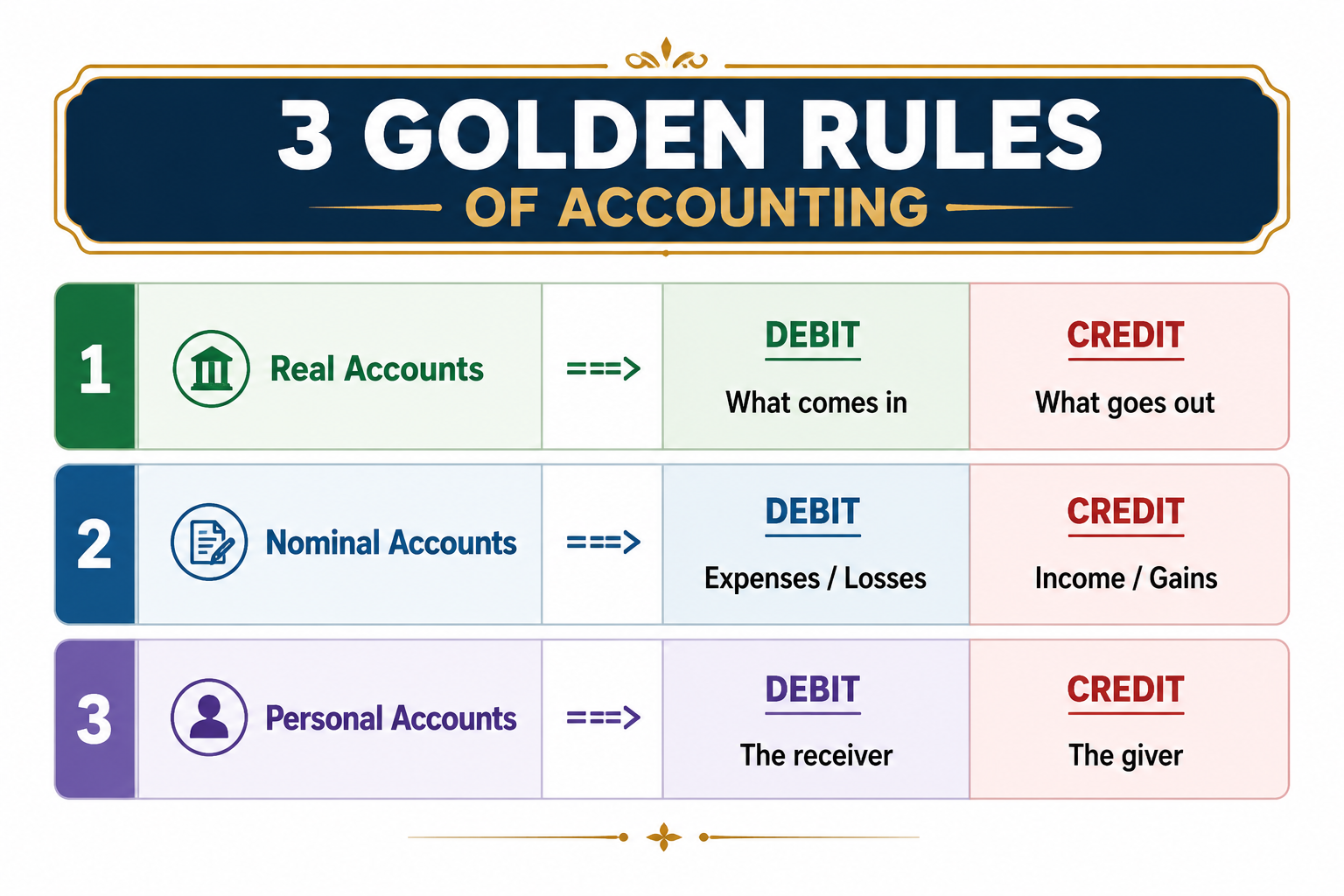
To record transactions without errors, you must understand the foundational concept of debits (Dr.) and credits (Cr.). In financial accounting, these terms simply indicate the left side (Debit) or right side (Credit) of a standard T-account.
The entry mechanism is governed by the 3 Golden Rules of Accounting:
Types of Accounts
To apply the Golden Rules accurately, an accountant must first look at a transaction and identify what type of account is being modified. Accounts are classified using two distinct frameworks: the Traditional Approach and the Modern Approach.
The Traditional Approach (3 Account Types)
Real Accounts: Accounts linked to physical assets, properties, or tangible possessions of a business. (Examples: Cash, Building, Inventory, Machinery).
Nominal Accounts: Accounts linked directly to temporary business operational transactions. (Examples: Salaries Expense, Rent Income, Sales Revenue, Printing Costs).
Personal Accounts: Accounts linked directly to individual people, specific legal entities, corporate vendors, or banking firms. (Examples: Accounts Receivable, Accounts Payable, Apex Corp, Bank Account).
The Modern Approach (5 Basic Accounts)
The modern accounting approach groups items directly based on how they alter the fundamental Accounting Equation:
Assets = Liabilities} + Equity
The balance direction of these five modern account types follows a clear, predictable pattern:
Modern Account Type | To Increase the Balance | To Decrease the Balance | Normal Balance Position |
Asset | Debit (Dr.) | Credit (Cr.) | Debit |
Liability | Credit (Cr.) | Debit (Dr.) | Credit |
Equity | Credit (Cr.) | Debit (Dr.) | Credit |
Income / Revenue | Credit (Cr.) | Debit (Dr.) | Credit |
Expense | Debit (Dr.) | Credit (Cr.) | Debit |
Journal Entries in Financial Accounting
A Journal is known as the book of original entry. It serves as a chronological diary where every financial transaction is first recorded using a double-entry format before moving anywhere else in the accounting system.
Here are the 7 core types of journal entries that every financial accounting student will encounter on a Semester 1 final exam.
1. Opening Entry
Used at the absolute start of a brand new financial year to transfer the closing balances of permanent assets, liabilities, and equity from the previous year's balance sheet into the new active ledger.
2. Purchase Entry
Records the acquisition of trading inventory or raw operational goods by the company.
Scenario: Purchased goods for cash worth $5,000.
Date | Particulars | Debit ($) | Credit ($) |
|---|---|---|---|
2026-01-05 | Purchases A/c................ Dr. | $5,000 | |
To Cash A/c................ (Being goods purchased for cash) | $5,000 |
3. Sales Entry
Records the outbound transfer of inventory or services to a customer in exchange for economic value.
Scenario: Sold goods for cash worth $8,000.
Date | Particulars | Debit ($) | Credit($) |
|---|---|---|---|
2026-01-06 | Cash A/c..................... Dr. | 8,000 | |
To Sales A/c............... (Being goods sold for cash) | 8,000 |
4. Credit Entry
Executed whenever goods are bought or sold on time-delayed billing terms without an immediate swap of physical cash.
Scenario: Sold goods to client John Doe on credit terms for $3,500.
Date | Particulars | Debit ($) | Credit($) |
|---|---|---|---|
2026-01-07 | John Doe (Accounts Rec.)..... Dr. | 3,500 | |
To Sales A/c............... (Being goods sold on credit terms) | 3,500 |
5. Cash Entry
Any transaction where physical currency or electronic bank clearing changes hands instantly during the operational step.
Scenario: Paid monthly office rent worth $2,000.
Date | Particulars | Debit ($) | Credit($) |
|---|---|---|---|
2026-01-08 | Rent Expense A/c............. Dr. | 2,000 | |
To Cash A/c................ (Being the monthly office rent paid) | 2,000 |
6. Adjustment Entry
Passed at the very end of an accounting period under accrual accounting rules to recognize unrecorded revenue or match expenses before compiling final reports.
Scenario: Salaries earned by workers but unpaid at month-end are worth $1,500.
Date | Particulars | Debit ($) | Credit($) |
|---|---|---|---|
2026-01-31 | Salaries Expense A/c......... Dr. | 1,500 | |
To Outstanding Salaries A/c. (Being adjusted entry for unpaid payroll) | 1,500 |
7. Closing Entry
Temporary nominal accounts (revenues and expenses) are closed out at the end of the year by migrating their total balances into the permanent Income Summary account, clearing their operational lines to zero for the upcoming year.
Standard Ledger Account T-Format
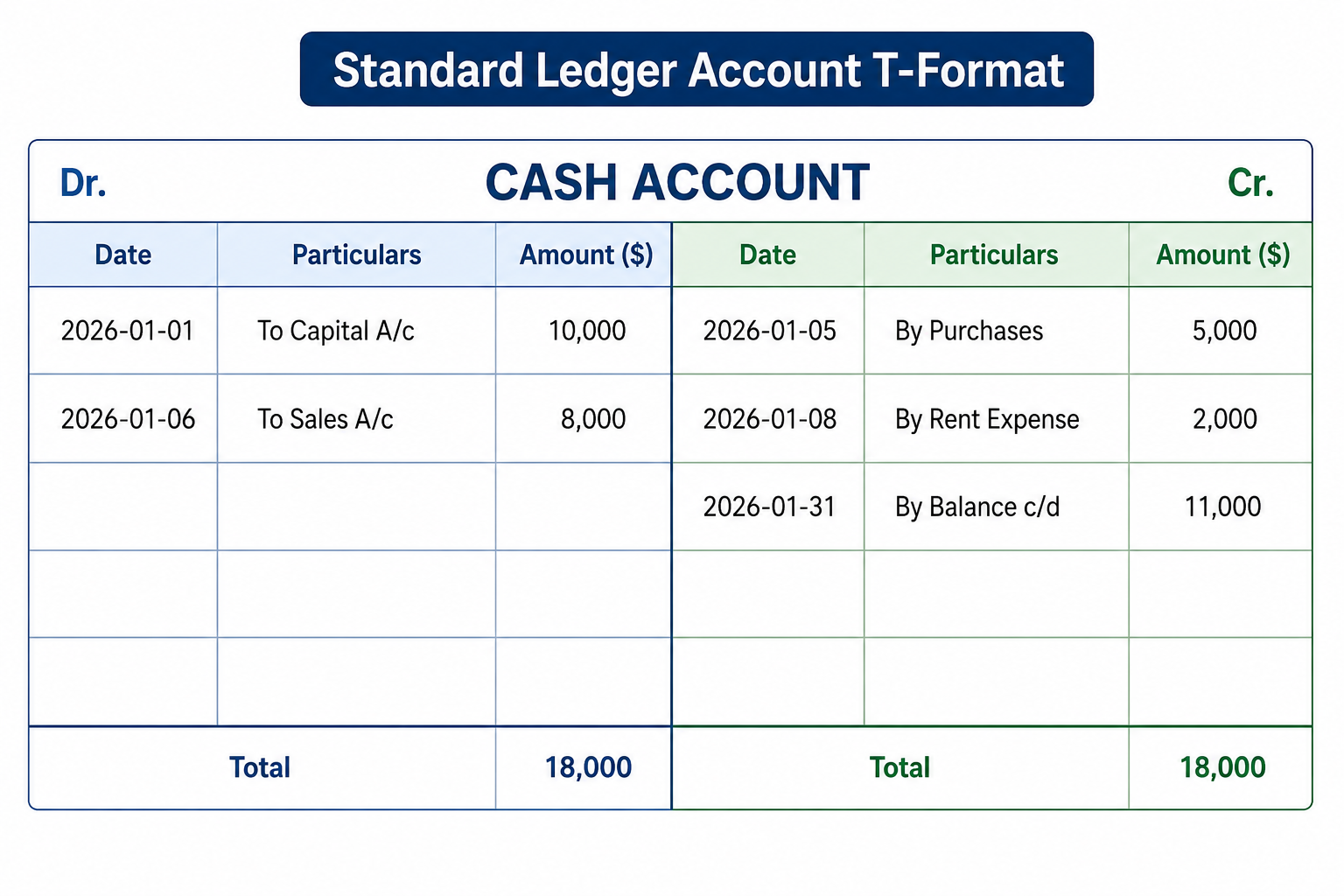
Posting ensures that instead of looking through hundreds of individual chronological journal pages, you can open a single ledger page to instantly see your total real-time cash balance, inventory metrics, or vendor tracking balances.
5 Steps of the Financial Accounting Cycle
The processing of financial metrics flows through a continuous loop known as the Accounting Cycle. While software now handles much of this tracking mechanically, understanding the core five steps is vital for structural auditing and academic exams.
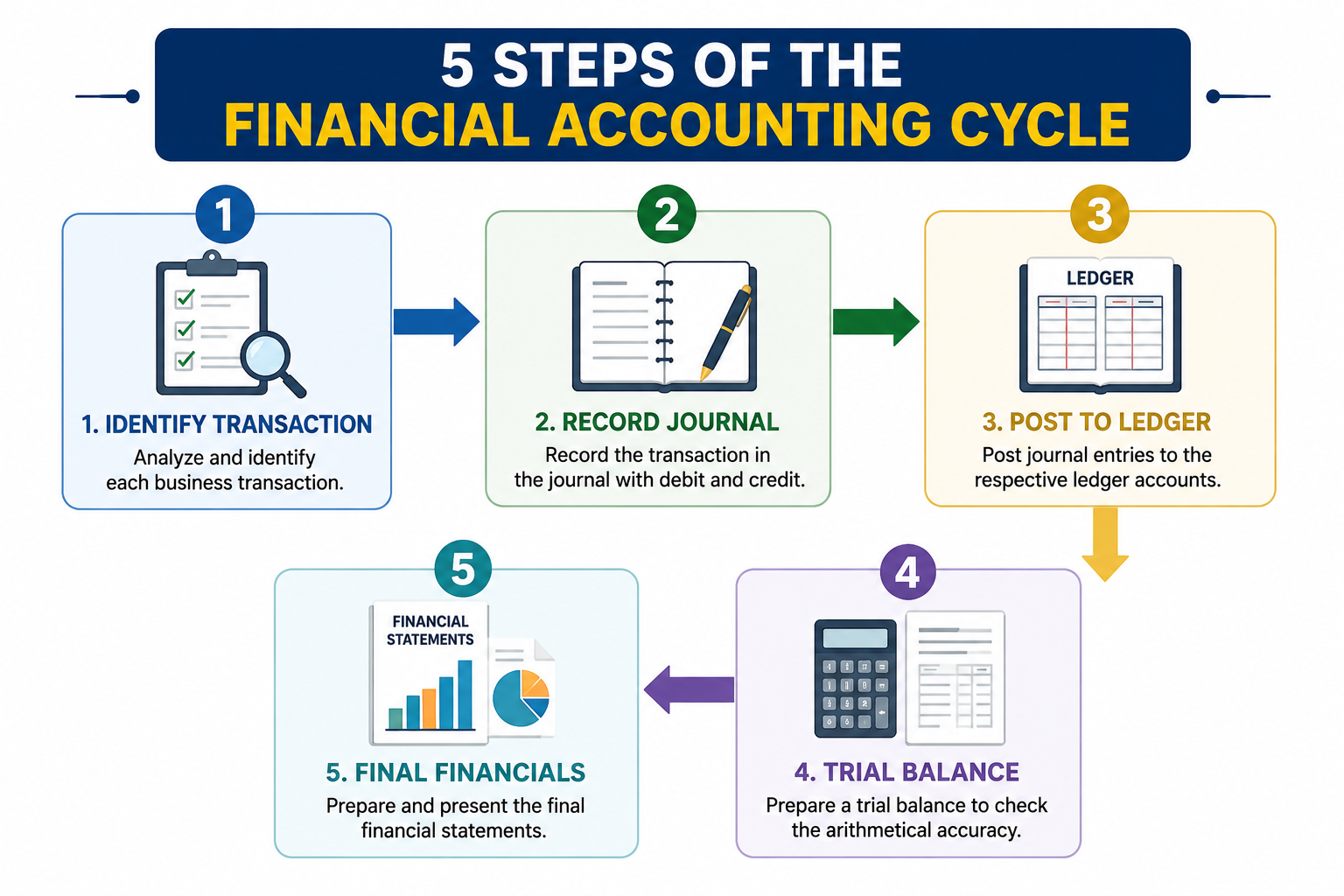
Step 1: Identify and Analyze Transactions: Gathering raw external business source documents, like vendor invoices, bank stubs, or point-of-sale logs—and verifying that an actual financial transaction occurred.
Step 2: Record in the Journal: Processing the transactions chronologically using standard debit and credit formatting rules.
Step 3: Post to the Ledger: Categorizing journal entries by shifting their values into their specific individual T-accounts.
Step 4: Prepare a Trial Balance: A checking step where all debit balances and credit balances from the general ledger are listed side-by-side. If the total debits do not match the total credits perfectly, a calculation or entry error occurred during the posting cycle.
Step 5: Adjust and Prepare Financial Statements: Passing final adjusting entries and publishing the formal, verified financial statements to external parties.
Financial Statements Overview
The entire accounting cycle builds toward a singular goal: compiling formal financial statements. These reports act as a corporate scorecard. To learn how these coordinate into high-level global audits, tracking via standardized IFRS reporting frameworks guarantees universal visibility across the industry.
Income Statement (Profit & Loss): Measures a company's financial performance over a specific period by subtracting expenses from revenues to reveal the net profit or loss.
Balance Sheet: A statement of financial position that acts as a snapshot taken on an exact date. It maps out the core accounting balance structure: Assets = Liabilities + Equity.
Cash Flow Statement: Tracks the physical movement of money into and out of the company across three specific operational areas: Operating Activities, Investing Activities, and Financing Activities.
Financial Accounting Step-by-Step Practical Example
Let's look at a concrete, practical example tracking the first month of a small business start-up.
The Business Transactions
Jan 1: John Smith starts a software company by depositing $20,000 cash into a business bank account.
Jan 3: Pays $4,000 cash to rent an office space for the month.
Jan 15: Delivers software consulting to a client and sends an invoice for $6,000 on credit.
Step 1: The Chronological Journal Entries
Jan 01 | Cash A/c......................... Dr To Capital Ac................. (Owner equity investment) | 20,000 | |
20,000 | |||
Jan 02 | Rent Expense A/c................. Dr To Cash A/c.................... 4,000 (Office rent paid in cash) | 4,000 | |
4,000 | |||
Jan 03 | Accounts Receivable A/c.......... Dr To Consulting Revenue A/c...... (Revenue recognized on credit terms) | 6,000 | |
6,000 |
Step 2: Extracting Ledger Balances
After opening the individual ledger pages and balancing the entries, the company extracts these final figures:
Cash Account: $20,000 - $4,000 = $16,000 (Debit Balance)
Accounts Receivable: $6,000 (Debit Balance)
Rent Expense: $4,000 (Debit Balance)
Capital Account: $20,000 (Credit Balance)
Consulting Revenue: $6,000 (Credit Balance)
Step 3: Compiling the Final Statements
First, we calculate the net performance on the Income Statement:
Revenue ($6,000) - Rent Expense ($4,000) = Net Income ($2,000)
Next, we map our assets, liabilities, and retained equity onto the closing Balance Sheet:
ASSETS | LIABILITIES & OWNER'S EQUITY |
Cash................. $16,000 | Liabilities.......... $ 0 |
Accounts Rec......... 6,000 | Capital.............. 20,000 |
TOTAL ASSETS......... $22,000 | Retained Earnings.... 2,000 |
TOTAL LIAB & EQUITY.. $22,000 |
The equation balances perfectly: $22,000 = $0 + $22,000.
Financial Accounting Syllabus
For students structured within university degree paths or international professional certifications, a benchmark Semester 1 Financial Accounting Syllabus breaks down into five key learning blocks. To see how these modules line up with continuous training paths, you can review our comprehensive financial accounting course framework for structured mentorship details.
Module 1: Foundational Framework: Accounting definitions, historical tracking concepts, GAAP vs. IFRS, and user intent.
Module 2: Recording Mechanism: The double-entry bookkeeping blueprint, identifying sources, drafting journal entries, ledger balancing, and cash book management.
Module 3: Rectification and Trial Balance: Building trial balances, tracking accounting errors, and executing adjusting entry lines.
Module 4: Valuation Methods: Calculating asset depreciation timelines (Straight-line vs. Diminishing value) and tracking inventory lines (FIFO, LIFO, Weighted Average).
Module 5: Statement Preparation: Compiling standalone Income Statements, Retained Earnings reports, and finalized Balance Sheets.
Financial Accounting Notes & PDF Resources
When studying for a final accounting examination, relying on large textbooks can slow down your progress during high-stress revision weeks.
Core Formulas to Memorize
Accounting Equation: Assets = Liabilities + Equity
Net Income: Gross Revenues - Total Expenses
Cost of Goods Sold (COGS): Beginning Inventory + Net Purchases - Ending
Inventory
Gross Profit: Net Sales - COGS
If you want to access comprehensive, summarized breakdown modules for quick revision sessions, you can download academic study notes containing direct sample templates, step-by-step T-accounts, and formula cheat sheets directly.
Financial Accounting Recommended Books
To build deep conceptual tracking over complex reporting transactions, add these authoritative academic references to your study layout:
“Financial Accounting” by Robert Libby, Patricia Libby, and Frank Hodge — Widely recognized as the premier university textbook for clear, real-world corporate case breakdowns.
“Financial Accounting: An Introduction to Concepts, Methods and Uses” by Roman L. Weil, Schipper, and Francis — Excellent for students preparing for advanced analyst positions or CPA pathways.
“Frank Wood’s Business Accounting” by Alan Sangster — The absolute global gold standard for mastering foundational double-entry bookkeeping workflows and manual journal systems.
Types of Financial Accounting
Financial accounting splits into specialized sub-disciplines based on the unique regulatory rules of different target entities. To protect your structural cash reporting workflows against localized filing errors, establishing a pipeline with corporate accounting and tax services provides complete structural security across your entire accounting footprint.
Corporate Financial Accounting: Standard commercial reporting tracking focused on generating statements for public and private market shareholders.
Public Accounting: Independent financial advisory firms and audit bureaus (such as the Big Four) that review and validate corporate statements to ensure absolute regulatory compliance.
Governmental Accounting: A specialized tracking system focused entirely on public fund allocation, tax receipt deployment, and budget control metrics under explicit governmental reporting standards.
Tax Financial Accounting: Focuses entirely on processing financial metrics to comply with state and national tax laws when filing annual returns, separating tax obligations from standard corporate accounting profits.
Importance of Financial Accounting
Without financial accounting, the modern global economy would collapse into complete operational chaos.
Establishing Investor Confidence
Public stock exchanges depend entirely on verified corporate disclosure. Financial accounting gives everyday retail investors and institutional funds the assurance that a company's data is verified, accurate, and reliable.
Securing Credit Lines and Loans
Commercial banks will never lend capital to a business based on verbal growth claims. They require formal financial records to evaluate a company's debt-service capabilities before approving loans.
Common Mistakes in Financial Accounting
When running calculations manually on homework sheets or inside company systems, watch out for these frequent mistakes:
Error of Omission: Forgetting to record a transaction entirely, causing cash and asset accounts to look lower than they actually are.
Error of Commission: Posting a correct journal entry to the wrong person's ledger account page (e.g., debiting Account Receivable John Doe instead of Jane Doe).
Error of Principle: Violating core accounting rules, such as accidentally recording a physical asset purchase (like a company van) as a standard repair expense. This error completely distorts your net profit figures.
Transposition Error: Accidentally reversing two numbers when typing out entries (e.g., writing $5,400 as $4,500). These errors can be identified early because the variance is always cleanly divisible by 9.
Frequently Asked Questions
What is meant by financial accounting?
Financial accounting is a structured branch of bookkeeping that records, summarizes, and reports a company's historical financial transactions to external stakeholders via standardized statements.
What are 7 journal entries?
The seven primary journal entry categories used in standard accounting systems are Opening Entries, Purchase Entries, Sales Entries, Credit Entries, Cash Entries, Adjustment Entries, and Closing Entries.
What are the 5 steps of financial accounting?
The five core phases of the accounting cycle are: Identifying business source transactions, recording entries in the journal, posting data to general ledgers, preparing an initial trial balance, and compiling finalized financial statements.
What are the 5 basic accounting principles?
The five foundational pillars of financial reporting are the Going Concern Principle, the Accrual Concept, the Consistency Principle, the Prudence Principle, and the Matching Principle.
What are the 3 type of accounts?
Under the traditional accounting approach, accounts are classified into three types: Real Accounts (assets), Nominal Accounts (revenues/expenses), and Personal Accounts (individuals/entities).
What are the 3 golden rules?
The three golden rules of double-entry bookkeeping are: Debit what comes in, credit what goes out (Real); Debit expenses and losses, credit income and gains (Nominal); and Debit the receiver, credit the giver (Personal).
What are the 4 types of journals?
The four specialized subsidiary journals used to separate high-volume repetitive tracking entries are the Sales Journal, the Purchases Journal, the Cash Receipts Journal, and the Cash Disbursements Journal.
What is a general ledger?
A general ledger is the master financial record book that aggregates all individual chronological journal entries into sorted, dedicated T-account pages.
Conclusion
Mastering financial accounting basics requires a clear understanding of its foundational elements: identifying account types, applying the three golden rules of double-entry bookkeeping, and following the complete five-step accounting cycle.
Whether you are studying for a university exam or auditing a growing corporate entity, look past the raw numbers. Focus on the core principles of matching and accruals to protect your business records from costly errors.
Consistency is key in accounting. Set aside time to practice manual double-entry entries every week to build the intuitive analytical skills required for long-term professional success.