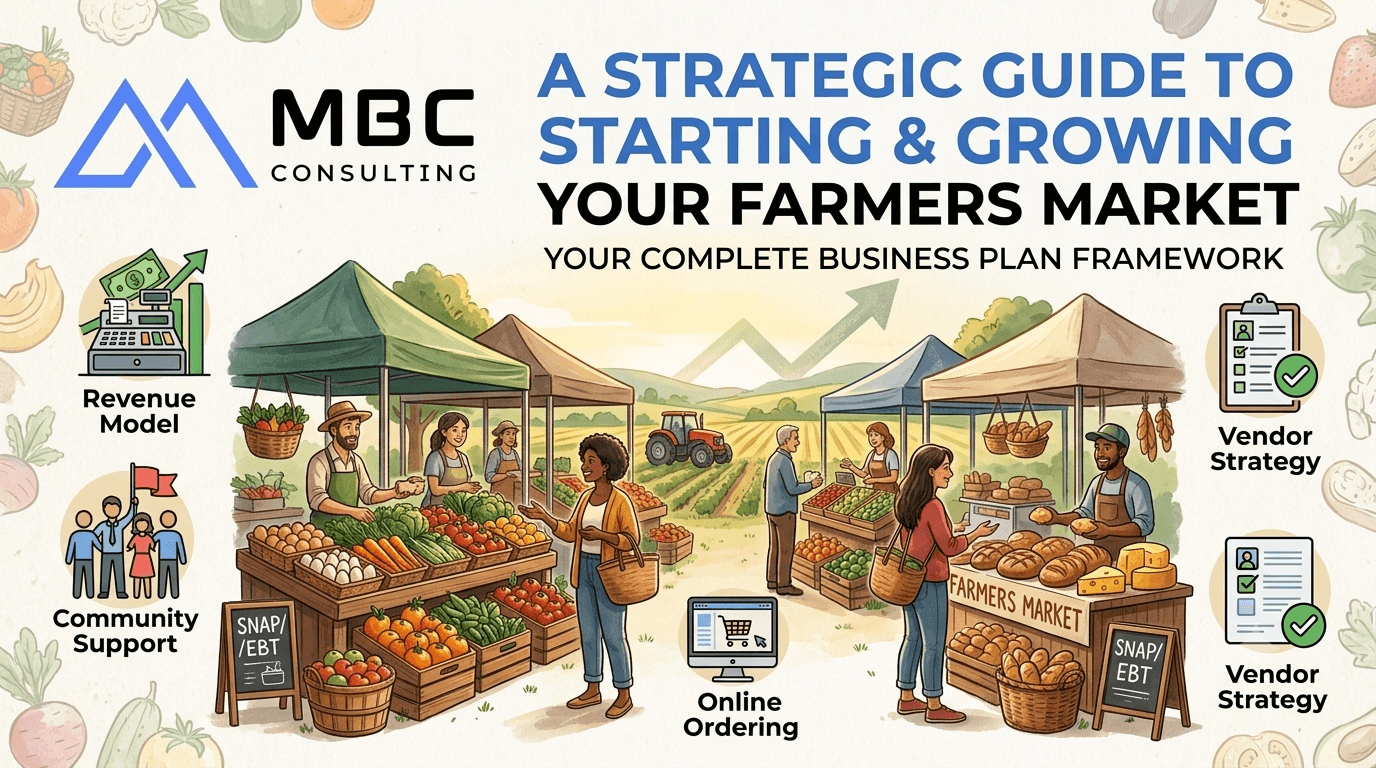
Introduction
Starting a farmers market is one of the most rewarding small business ventures in the United States, combining entrepreneurship, community building, and support for local agriculture into a single operation. But without a solid farmer market business plan, even the most well-intentioned market can fail before its first season ends.
This guide covers everything you need: what a farmers market is, how to start one, how to write a complete farming business plan, and real-world examples that reflect actual startup costs, revenue models, and vendor management strategies. Whether you are an entrepreneur, a farmer, a city official, or a community organizer, this is the most comprehensive resource available.
Quick Answer: A farmer market business plan is a written document that defines your market's concept, target customers, vendor strategy, startup costs, revenue model, and marketing approach. It is essential for securing funding, permits, and long-term operational success.
KEY TAKEAWAYS
• A farmers market business plan is required by most lenders, grant programs, and municipal permitting offices
• Startup costs in the US typically range from $5,000 to $50,000, depending on location, scale, and infrastructure needs
• Revenue streams include vendor fees, stall rentals, event income, sponsorships, and membership programs
• Vendor recruitment and retention is the single most critical operational challenge in year one
• Local SEO, Google Business Profile, and community partnerships are the highest-ROI marketing strategies for new markets
• Farmers' markets contribute significantly to local economies, every dollar spent recirculates 2–3x within the community
What is a farmers' market?
A farmers' market is a physical retail market, held on a regular schedule in a public or semi-public space, where local farmers, food producers, and artisan vendors sell directly to consumers. It is a direct-to-consumer sales model that removes the traditional grocery supply chain middleman, allowing both producers and buyers to benefit from fair pricing and freshness.
In the US, farmers' markets are regulated at the state and local level. They range from small weekly neighbourhood gatherings of 10–20 vendors to major year-round public markets with hundreds of stalls and thousands of daily visitors.
Types of Farmers Markets
• Community Markets: Neighborhood-level, typically weekly, 10–40 vendors. Emphasis on relationship-building and hyper-local produce.
• Seasonal Markets: Operate during specific seasons (spring through fall). Common in colder US states. Vendor count varies widely.
• Public Markets: Large permanent or semi-permanent structures (like Pike Place in Seattle or Eastern Market in DC). Year-round operation. Require significant infrastructure investment.
• Speciality Farmers Markets: Focus on specific categories, organic only, heritage breed meats, artisan foods, or specific cultural cuisines.
Farmers Market vs. Grocery Store
Factor | Farmers Market | Grocery Store |
Freshness | Harvested 24–48 hours before sale | Shipped 3–14 days in advance |
Price Transparency | Direct from the producer, full traceability | Multiple supply chain layers |
Product Variety | Seasonal, regional, unique varieties | Year-round standardized inventory |
Economic Impact | 80–90% stays local | 15–30% stays local (corporate chains) |
Community Connection | High direct farmer-to-consumer dialogue | Low anonymous transaction |
Business Model | Vendor fee/stall rental model | Retail margin model |
Entered graphics
Farmers Market Industry Overview
The US farmers market industry has grown dramatically over the past two decades, driven by rising consumer demand for fresh produce, local food systems, and farm-to-table dining culture. According to the USDA, the number of registered farmers' markets in the US grew from 1,755 in 1994 to over 8,600 by the early 2020s, a nearly 5x increase.
Current Market Trends
• Health and Wellness: Post-pandemic consumer behaviour has accelerated demand for organic goods, minimally processed foods, and transparent food supply chains.
• Direct-to-Consumer Sales Growth: Farm-to-table and direct-to-consumer sales channels now represent a significant and growing share of US farm revenue.
• Technology Integration: Markets are increasingly adopting digital payment systems (Square, Stripe), online vendor portals, and social media marketing.
• Urban Market Growth: Farmers' markets in metropolitan US cities (New York, Los Angeles, Chicago, Austin) have seen some of the strongest growth, driven by high foot traffic and health-conscious consumer demographics.
Future Growth Opportunities
• CSA (Community Supported Agriculture) integration alongside market operations
• Year-round covered market infrastructure investment in northern states
• SNAP/EBT acceptance expands market accessibility and federal grant eligibility
• Agri-tourism partnerships and on-farm market events
Challenges in the Industry
• Weather dependency for outdoor seasonal markets
• Vendor recruitment and retention, especially in competitive metro areas
• Municipal permitting complexity and zoning restrictions
• Rising real estate and space rental costs in urban markets
Entered graphics
Why Start a Farmers Market Business?
Revenue Potential
A well-run farmers' market can generate between $50,000 and $500,000 or more in annual revenue, depending on size, location, and season length. Revenue comes from multiple streams: vendor booth fees, stall rentals, event hosting, corporate sponsorships, advertising partnerships, and membership programs. A market with 50 vendors charging $30–$75 per booth per market day can generate $1,500–$3,750 per event before additional revenue streams.
Community Benefits
Farmers' markets serve as community anchors, places where neighbours gather, local identity is reinforced, and social capital is built. Studies from the USDA and various land-grant universities consistently show that markets improve public space utilization, increase foot traffic for surrounding businesses, and strengthen local food systems.
Support for Local Farmers
For small and mid-scale US farmers, direct-to-consumer sales at a farmers' market often generate 30–50% higher margin than wholesale distribution. Markets give farmers a direct sales channel, real-time consumer feedback, and the ability to test new products without major retail risk.
Sustainable Food Ecosystem
A functioning farmers' market reduces food miles, supports sustainable agriculture practices, and builds the local food supply chain resilience that became visibly important during the 2020 supply chain disruptions. Agricultural entrepreneurship at the local market level is foundational to regional food security.
Benefits of Shopping at a Farmers Market
Understanding why consumers choose farmers' markets helps market operators make smarter marketing and vendor decisions. The benefits that drive repeat customer behaviour are:
• Fresher Produce: Fruits and vegetables sold at farmers' markets are typically harvested within 24–48 hours of sale, compared to produce that may spend 7–14 days in transit and cold storage before reaching a grocery store shelf.
• Better Product Transparency: Shoppers can ask farmers directly about growing methods, pesticide use, animal welfare practices, and harvest dates. This level of transparency is impossible at a standard grocery store.
• Supporting Local Businesses: Every dollar spent at a farmers' market stays predominantly within the local economy. Consumer research consistently shows that mission-driven purchasing supporting neighbours and local farmers is a primary motivation for farmers' market shoppers.
• Seasonal Variety: Farmers' markets introduce consumers to heirloom varieties, seasonal produce, and speciality items (like ramps, fiddleheads, or speciality chilli peppers) that never appear in standard grocery inventory.
• Economic Benefits for Communities: Markets increase foot traffic for surrounding retail and restaurant businesses, raise local property values, and create direct and indirect employment for vendors, staff, and supporting services.
How to Start a Farmers Market Business — Step-by-Step
Starting a farmers market involves navigating business registration, location scouting, vendor recruitment, legal compliance, and community building simultaneously. Here is the practical roadmap:
1. Conduct Market Research: Survey your target community. Identify competing markets within your geography, their vendor counts, days of operation, and attendance. Determine whether the local consumer demand justifies a new market entry.
2. Identify Your Target Customers: Define your primary shopper demographics, families, health-conscious millennials, restaurant buyers, and seniors. Your vendor mix and marketing strategy should align directly with your target audience profile.
3. Choose the Right Location: Look for high-foot-traffic, publicly accessible sites, parks, parking lots, town squares, or vacant commercial spaces. Evaluate parking access, electrical infrastructure, shade, and proximity to complementary businesses (coffee shops, bakeries).
4. Create a Business Structure: Most US farmers' markets operate as nonprofits (501(c)(3) or 501(c)(6)), cooperatives, or LLCs. Each structure has different tax implications, grant eligibility, and liability protections. Consult with a US business attorney before registering.
5. Register Your Business and Obtain Licenses: Register with your state's Secretary of State office, obtain a federal EIN, and acquire any required local business licenses. Health permits, temporary food establishment licenses, and state agricultural market licenses may also be required, depending on your state.
6. Obtain Location-Specific Permits: Many markets operate on public land requiring municipal permits and liability insurance. Obtain general liability insurance (minimum $1–2 million coverage) before opening day.
7. Build Vendor Partnerships: Begin recruiting vendors 3–6 months before launch. Prioritize local farmers first (they are the core credibility of your market), then expand to artisan food producers, prepared foods, and non-food vendors.
8. Develop Market Rules and Vendor Agreements: Create a vendor handbook covering product eligibility, booth requirements, payment terms, cancellation policy, and code of conduct. Clear rules prevent disputes and protect market integrity.
Entered Graphics
Farmer Market Business Plan Framework
A complete farmer market business plan follows a structure that satisfies both investors and municipal grant programs. Here is the full framework with what belongs in each section:
Executive Summary
A 1–2 page overview of your entire plan. Write this last. It should cover: what your market is, where it will be located, who it serves, how it generates revenue, and what funding or support you need. This is the first, and sometimes only, section a grant committee or lender will read. Make it count.
Company Overview
Describe your market's legal structure, founding team, location, operating schedule (days, times, season), and organizational mission. Include your business registration details and any existing community partnerships.
Mission and Vision
Example mission statement: 'To create an accessible, vibrant community marketplace that connects local farmers and artisan producers directly with [City Name] residents while supporting sustainable agricultural entrepreneurship and regional food systems.'
Market Analysis
Include your competitive analysis (competing markets in your area), consumer demand data, local demographics, and market size estimates. Reference USDA data, local census information, and any primary research you conducted (surveys, community meetings).
Vendor Acquisition Plan
Detail how you will recruit, vet, and retain vendors. Specify your vendor mix targets (e.g., 60% produce farms, 20% artisan foods, 20% prepared foods and non-food vendors), your application process, booth fee structure, and how you will handle vendor disputes.
Marketing Strategy
Cover your digital marketing plan (Google Business Profile, social media channels, email list), local PR strategy, community partnerships, and seasonal promotion calendar. Quantify goals where possible (target follower count, target email subscribers by launch, first-season attendance goals).
Operational Plan
Define your physical site layout, staffing requirements, equipment needs, vendor check-in process, customer flow management, security plan, and weather contingency policies. Include your opening and closing procedures.
Financial Plan
This is the most scrutinized section by investors and grant committees. Include a startup cost breakdown, a monthly operating budget, revenue forecasts by stream (vendor fees, events, sponsorships), break-even analysis, and a three-year profitability timeline.
Market Analysis for a Farmers' Market
Target Audience Segmentation
Customer Segment | % of Shoppers | Primary Motivation | Marketing Channel |
Health-Conscious Millennials (25–40) | 35% | Organic, sustainable, transparent | Instagram, TikTok, Email |
Families with Children | 25% | Fresh produce, educational experience | Facebook, Community boards |
Seniors (60+) | 20% | Tradition, social connection, freshness | Local newspaper, flyers, radio |
Restaurant Buyers | 10% | Speciality ingredients, relationships | Direct outreach, LinkedIn |
Tourists & Occasional Shoppers | 10% | Experience, local culture, souvenirs | Google Maps, TripAdvisor, signage |
SWOT Analysis
| Positive | Negative |
Internal | STRENGTHS: Community goodwill, low overhead vs brick-and-mortar, recurring vendor revenue, mission-driven brand | WEAKNESSES: Weather dependency, vendor retention challenges, seasonal revenue volatility, and limited operating hours |
External | OPPORTUNITIES: Growing demand for local food, SNAP/EBT expansion, agri-tourism, event revenue, and grant funding | THREATS: Competing markets, rising permit costs, inflation impact on vendor margins, and economic downturns, reducing discretionary spending |
Products You Can Find and Sell at a Farmers Market
The vendor mix is the product mix of your market. A well-balanced vendor selection drives repeat shopper visits by ensuring customers can complete a meaningful portion of their weekly grocery and speciality shopping in one stop.
Core Product Categories
• Fresh Fruits and Vegetables: The heart of any farmers market. Prioritize local, seasonal produce. Aim for at least 5–8 distinct farm vendors in this category.
• Dairy Products: Artisan cheese, butter, eggs, and small-batch yoghurt. Dairy vendors require specific health permits to verify state dairy licensing requirements.
• Meat and Poultry: Grass-fed beef, heritage breed pork, free-range chicken, and wild game (where legal). Cold storage and USDA inspection requirements apply.
• Organic and Speciality Goods: Certified organic produce commands premium pricing and attracts health-focused shoppers. Certify your market's organic vendor section if possible.
• Handmade and Artisan Products: Soap, candles, handmade textiles, ceramics, and woodwork. Limit non-food vendors to 20–30% of the total booth count to maintain market identity.
• Artisan Foods: Baked goods, preserves, hot sauces, speciality oils, honey, and fermented products. One of the highest-revenue vendor categories per square foot.
• Prepared Foods and Ready-to-Eat: Freshly prepared ethnic foods, sandwiches, juices, and coffee. Drive dwell time and event-day atmosphere.
Farmers Market Revenue Model
Understanding your revenue streams is essential before finalizing your business plan's financial section. Farmers' markets have more revenue diversity than most first-time operators expect:
Revenue Stream | How It Works | Typical Annual Range | Notes |
Vendor Booth Fees | Daily or seasonal fee per vendor stall | $15,000–$120,000 | Primary revenue. Scale with vendor count and market frequency. |
Stall Rental (Premium) | Premium placement fees for corner or high-traffic spots | $2,000–$15,000 | Charge 20–30% premium for best locations. |
Corporate Sponsorships | Local businesses sponsor the market or events | $3,000–$30,000 | Target banks, health food brands, local restaurants. |
Event Revenue | Cooking demos, festivals, live music, holiday events | $2,000–$25,000 | High-margin. Drive off-season and shoulder-season income. |
Advertising | Banner placement, social media shoutouts, newsletter ads | $1,000–$10,000 | Secondary stream. Grows with audience size. |
Membership Programs | Shopper loyalty programs or vendor annual contracts | $1,000–$8,000 | Predictable recurring revenue. Improves retention. |
Startup Costs and Financial Planning
Financial planning is one of the most important parts of any farmer market business plan and is required by virtually every lender, grant program, and municipal authority that evaluates new market applications. Be thorough, realistic, and conservative in your projections.
Startup Cost Breakdown
Cost Category | Low Estimate | High Estimate | Notes |
Location / Space Rental Deposit | $500 | $5,000 | Public space permits often have a lower cost; private lot leases are higher |
Business Registration & Legal Fees | $300 | $2,000 | Includes attorney fees for structure choice and vendor contract templates |
Insurance (General Liability) | $800 | $2,500/yr | Minimum $1M coverage recommended for US markets |
Infrastructure (Tents, Tables, Signage) | $2,000 | $15,000 | Scale with market size; many vendors bring their own tents |
Technology (POS, Website, Email) | $500 | $3,000 | Square for markets + basic WordPress site + Mailchimp |
Marketing & Pre-Launch Promotion | $500 | $5,000 | Social ads, print materials, community outreach |
Working Capital (First 90 Days) | $1,000 | $10,000 | Operating buffer before consistent vendor revenue begins |
Miscellaneous / Contingency (10%) | $500 | $4,000 | Always build a contingency buffer into your plan |
TOTAL STARTUP COST ESTIMATE | $6,100 | $46,500 | Most small community markets launch for $10,000–$25,000 |
Revenue Forecast Example Year 1 (30-Vendor Weekly Market, 26 Weeks)
Revenue Stream | Calculation | Year 1 Total |
Vendor Booth Fees | 30 vendors × $40/day × 26 market days | $31,200 |
Premium Stall Placement | 5 premium spots × $15 premium × 26 days | $1,950 |
Corporate Sponsorship | 2 sponsors × $2,500 | $5,000 |
Event Revenue | 4 special events × $1,500 net | $6,000 |
TOTAL YEAR 1 REVENUE |
| $44,150 |
TOTAL YEAR 1 OPERATING COSTS | Staff, permits, marketing, insurance, misc. | ~$28,000 |
YEAR 1 NET INCOME (PROJECTED) |
| ~$16,150 |
Financial Planning Note: These projections assume consistent vendor attendance and average weather. Build a 15–20% weather/cancellation buffer into all financial forecasts. Most markets take 2–3 seasons to reach stable profitability as vendor networks and shopper habits develop.
Entered Graphics
Marketing Strategies for Farmers Markets
The most successful US farmers' markets combine hyperlocal community marketing with modern digital channels. Here is the highest-ROI marketing stack for a new market:
Local SEO Strategy
Your Google Business Profile is your single most important digital marketing asset. Claim and fully optimize your profile with accurate hours, location, photos of vendors and produce, and regular posts. Target local search terms like 'farmers market near me,' '[City] farmers market,' and 'fresh produce [City].' Create location-specific website pages for each market location and season.
Social Media Marketing
Instagram and Facebook are the primary channels for US farmers' markets. Post vendor spotlights weekly, seasonal produce features, market day behind-the-scenes content, and customer testimonials. Short-form video (Instagram Reels, TikTok) showing market atmosphere drives the highest organic reach. Target 3–5 posts per week during market season.
Email Marketing
Build an email list from day one. Offer a simple incentive (early vendor announcements, first-to-know about seasonal specials) to drive sign-ups at the market and online. Send a weekly newsletter during market season with that week's featured vendors, seasonal produce availability, and upcoming events. Email consistently delivers the highest conversion rate for repeat market visits.
Community Partnerships
Partner with local restaurants, food bloggers, nutritionists, fitness studios, and schools. Restaurant partnerships are especially powerful. Chefs who source from your market will market it for free to their customers. School field trip programs and cooking demonstrations build community trust and attract media coverage.
Seasonal Promotions
Plan a marketing calendar around your region's agricultural seasons: spring planting and asparagus; summer tomatoes, corn, and berries; fall apple season, harvest festivals, and pumpkins; holiday markets. Seasonal urgency ('only available this week') is one of the most effective drivers of impulse visits and social sharing.
Entered Graphics
Vendor Recruitment Strategy
Your vendor base is your market's product mix, reputation, and financial engine. Weak vendor recruitment is the number one reason new farmers' markets fail in their first two seasons.
Finding Local Farmers
Contact your state's Department of Agriculture for a list of licensed farms in your region. Attend regional agricultural fairs and farm bureau meetings. Connect with your state's land-grant university cooperative extension office — extension agents often have direct relationships with dozens of local farmers looking for new sales channels.
Vendor Qualification Process
Create a simple application form that captures: business name, products sold, production scale, certifications (organic, USDA, etc.), insurance status, and references. Require proof of any relevant food handler certifications. Make your qualification process thorough but not onerous; overly complex applications will discourage small farm applicants.
Vendor Retention Plan
Retention is more cost-effective than recruitment. Provide vendors with monthly market performance data (attendance counts, foot traffic, anecdotal feedback). Host a vendor appreciation event at the end of each season. Create a vendor advisory council, a small group of senior vendors who meet quarterly with market management. Giving vendors ownership over market direction dramatically improves retention rates.
Building Long-Term Partnerships
Offer multi-season vendor contracts with locked-in pricing to your best performers. Develop a referral program where existing vendors receive booth credit for recruiting new qualifying vendors. Consider a tiered vendor classification system that rewards long-term vendors with priority booth placement and reduced fees.
Operations and Market Management
Site Layout Planning
Design your market layout to optimize customer flow. Place the most popular produce vendors (fresh fruits, vegetables) toward the back of the market to draw shoppers past other vendors. Position prepared food and coffee vendors near the entrance to attract impulse visitors. Ensure ADA-compliant pathways (minimum 5-foot clear aisles) throughout.
Staffing Requirements
A small market (20–40 vendors) typically requires: one market manager, 1–2 setup crew, a cashier or fee collector, and 1–2 floaters for customer assistance and vendor support. As your market grows, consider adding a vendor relations coordinator and a dedicated social media/marketing staff member.
Security and Compliance
Require all vendors to carry their own product liability insurance (minimum $500K) and name the market as an additional insured. Conduct periodic compliance checks to ensure vendors sell only approved, permitted products. Have a documented incident response protocol for food safety complaints, accidents, and weather emergencies.
Real-World Example: Understanding a Farmers Market Business in Action
Let's walk through a realistic launch scenario for a mid-size US community farmers' market:
Market Setup: Green Valley Community Farmers Market
• Location: Municipal parking lot, 12,000 sq ft — [Small City, Midwest USA]
• Operating Schedule: Saturday mornings, 7 am–12 pm, May through October (26 market days)
• Vendor Count at Launch: 28 vendors (18 produce farms, 6 artisan food, 4 prepared food)
• Booth Fee: $35/day flat rate; $45/day premium corner spots
• Legal Structure: 501(c)(3) nonprofit eligible for USDA Farmers Market Promotion Program (FMPP) grants
Year 1 Financial Snapshot
• Total Vendor Revenue: $26,040 (28 vendors × avg $35.73/day × 26 days)
• Sponsorship Income: $4,500 (local bank + regional grocery co-op + health food brand)
• Event Revenue: $3,200 (3 seasonal events: spring kickoff, midsummer festival, fall harvest)
• Year 1 Total Revenue: $33,740
• Year 1 Total Operating Costs: $21,500
• Year 1 Net Operating Surplus: $12,240
Customer Growth Example
The market averaged 280 visitors per market day in its first month. By week 10, consistent word-of-mouth, Instagram growth to 1,200 followers, and a feature in the local newspaper pushed average attendance to 520 visitors per day. By the end of Year 1, the market had a waitlist of 11 vendor applicants for Year 2.
Expert Insight: The Green Valley example reflects a realistic scenario for a well-planned, nonprofit-structured community market in a mid-size US city. Markets in major metro areas (NYC, LA, Chicago) command significantly higher vendor fees ($75–$200/day) and attendance, but also face much higher startup and operating costs.
Farmers Market Business Plan Template
Use this section-by-section template framework to build your own farmer market business plan. Each section includes the minimum required content to satisfy grant reviewers, lenders, and municipal permit offices.
Section | Minimum Content Required | Target Length |
Executive Summary | Market concept, location, revenue model, funding need, mission | 1–2 pages |
Company Overview | Legal structure, founding team, operating schedule, business registration | 1 page |
Market Analysis | Local competitor map, consumer demographics, demand data, SWOT | 2–3 pages |
Vendor Acquisition Plan | Vendor mix targets, recruitment strategy, application process, and fee structure | 1–2 pages |
Marketing Strategy | Digital channels, local partnerships, event calendar, first-year goals | 2 pages |
Operational Plan | Site layout, staffing, vendor management, compliance, safety protocols | 2–3 pages |
Financial Plan | Startup costs, Year 1–3 projections, break-even analysis, funding sources | 3–5 pages |
Farm Business Plan Examples
Beyond the market operator plan, individual vendors may need their own farm business plan for bank financing, USDA loan programs, or FSA farm operating loans. Here are the key plan types:
Small Farm Business Plan Example PDF
A small farm business plan covers the farm's production model, acreage, crop or livestock mix, capital equipment needs, labour requirements, and direct-to-consumer and wholesale sales strategy. Typically, 10–20 pages for financing purposes. USDA's Farm Service Agency and many state agriculture departments offer free templates.
Vegetable Farm Business Plan PDF
A vegetable farm plan should specify crop rotation schedule, planting calendar, yield projections per acre, equipment needs (irrigation, tractors, cold storage), harvest and post-harvest handling, and market channels (farmers market, CSA, restaurant, wholesale, grocery).
Livestock Farming Business Plan Sample PDF
Livestock plans must address herd size, breeding program, feed sourcing and costs, veterinary care budget, housing and infrastructure, waste management compliance, and both direct-sale and wholesale revenue projections. USDA regulations and state livestock laws must be addressed explicitly.
Agriculture Business Plan Template Free
Free agricultural business plan templates are available from the USDA Farm Service Agency (fsa.usda.gov), your state's SBDC (Small Business Development Centre), and SCORE (score.org). These templates are designed to meet lender and government grant requirements for US farm and market operations.
Entered graphics
Common Mistakes in Farmers Market Planning
• Poor Market Research: Launching a market in an area already served by a well-established competitor without a meaningful differentiation strategy. Always map competing markets within a 10-mile radius before committing.
• Weak Vendor Recruitment: Opening with too few vendors (fewer than 15–20) creates a sparse atmosphere that discourages repeat visits. Secure vendor commitments before setting your opening date.
• Underestimating Costs: First-time operators consistently underestimate insurance, permit, and infrastructure costs. Use the startup cost breakdown in Section 10 and add a 20% contingency.
• Ineffective Marketing: Relying solely on word-of-mouth or one social media channel. A multi-channel approach (Google, Instagram, email, and local media) is required to build market-season attendance.
• Lack of Financial Planning: Operating without a written budget, revenue forecast, or break-even timeline. Without a financial plan, cash flow surprises in mid-season can force markets to close prematurely.
• Ignoring Vendor Retention: Focusing entirely on acquiring new vendors while neglecting existing ones. Turnover is expensive and disrupts the shopper experience. Invest in vendor satisfaction from day one.
Why Farmers' Markets Matter to Local Communities
Economic Development
Studies from the USDA Economic Research Service and various US universities show that farmers' markets generate significant economic multiplier effects. Every dollar spent at a farmers market circulates 2–3 times within the local economy before leaving, compared to roughly 1.5 times for dollars spent at chain retailers. Markets also anchor commercial corridors, increasing adjacent retail sales on market days.
Food Security
Farmers' markets expand access to fresh produce in food-insecure communities, particularly when they accept SNAP/EBT payments and participate in programs like Double Up Food Bucks (which doubles the value of SNAP dollars spent on fresh produce). Markets that operate in food deserts can meaningfully improve community nutrition outcomes.
Local Job Creation
A single farmers market with 40 vendors supports direct employment for vendors, farm workers, and market staff, often 80–120 direct and indirect jobs in a single growing season. This agricultural entrepreneurship ripple effect is one of the most cited economic arguments for municipal support of local markets.
Sustainable Agriculture
Markets create a reliable revenue channel for farmers practising sustainable agriculture, regenerative farming, and organic production practices that are often economically unviable at commodity-scale wholesale prices. The premium pricing available at direct-to-consumer markets makes sustainable practices financially viable for small and mid-scale US farms.
FREQUENTLY ASKED QUESTIONS
What is a farmers' market?
A farmers' market is a direct-to-consumer retail market held on a regular schedule, typically weekly, where local farmers, food producers, and artisan vendors sell products directly to shoppers. It operates as a marketplace where the market operator manages the space and vendors pay booth fees, while maintaining a curated, locally-sourced product mix.
What are the benefits of shopping at a farmers' market?
Key benefits include fresher produce (harvested 24–48 hours before sale), full supply chain transparency (you can ask the farmer directly), support for the local economy, access to seasonal and speciality varieties unavailable at grocery stores, and the community experience of shopping in a vibrant outdoor or indoor market environment.
How do I start a farmers' market?
Starting a farmers market requires: conducting market research, selecting a location, forming a legal business entity, obtaining permits and insurance, recruiting vendors, creating market rules, and building a pre-launch marketing campaign. Most successful US markets take 6–12 months of planning before their first market day. A detailed farmer market business plan is the essential first step.
What products can I find at a farmers' market?
A well-curated US farmers market typically offers: fresh fruits and vegetables, dairy products (cheese, eggs, butter), meat and poultry, artisan baked goods, preserves and speciality foods, handmade non-food products, prepared foods and beverages, honey, and locally grown flowers and herbs. Product availability varies by season and region.
Why are farmers' markets important to the local community?
Farmers markets strengthen local food systems, support agricultural entrepreneurship, create direct and indirect employment, improve access to fresh produce (especially in underserved communities), and generate economic multiplier effects. Every dollar spent at a farmers market recirculates 2–3 times in the local economy, significantly higher than dollars spent at chain retailers.
How much does it cost to start a farmers' market?
Startup costs for a small US community farmers' market typically range from $6,000 to $46,500, depending on scale, location, and infrastructure. Most small community markets launch successfully for $10,000–$25,000. The largest cost variables are location/permit fees, infrastructure (tents, signage, tables), insurance, and pre-launch marketing.
Is a farmers' market profitable?
Yes, a well-managed farmers' market can be profitable. A 30-vendor market operating 26 weeks per year at $35–$40/day per vendor generates approximately $27,000–$31,000 in booth fees alone. With sponsorships and events added, Year 1 revenue of $35,000–$50,000 is achievable for a well-planned market, with operating costs of $20,000–$30,000 for a small operation.
How do farmers' markets make money?
Farmers' markets generate revenue through: vendor booth fees (primary revenue), premium stall placement charges, corporate and brand sponsorships, special event revenue (festivals, cooking demos, seasonal markets), advertising income from newsletters and social media, and membership programs for both vendors and loyal shoppers.
Conclusion
A farmer market business plan is the foundation of every successful US farmers market, from the smallest community weekend market to a large year-round public market. It forces you to think through every dimension of your operation before you commit real resources, and it gives lenders, grant committees, and municipal officials the structured documentation they need to support your market.
The markets that succeed long-term are those that invest in vendor relationships, build genuine community identity, execute consistent multi-channel marketing, and manage finances with realistic projections and conservative buffers. They treat their farmers' market not just as an event but as a business one that happens to serve a profoundly valuable community purpose.
Use the framework, templates, financial models, and real-world examples in this guide to build a plan that gets funded, gets permitted, and gets your market to opening day, and beyond.