Introduction
A cleaning business can offer strong demand and steady cash flow, but long-term success depends on more than finding your first few clients. A well-structured plan helps you define your service model, target market, pricing, operating costs, staffing pipeline, and financial goals.
Creating a comprehensive strategy clarifies how you will win clients, manage daily operations, and maintain healthy margins. When starting, grounding your financial assumptions in realistic local market research rather than generic online templates is critical for building a viable company.
What Is a Business Plan for a Cleaning Service Company?
A business plan for a cleaning service company is a formal document that outlines your business goals, target audience, competitive advantages, operational workflows, and financial forecasts.
Whether launching an independent residential service or a commercial janitorial firm, this document transforms a business idea into an actionable operational roadmap.
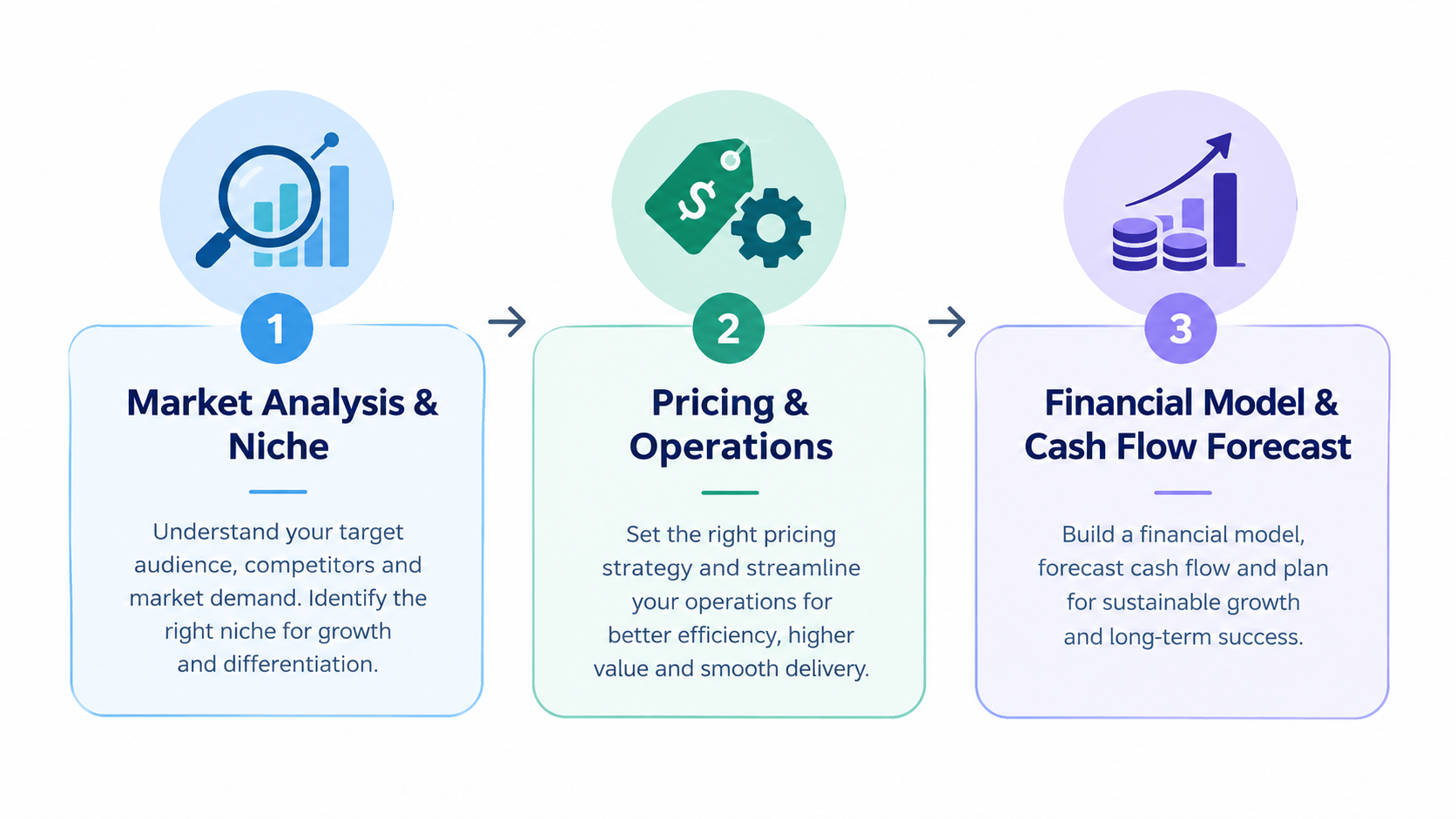
A well-structured plan helps you:
Make informed decisions: Evaluate expansion, equipment purchases, and staffing with clear data.
Secure business financing: Present realistic cash flow and break-even projections to banks or investors.
Set financial milestones: Measure monthly revenue, gross margins, and customer retention against planned targets.
Mitigate operational risks: Identify labour shortages, seasonal demand shifts, or supply cost increases before they impact profit.
Learn about official federal business planning frameworks at the U.S. Small Business Administration (SBA).
Why Does a Cleaning Business Need a Business Plan?
Without a strategic roadmap, service businesses often run into cash flow bottlenecks, underpriced contracts, and high employee turnover.
Define Your Business Model
Clarify whether you will focus on high-volume residential turnover, lucrative commercial janitorial contracts, or specialized post-construction cleaning.
Identify Your Target Customers
Determine who needs your services, what problems they face, and how much they are willing to pay.
Estimate Startup and Operating Costs
Calculate one-time launch costs such as commercial equipment, licensing, and insurance alongside recurring monthly expenses.
Set Profitable Pricing
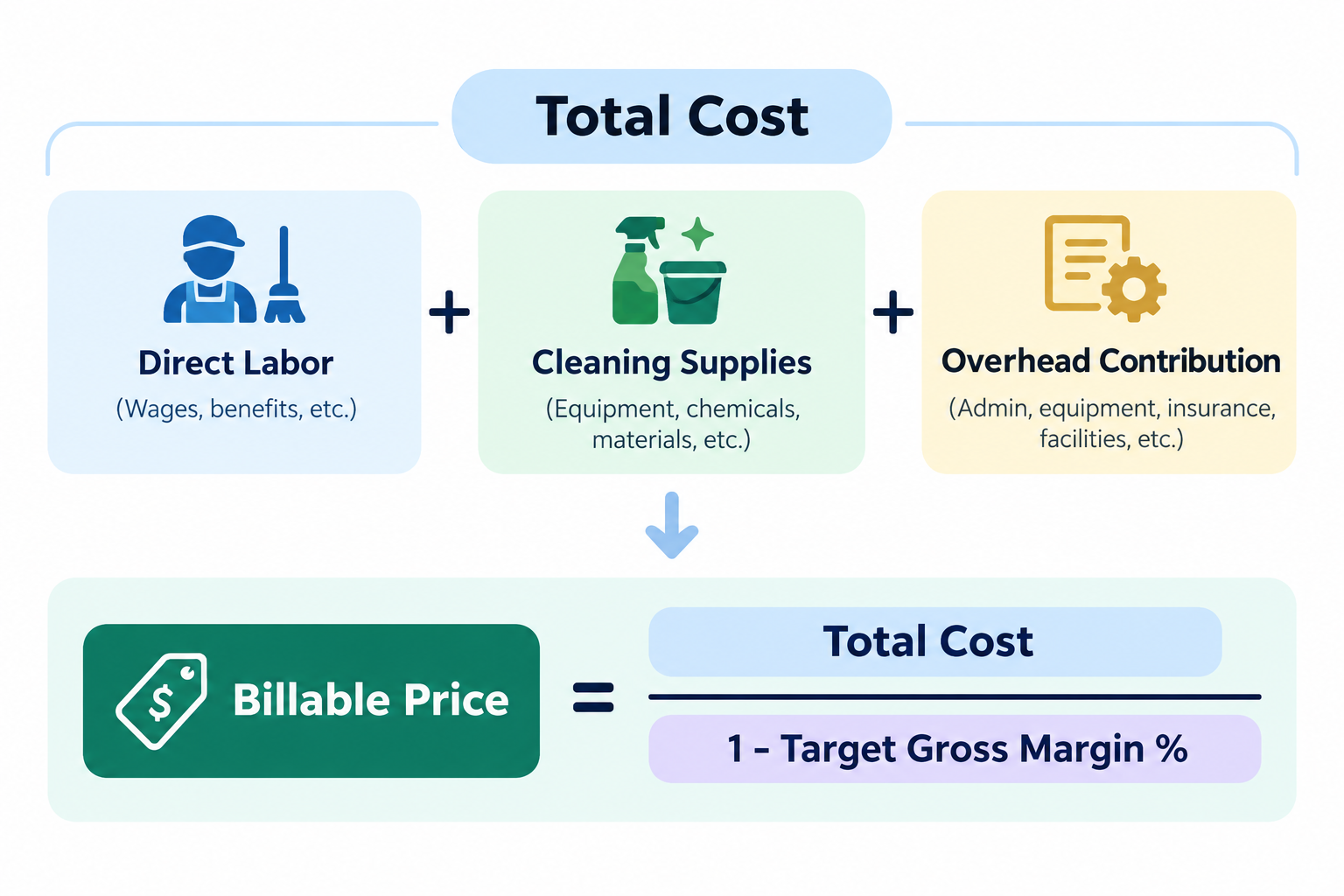
Avoid undercutting your business. Calculate direct labour, overhead, supplies, and target margins before setting hourly or flat rates.
Forecast Revenue and Cash Flow
Map expected inflows against payment delays, payroll schedules, and recurring operational costs to maintain liquid working capital.
Plan Hiring and Staffing
Outline recruitment, compensation models, training protocols, and scheduling workflows to support operational growth.
Reduce Financial Risk
Pinpoint financial break-even points to ensure your business remains resilient during seasonal slowdowns.
Prepare for Business Financing
Lenders and equity partners require audited financial projections, market data, and risk assessments before approving credit lines or loans.
How to Write a Business Plan for a Cleaning Company
Use this step-by-step framework to build your business plan.
1. Write an Executive Summary
The executive summary introduces your company. While it appears first in the final document, write this section last so you can synthesize key data points from your research.
Include:
Business name and legal structure
Mission statement and core values
Primary service offerings and geographic market
Key competitive advantages
High-level financial objectives and funding needs
2. Describe Your Cleaning Service Business
Detail your company’s structure, market positioning, and service scope. State whether you operate as a sole proprietorship, partnership, or limited liability company.
Primary Service Categories
Residential Cleaning: Recurring maid services, deep cleaning, move-in/move-out cleans.
Commercial Cleaning: Office buildings, retail spaces, industrial warehouses, educational institutions.
Specialized Cleaning: Post-construction cleanup, medical facility sanitation, window washing, carpet restoration.
3. Conduct Market Research
Gather market intelligence on local demand, demographic shifts, commercial development, and competitor pricing.
Research Area | Key Questions to Answer | Data Sources |
Target Market | Who requires cleaning services in your target zip codes? | Census data, local business directories |
Competitors | Who currently holds market share, and what are their service gaps? | Competitor reviews, local market listings |
Pricing Trends | What are prevailing hourly and square-foot rates? | Industry benchmarks, market mystery shopping |
Demand Frequency | Is market demand predominantly weekly, bi-weekly, or seasonal? | Local surveys, real estate listing velocity |
Market Gaps | Are clients seeking eco-friendly products or specialized schedules? | Online customer review analysis |
Define Your Target Market
Segmenting your target market allows for more focused marketing and clearer service pricing.
Residential Customers: Homeowners, busy professionals, and families seeking recurring weekly or bi-weekly cleaning.
Commercial Customers: Corporate offices, retail stores, and co-working spaces requiring after-hours janitorial upkeep.
Property Managers: Multi-family apartment complexes requiring rapid turnover cleans between tenant leases.
Real Estate Agents: Brokers needing deep cleaning and staging preparation for property listings.
Short-Term Rental Operators: Airbnb and VRBO hosts requiring quick turnarounds and linen resets.
Healthcare & Specialized Facilities: Clinics and dental practices needing strict terminal cleaning and disinfection protocols.
Define Your Cleaning Services and Pricing Strategy
Pricing must account for direct labour, consumable supplies, transit expenses, administrative overhead, and target net margins.
Common Pricing Models
Hourly Pricing: Ideal for custom, deep-cleaning, or initial jobs where scope varies.
Flat-Rate Pricing: Based on square footage or room count, providing clear costs for residential customers.
Recurring-Service Pricing: Discounted rates for weekly, bi-weekly, or monthly contracts that secure steady cash flow.
Specialized-Service Pricing: Premium rates for high-risk or labour-intensive work, such as post-construction or biohazard cleanup.
Create a Marketing Plan for Your Cleaning Company
A strong marketing strategy generates qualified leads and lowers your customer acquisition costs (CAC).
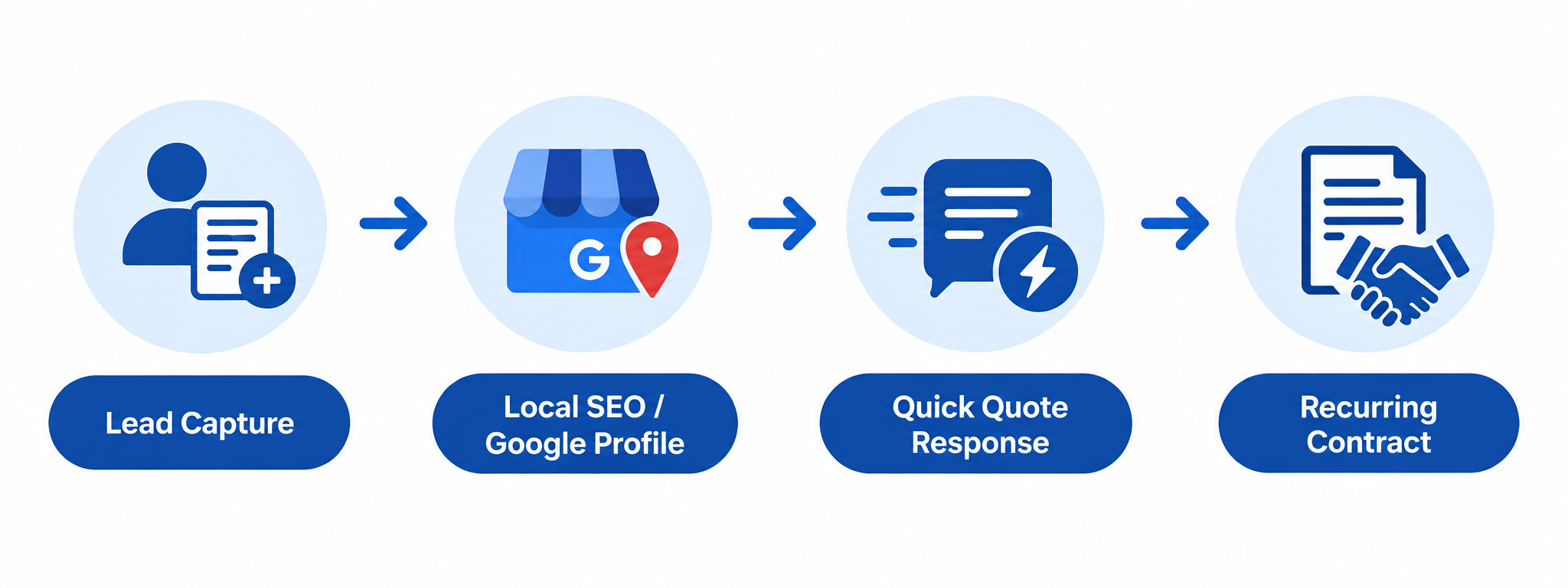
Website and Local SEO: Build a fast, mobile-friendly site with clear call-to-action buttons, clear service pages, and transparent quote request forms.
Google Business Profile: Optimize your business profile to capture high-intent local searches like "commercial cleaning near me."
Social Media Marketing: Share before-and-after transformations, team highlights, and customer testimonials on visual platforms.
Paid Advertising: Run targeted Google Search ads to capture immediate local intent, paired with Facebook retargeting campaigns.
Referral Programs: Offer existing clients service credits for referring new recurring accounts.
Strategic Partnerships: Build networks with local realtors, property managers, and interior designers.
Create an Operations Plan
Your operational plan covers day-to-day service execution, quality assurance, and scheduling logistics.
Operational Framework
Booking & Scheduling: Implement cloud software (e.g., Jobber, Housecall Pro) to manage quotes, dispatching, and automated client reminders.
Equipment & Inventory: Maintain commercial-grade vacuums, microfiber systems, chemical dilution units, and protective gear.
Quality Control: Use standardized digital inspection checklists to evaluate field team performance.
Invoicing & Collections: Set up recurring credit card billing or clear net-15/net-30 terms for commercial accounts.
Staffing and Recruitment
Field personnel directly impact customer retention. Decide early whether to hire W-2 employees or engage 1099 independent contractors, keeping in mind local tax and worker classification laws. To retain reliable staff, structure competitive hourly wages, clear performance bonuses, and efficient travel routes.
Create a Financial Plan for Your Cleaning Business
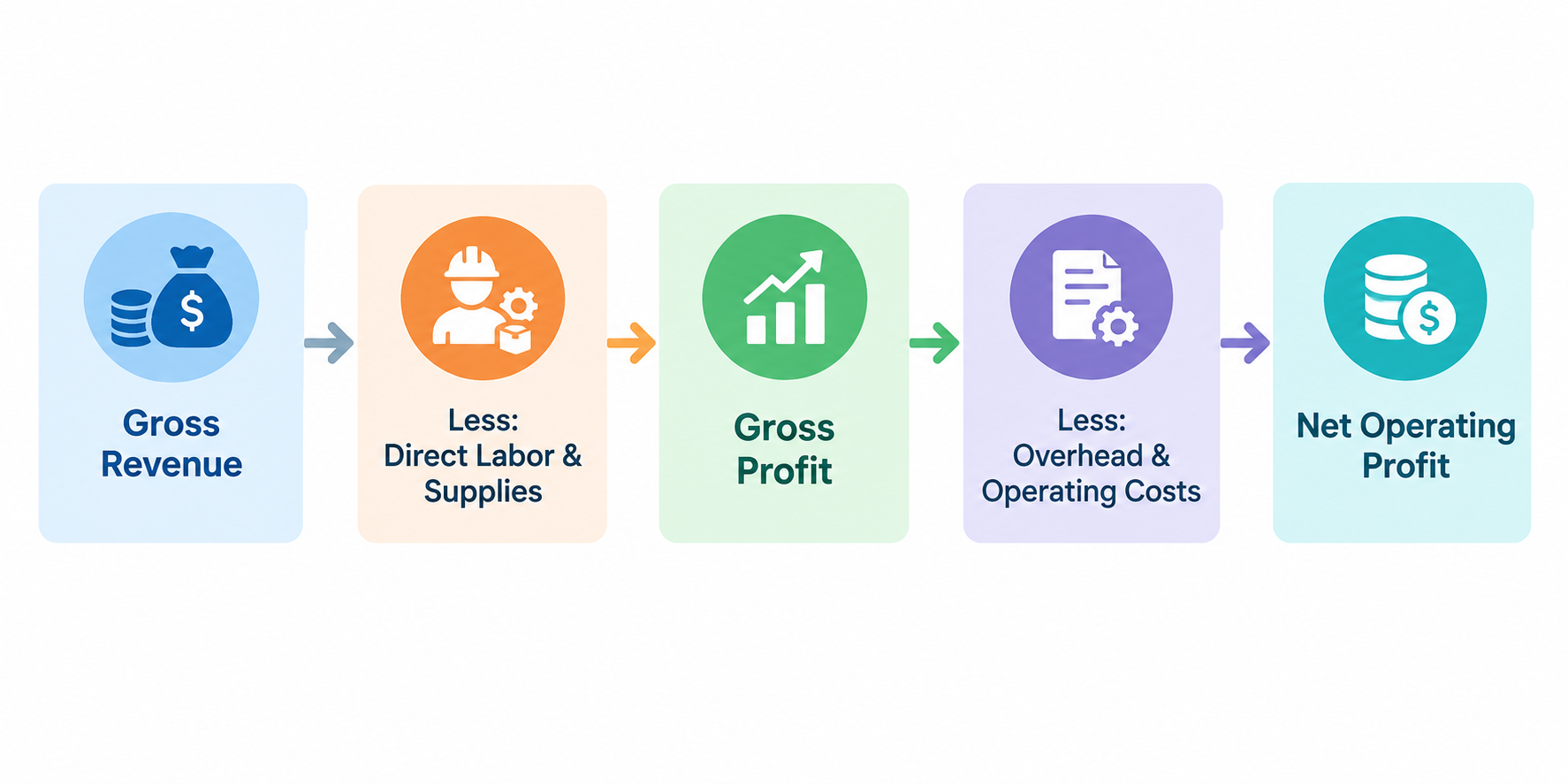
The financial plan shows whether your operational strategy can generate sustained profit and positive cash flow.
Startup Costs
Initial investment requirements typically fall into two categories:
Category | Example Items |
Capital Expenditures | Commercial vacuums, floor scrubbers, vehicle wraps, branded gear |
Operational Reserve | Initial insurance premiums, registration fees, website development, initial marketing deposit |
Monthly Operating Expenses
Keep track of fixed and variable costs:
Fixed Expenses: Commercial insurance, software subscriptions, office space rent, legal/accounting fees.
Variable Expenses: Cleaning chemicals, disposable supplies, field staff wages, fuel, vehicle upkeep, marketing spend.
Revenue Forecast
Forecast revenue using realistic capacity limits:
Monthly Revenue = Active Clients multiplied by Average Job Value multiplied by Monthly Service Frequency
For example, 40 recurring residential accounts serviced bi-weekly (80 cleans/month) at an average value of $175 per clean generates $14,000 in monthly revenue.
Cash Flow Forecast
Profit is not the same as liquid cash. Commercial clients often pay on 30- to 60-day terms, while field staff must be paid weekly or bi-weekly. Your cash flow statement tracks liquid balances to ensure your business covers payroll and vendor expenses during billing lags.
Break-Even Analysis
Your break-even point shows the exact monthly sales volume needed to cover fixed overhead and direct costs:
Break-Even Volume = Total Monthly Fixed Overhead divided by Gross Margin Index
Working with experienced business budgeting advisors helps you build dynamic models that adjust to seasonal shifts and cost changes.
Cleaning Business Plan Financial Example
The following baseline model shows the financial breakdown for a growing small cleaning business:
Financial Metric | Monthly Figures | % of Total Revenue |
Active Recurring Clients | 80 accounts | — |
Average Job Value | $150 | — |
Total Monthly Revenue | $12,000 | 100.0% |
Direct Field Labour | $5,400 | 45.0% |
Cleaning Supplies & Consumables | $600 | 5.0% |
Total Cost of Goods Sold (COGS) | $6,000 | 50.0% |
Gross Profit | $6,000 | 50.0% |
Marketing & Client Acquisition | $900 | 7.5% |
Insurance & Licensing | $400 | 3.3% |
Software, Scheduling & Administrative | $500 | 4.2% |
Vehicle Fuel & Transport Expenses | $700 | 5.8% |
Total Operating Expenses (OpEx) | $2,500 | 20.8% |
Net Operating Profit (EBITDA) | $3,500 | 29.2% |
Note: This hypothetical scenario assumes an established routine route. Actual margins will fluctuate based on localised labour rates, transit times, and client retention rates.
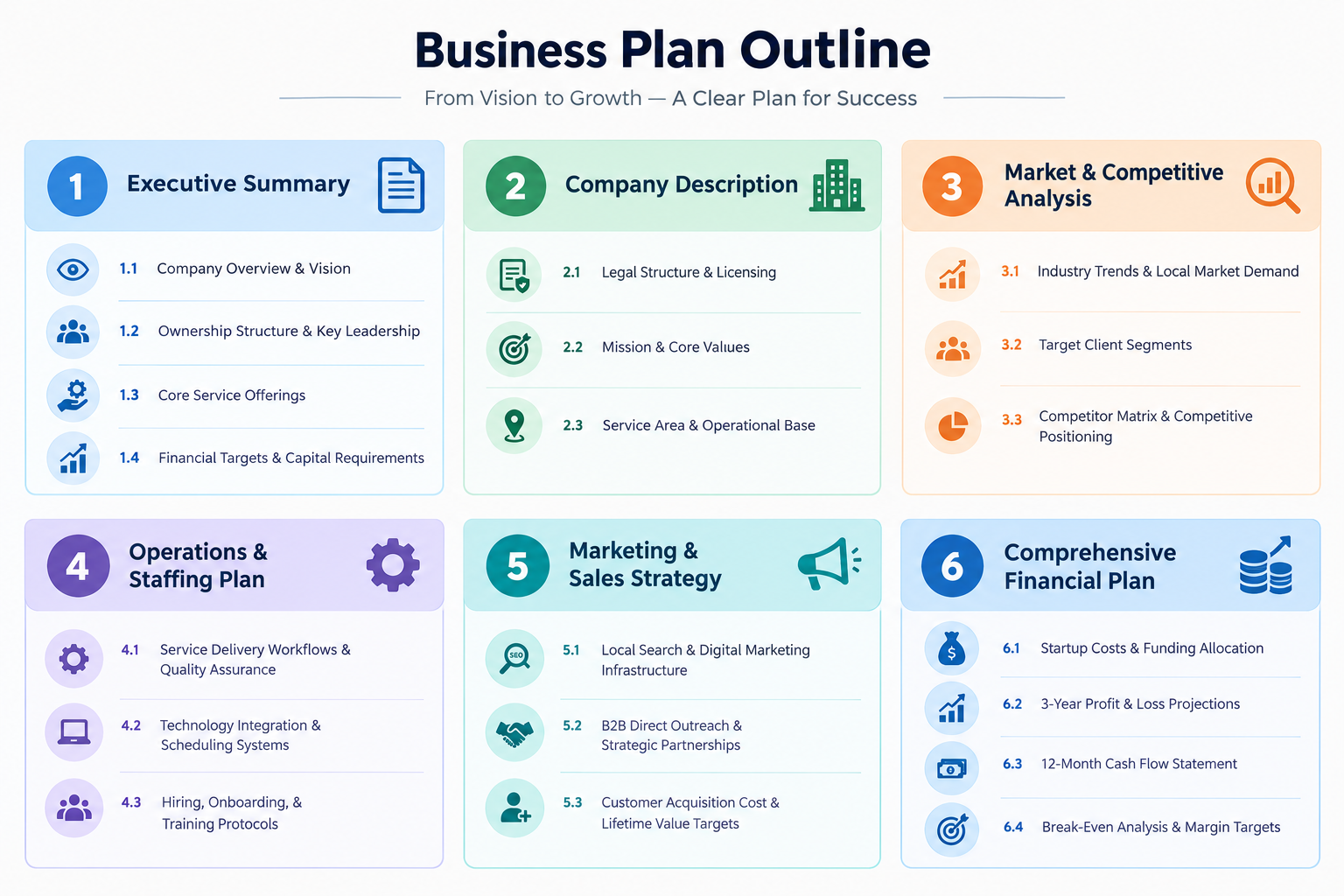
Sample Business Plan Outline
Use this template as an executive outline for lenders, equity investors, or business partners:
Free Cleaning Company Business Plan Checklist
Use this checklist to ensure your plan covers every essential detail before launching:
Executive summary and business mission statement
Clear service definitions (residential vs. commercial vs. specialized)
Competitive pricing model accounting for labour, supplies, and overhead
Verified market demand and demographic target profiles
Marketing strategy covering local SEO, digital profiles, and referrals
Operational workflow covering equipment, scheduling software, and quality checks
Detailed hiring and payroll management framework
Startup capital calculation and monthly operating expense budget
12-month revenue, profit/loss, and cash flow projections
Emergency contingency plan for labour shortages or seasonal demand dips
Access free business advice, planning templates, and executive coaching through SCORE.
Common Mistakes When Creating a Cleaning Business Plan
Avoid these common planning pitfalls:
Overestimating initial sales velocity: Assuming maximum route capacity from day one without accounting for marketing ramp-up time.
Underestimating true labour costs: Forgetting to include taxes, workers' compensation insurance, non-billable travel time, and training wages.
Ignoring cash flow lag: Failing to plan for unpaid commercial invoices while meeting weekly payroll obligations.
Competing on price alone: Setting low rates that attract price-sensitive customers while destroying your gross profit margins.
Mixing personal and business finances: Combining funds instead of setting up dedicated business accounts, complicating tax filings and profit tracking.
Building static spreadsheets: Creating financial projections without dynamic assumptions that can be updated as expenses change.
How to Get Clients for a Cleaning Company
Building an active client list requires using several marketing channels at once:
Claim local online listings: Optimize your local directory listings to build visibility in local map searches.
Build relationships with property managers: Reach out to commercial real estate managers who need reliable, recurring cleaning services.
Set up automated review requests: Send follow-up emails or texts after completed jobs to collect positive customer reviews.
Offer launch incentives: Run temporary promotions for new clients who sign up for recurring weekly or bi-weekly cleaning contracts.
Use direct mail in targeted neighbourhoods: Send targeted postcards to high-income residential areas near your existing routes.
What Is the Best Legal Structure for a Cleaning Business?
The right legal structure depends on your growth strategy, tax preferences, and risk tolerance.
Sole Proprietorship: Simple and cheap to set up, but offers no personal liability protection against lawsuits or debts.
Limited Liability Company (LLC): Separates business assets from personal assets, providing liability protection while maintaining simple pass-through taxation.
Corporation (S-Corp / C-Corp): Ideal for larger companies seeking equity investment, though it requires stricter administrative compliance.
Disclaimer: Legal and regulatory requirements vary by jurisdiction. Work with a qualified attorney or business advisory firm to choose the best structure for your specific business goals.
Will AI Replace Cleaning Services?
While physical cleaning requires hands-on labour that artificial intelligence cannot automate, modern cleaning companies use AI technology to streamline back-office management.
Modern operators use technology for:
Route optimization: Reducing travel time and fuel costs across service routes.
Automated scheduling & customer response: Handling online booking requests and customer service instantly.
Predictive financial forecasting: Analyzing past revenue data to project cash flow and seasonal hiring needs.
Integrating these digital tools with professional financial management services gives cleaning companies a clear operational advantage.
What Are the 7 Steps of Cleaning?
A standardized cleaning procedure ensures consistent quality across field teams:
Prepare and Inspect: Assess the workspace, check safety conditions, and set up supplies.
Declutter: Clear loose items from surfaces to prepare for cleaning.
Dust High-to-Low: Clean fixtures, shelves, and surfaces from top to bottom so falling dust lands on uncleaned floors.
Wipe and Sanitize: Apply disinfectants to high-touch surfaces like light switches, handles, and countertops.
Clean Wet Areas: Scrub and sanitize high-moisture spaces like bathrooms and kitchens.
Floor Care: Vacuum carpets and sweep, dust-mop, and damp-mop hard surfaces.
Final Inspection: Perform a final checklist review to verify quality standards before leaving.
How Do I Start a Successful Cleaning Business?
Follow this timeline to build a sustainable business:
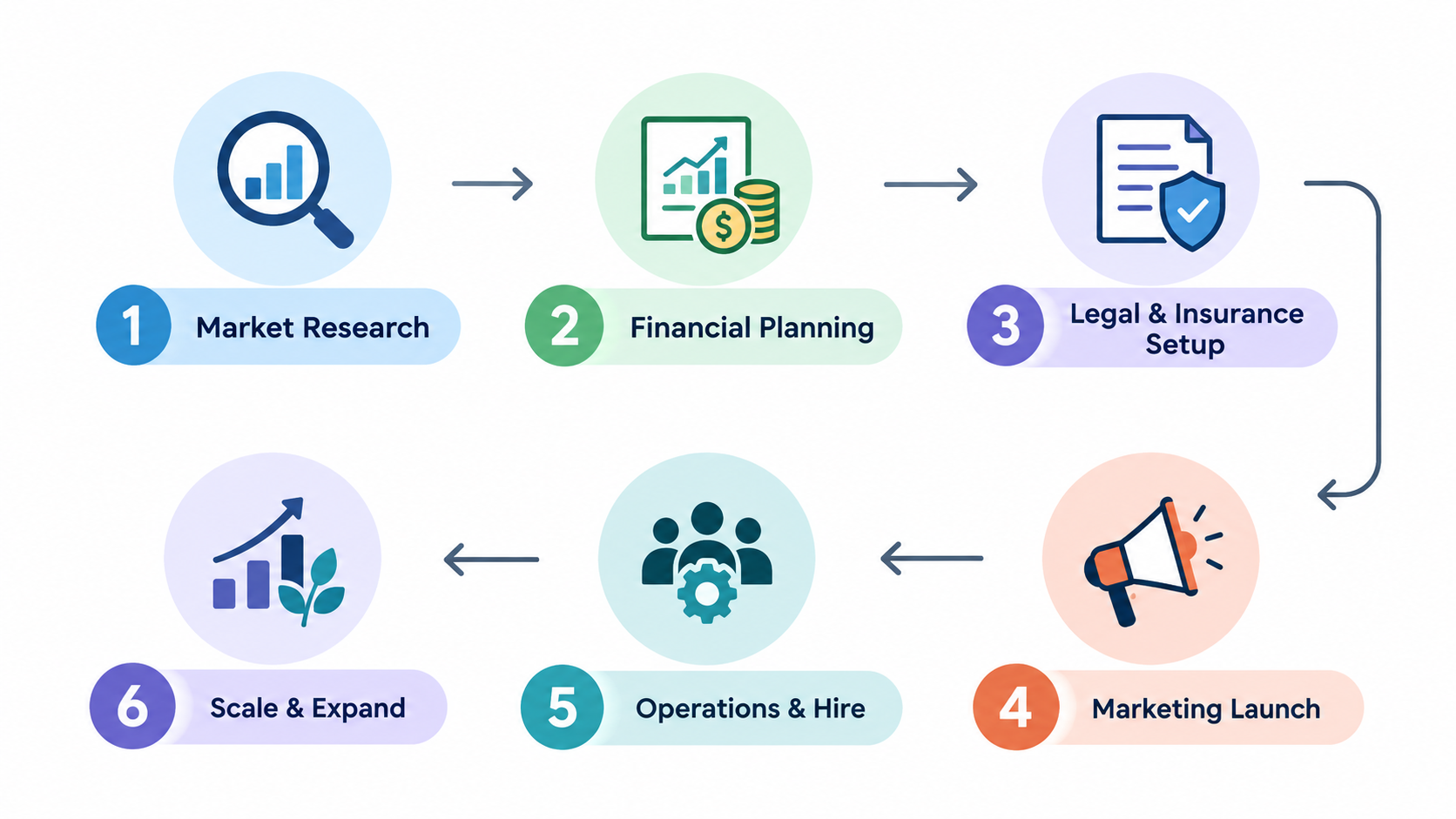
Research your market: Identify local demand gaps, target audience segments, and competitor pricing.
Build a financial model: Map out startup costs, ongoing operating expenses, and target margins.
Register your business: Secure your legal entity, business licenses, liability insurance, and tax IDs.
Set up your operations: Purchase commercial equipment, select software, and establish cleaning procedures.
Launch targeted marketing: Build your digital presence, gather early customer reviews, and run local ad campaigns.
Track financial metrics: Monitor monthly revenue, gross margins, and customer retention against your original forecast.
Frequently Asked Questions
How do I write a business plan for a cleaning company?
Start with market research, outline your services and pricing, build an operational strategy, and establish realistic financial projections covering costs, revenue, and cash flow.
What are the 7 steps of cleaning?
The core process involves preparing the area, decluttering, dusting from top to bottom, wiping high-touch surfaces, sanitizing wet areas, cleaning floors, and completing a final quality check.
Will AI replace cleaning services?
No. Physical cleaning requires hands-on labour that AI cannot replicate. However, cleaning businesses use AI to handle scheduling, route optimization, customer communication, and financial reporting.
What is the best legal structure for a cleaning business?
Most small to mid-sized cleaning businesses choose an LLC because it protects personal assets while keeping taxes simple. Consult a legal professional to confirm the best choice for your situation.
How do I get clients for a cleaning company?
Combine local search engine optimization, an updated Google Business Profile, property manager outreach, neighborhood referrals, and direct local marketing campaigns.
How do I start a successful cleaning business?
Define your niche, calculate your pricing using real operational costs, secure required licensing and insurance, set up management software, and track monthly cash flow.
Build a Stronger Financial Plan for Your Cleaning Business
A great business plan requires more than simple cost estimates and sales targets. Sustainable growth depends on keeping your pricing, labour
expenses, overhead costs, and cash flow aligned.
At MBC Consulting, we help service businesses turn financial plans into actionable growth strategies. Whether launching a new venture or scaling an existing operation, our advisors build realistic financial models grounded in commercial metrics.
Our financial team can support your growth through:
Custom Financial Modelling: Building dynamic financial models tailored to your business structure.
Financial Forecasting & Budgeting: Mapping cash flow, profit margins, and operational budgets.
Cash Flow Management Strategy: Protecting working capital against payment delays and seasonal shifts.
Virtual CFO Services: Delivering executive financial guidance to improve margins and control operating costs.
Conclusion
A well-structured business plan is more than just a setup requirement; it is your operational roadmap for sustainable profitability. By grounding your pricing in actual labour and overhead costs, defining a distinct market niche, and maintaining accurate financial forecasts, you position your cleaning company to manage cash flow smoothly, retain clients, and scale with confidence.
Need Help Building Realistic Financial Projections?
A strong cleaning business plan requires clear numbers. If you need support mapping out startup costs, setting profitable pricing, or building dynamic cash flow forecasts, MBC Consulting is here to help.
Schedule a Free Advisory Consultation with MBC Consulting Today