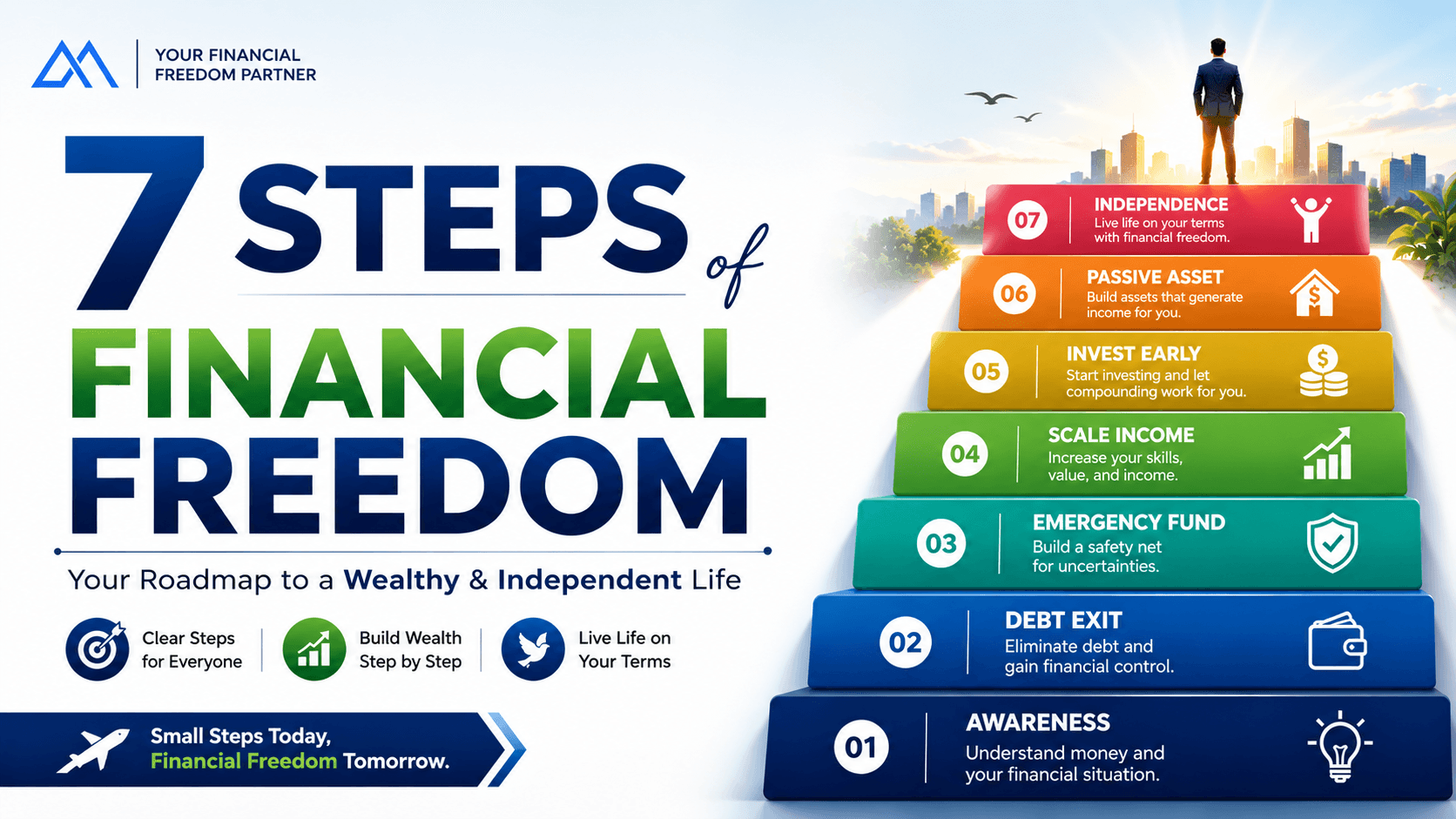
Introduction of Financial Freedom in 2026
Most people confuse high income with true financial freedom. A professional who earns $250,000 annually but spends $245,000 to maintain a luxury lifestyle is not financially free. They are locked into a cycle of active work dependence. If their primary source of labour stops, their economic lifestyle collapses instantly.
True financial freedom is not about accumulating status symbols. It is the exact point where your personal assets generate enough recurring cash flow to cover all of your living expenses without requiring active daily labour.
This master guide provides a structural roadmap to achieving absolute economic independence. Whether you want to escape debt, optimize your savings rate, or accelerate your investment timeline, this framework outlines the explicit calculations, rules, and strategies required to build sustainable wealth.
What is Financial Freedom?
In precise financial terms, financial freedom is the structural state where an individual possesses sufficient personal assets to pay for all necessary living expenses without being forced to sell their daily labour for active income.
To understand this state, you must differentiate between the two core mechanisms of money generation:
Active Income: Money generated through direct, continuous physical or mental labour. If you stop working as an accountant, lawyer, or executive, your active income streams drop to zero instantly.
Passive Income: Money generated continuously by accumulated capital or established business assets that do not require your daily operational presence. This includes stock dividends, real estate rental yields, bond interest, and business royalties.
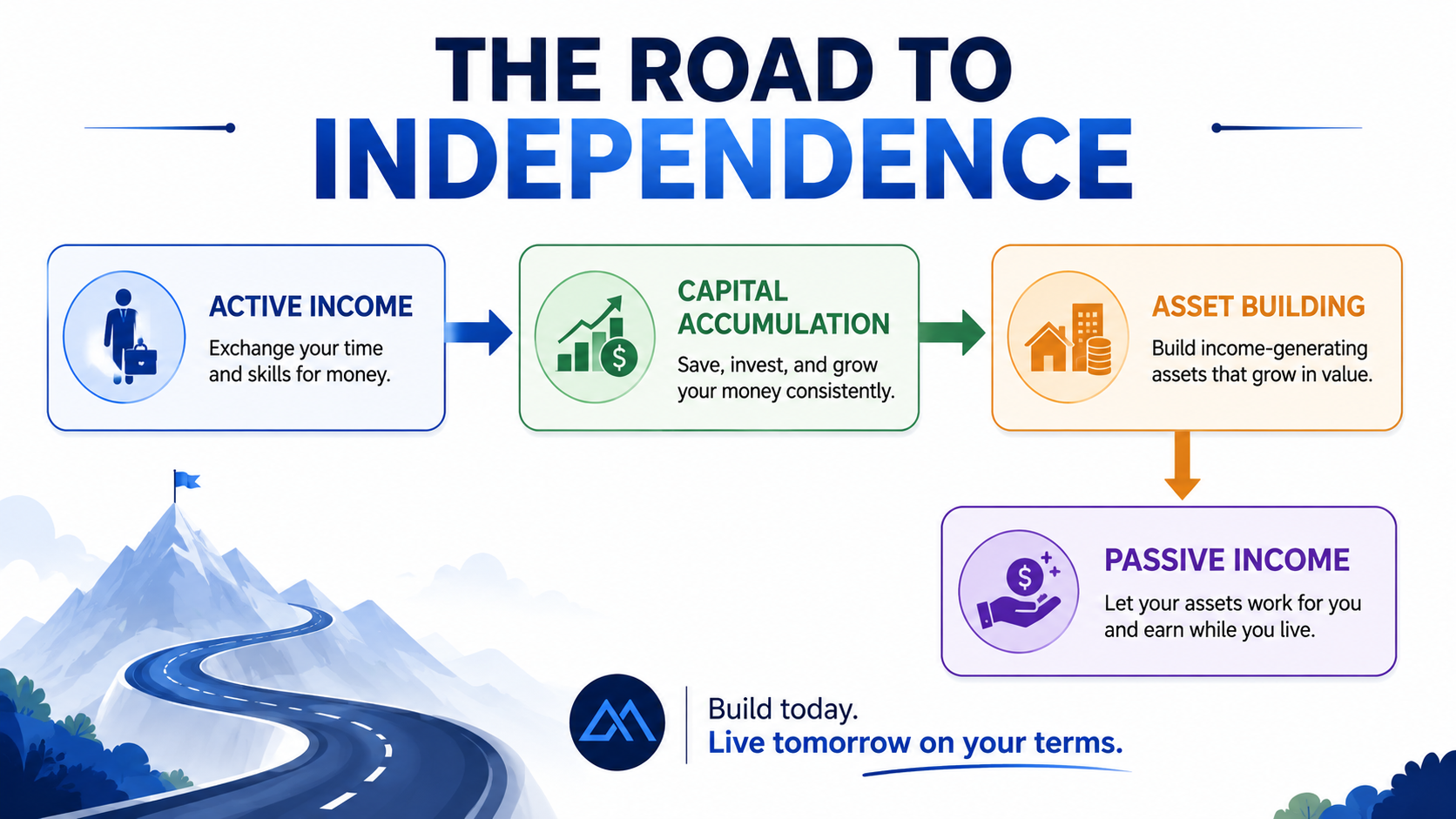
Financial independence occurs when the structural necessity of working for survival is completely removed from your lifestyle framework.
The Financial Freedom Formula
Achieving independence is not a matter of luck; it is a predictable mathematical equation. Every wealth-building framework relies on a singular core baseline model:
The Mathematical Formula
Financial Freedom = Passive Income Total Living Expenses
The Variables Explained
Passive Income: The total net annual cash flow generated by your asset portfolio (investments, properties, automated businesses).
Total Living Expenses: The absolute annual cash required to sustain your baseline lifestyle, including housing, food, taxes, healthcare, and insurance.
Real-World Example Scenario
Consider two distinct profiles to see how this equation operates in practice:
Profile A: The High-Earner Trap
Active Salary: $300,000/yr | Annual Expenses: $290,000/yr
Passive Income Portfolio: $5,000/yr
Result: NOT Free. Profile A is entirely dependent on active labor to avoid bankruptcy.

Profile B: The Freedom Architect
Active Salary: $70,000/yr  | Annual Expenses: $40,000/yr
Passive Income Portfolio: $42,000/yr
Result: FINANCIALLY FREE. Profile B can quit active work tomorrow morning because
Passive Income ($42,000) > Expenses ($40,000).
The 7 Steps of Financial Freedom
To move from active job dependence to complete passive asset sustainability, you must execute a structured, risk-managed seven-phase sequence.
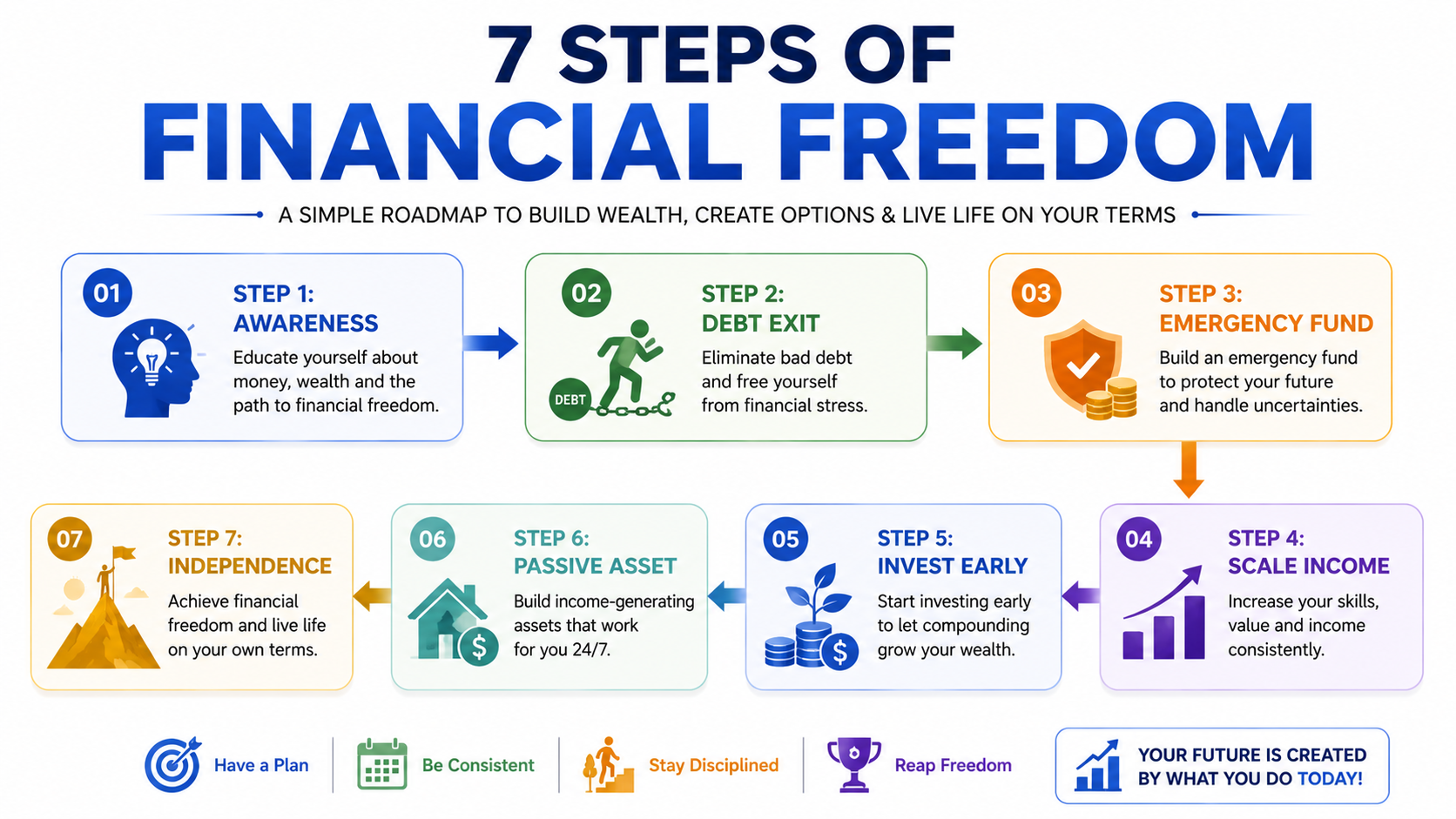
Step 1: Build Financial Awareness
You cannot optimize what you do not measure. This phase requires tracking every dollar of monthly net inflow and outflow. Compile a definitive personal balance sheet detailing your exact current net worth:
Net Worth = Total Assets - Total Liabilities
Step 2: Eliminate Bad Debt
Bad debt is any high-interest consumer liability that drains your monthly cash flow without generating economic value. Prioritize the immediate eradication of credit card balances, personal retail loans, and high-interest vehicle financing.
Step 3: Build an Emergency Fund
Protect your investment timeline from sudden disruptions. Accumulate three to six months of absolute baseline living expenses in a highly liquid, high-yield savings account. This capital exists purely for risk mitigation, not for investment deployment.
Step 4: Increase Active Income
Your savings rate is capped by your current income. To accelerate wealth building, you must increase your active income engine. Pursue corporate promotion, acquire high-income technical skills, or launch scalability side-hustles to maximize your monthly investable surplus.
Step 5: Start Investing Early
Shift your capital from depreciating cash into productive, appreciating assets. Deploy your investable surplus consistently into diversified index funds, real estate assets, or treasury securities to leverage the compounding mechanism.
Step 6: Build Passive Income Streams
As your asset base expands, structurally direct a portion of your capital specifically into cash-yielding investments. Focus on acquiring high-quality dividend equities, syndicating real estate properties, or building digital intellectual properties that distribute monthly or quarterly yields.
Step 7: Achieve Financial Independence
The ultimate phase where your total passive asset cash distributions match and exceed your lifestyle cash requirements. At this point, active work becomes completely optional.
Dave Ramsey's 7 Baby Steps Explained
A major benchmark system in personal finance tracking is Dave Ramsey’s 7 Baby Steps. While this framework is exceptional for debt liquidation and foundational behavioural discipline, it differs structurally from a high-growth passive investment roadmap. To transition from basic debt elimination into corporate-level capital preservation, leveraging comprehensive wealth management helps balance cash liquidity with aggressive market growth.
The 7 Baby Steps Breakdown
Baby Step 1: Save a beginner $1,000 emergency fund instantly.
Baby Step 2: Pay off all debt (except the home mortgage) using the Debt Snowball Method.
Baby Step 3: Build a fully funded emergency reserve covering 3 to 6 months of living expenses.
Baby Step 4: Invest 15% of your gross household income into tax-advantaged retirement accounts.
Baby Step 5: Fund college tuition accounts for your children.
Baby Step 6: Pay off your home mortgage early to achieve absolute debt-free status.
Baby Step 7: Build systemic wealth and give generously.
Structural Comparison Matrix
Architectural Feature | Dave Ramsey Baby Steps | Our 7 Steps of Financial Freedom |
Primary Core Focus | Absolute debt elimination and risk avoidance. | Scalable passive income and asset multiplication. |
Debt Treatment | Liquidate all low-interest debt (like mortgages) early. | Leverage low-interest debt strategically to buy assets. |
Investment Pace | Capped at a standard 15% rate until debt-free. | Maximized aggressively based on income optimization. |
5. Tony Robbins 7 Steps to Financial Freedom
Compiled from interviews with global hedge fund managers, Tony Robbins outlines an alternative wealth-building framework focused heavily on behavioural economics and structural market access.
Step 1: Make the Ultimate Financial Decision: Become an investor rather than just a consumer. Commit a fixed, unalterable percentage of every paycheck to an automated investment account.
Step 2: Become the Insider: Master the structural rules of the investment landscape. Minimize fee structures, understand the hidden costs of mutual funds, and eliminate retail investment traps.
Step 3: Make the Game Winnable: Calculate your exact, realistic financial numbers. Break down your targets into explicit milestones: Financial Security, Financial Vitality, and Absolute Financial Independence.
Step 4: Achieve the Allocation of a Lifetime: Establish institutional-grade asset allocation. Strategically split your capital between a Risk-Free/Safe Bucket (treasuries, cash equivalents) and a Growth Bucket (equities, real estate, commodities).
Step 5: Create a Lifetime Income Plan: Implement structured pension models. Utilize low-cost annuities and specific corporate dividend capture systems to build an unbreakable income floor.
Step 6: Invest Like the .001%: Mirror the portfolios of elite institutional asset managers by utilizing sophisticated risk-balancing models like Ray Dalio's All-Weather Strategy.
Step 7: Just Do It, Enjoy It, and Share It: Maintain strict emotional discipline, eliminate wealth-related anxieties, and utilize accumulated capital to create a lasting philanthropic footprint.
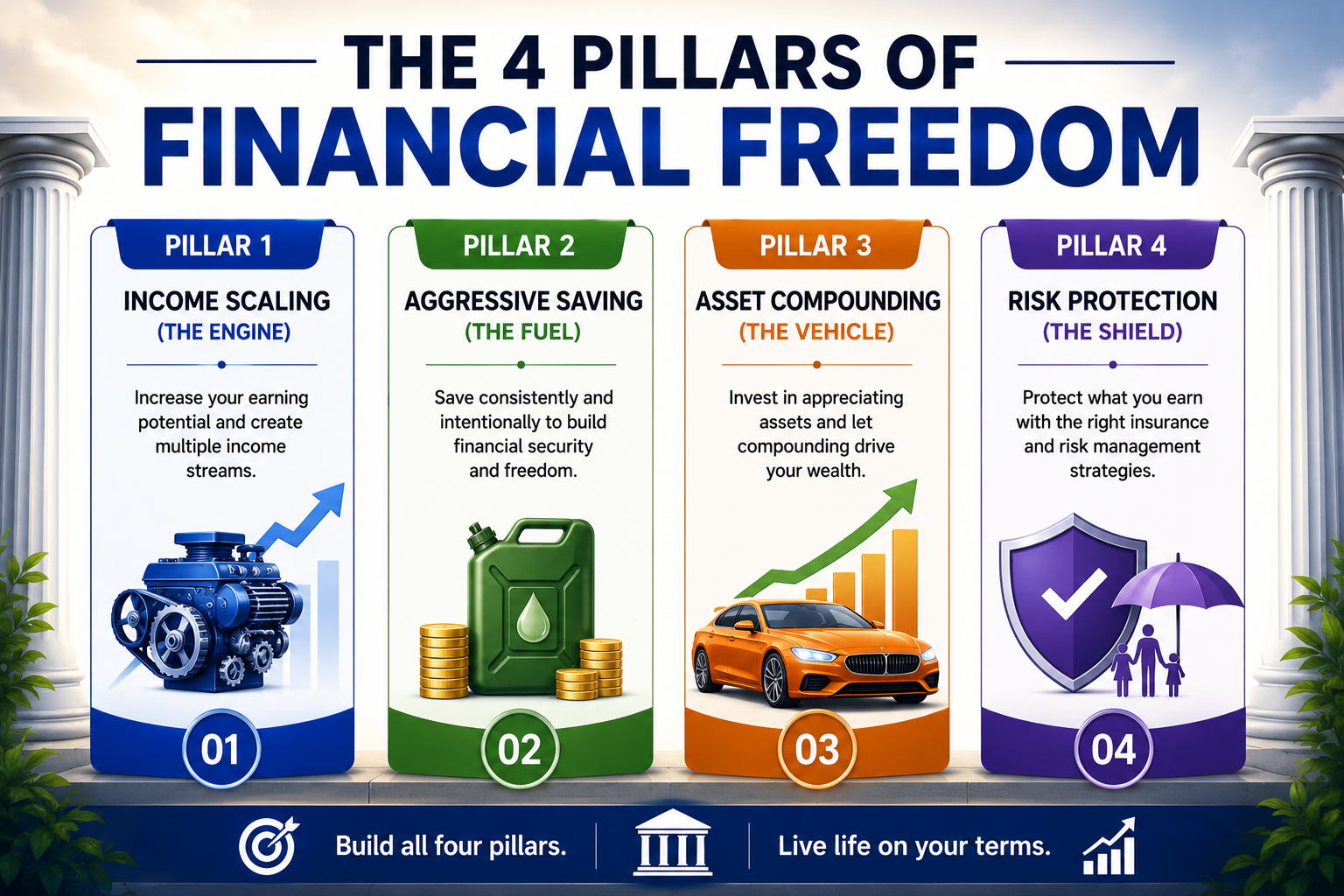
Income Scaling (The Engine): Continuously expanding your baseline earning capability across multiple distinct streams.
Aggressive Saving (The Fuel): Keeping lifestyle inflation low to maximize the delta between your income and your expenses.
Asset Compounding (The Vehicle): Allocating your excess capital into high-quality, productive investments that grow exponentially over time.
Risk Protection (The Shield): Deploying comprehensive life, health, and property insurance frameworks alongside strict legal structures to shield your accumulated wealth from lawsuits or health crises.
The 7 Pillars of Financial Success
Long-term financial security requires mastering seven distinct behavioural and structural competencies.
Proactive Budgeting: Directing every dollar of capital to a specific destination before the calendar month begins.
Systemic Saving: Automating your accumulation habits so that savings are extracted before lifestyle spending occurs.
Strategic Investing: Evaluating asset classes based on historical risk-adjusted returns rather than speculative trends.
Debt Management: Eradicating consumer liabilities while protecting your credit profile for strategic allocation.
Income Diversification: Ensuring your lifestyle is never dependent on a single corporate employer or client profile.
Risk Management: Maintaining deep emergency reserves to prevent forced asset liquidations during a market downturn.
Wealth Protection: Executing clear estate planning, trust generation, and legal asset mapping to preserve your family's multi-generational wealth.
How to Achieve Financial Freedom in 5 Years
Achieving a lifetime of financial independence within an accelerated five-year timeline requires a highly aggressive, non-traditional strategy. This compressed execution path demands a complete focus on three core mathematical levers.
Execute an Uncompromising 70% Savings Rate
To buy back your time quickly, you must save the majority of your income. A 70% savings rate means that for every 1 year of active labour, you accumulate 2.3 years of living expenses.
Maximize the Velocity of Income Growth
You cannot achieve a 70% savings rate on a minimum wage baseline. You must scale your income engine aggressively. Transition into high-fee consulting, launch a high-margin digital business, or pick up multiple scalable contract roles simultaneously.
Deploy Capital Into Cash-Flow Heavy Assets
Skip low-yield preservation assets. Focus your capital injections directly into cash-flowing investments like multi-family residential real estate, established small business acquisitions, or high-yield dividend growth equity portfolios.
Financial Freedom Rules & Wealth Principles
Professional wealth managers utilize specific mathematical rules of thumb to evaluate portfolio trajectory and baseline security levels.
The 3-6-9 Liquidity Rule
This protocol governs cash management. Keep 3 months of expenses in cash for basic personal protection, 6 months of capital if you operate in a volatile freelancing industry, and 9 months of liquid reserves if you are a business owner managing corporate payroll risks.
The Rule of 72 in Money
A classic formula used to calculate exactly how fast your investment capital will double at a specific compounding rate:
Years to Double =72 \ Annual Return Rate
Example: If your index fund portfolio returns an average of 8% annually, your invested capital will double every 9 years (72 divided by 8 = 9).
The 777 Capital Accumulation Rule
A benchmark model where an individual targets generating 7 independent income streams, accumulating a minimum of 7 times their annual living expenses in raw assets by age 40, and automating 70% of their investment deposits.
Warren Buffett’s Golden Rule
"Rule No. 1: Never lose money. Rule No. 2: Never forget Rule No. 1."
This principle emphasizes that avoiding major investment losses is far more important for long-term compounding than chasing risky, high-yield speculative wins.
Financial Freedom Stages (Wealth Journey Model)
The path to absolute wealth accumulation is divided into five distinct operational stages. Identify your current position on this matrix to determine your next strategic step.
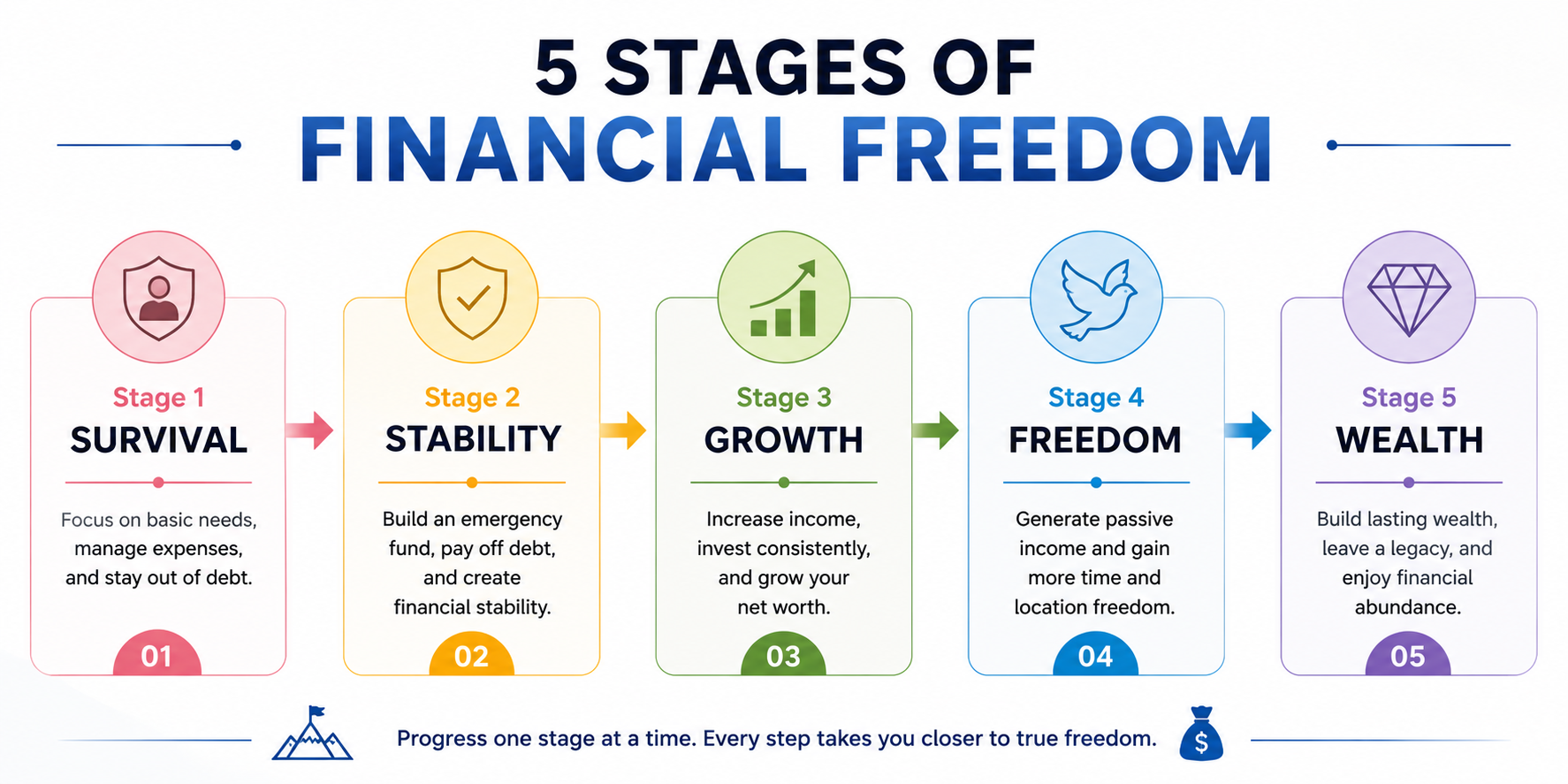
The Survival Stage: Living paycheck to paycheck. Total monthly liabilities and living expenses match or exceed total active income. Net worth is frequently negative.
The Stability Stage: Consumer debt is eliminated, a 3-to-6 month emergency fund is secured, and monthly cash flow is positive and predictable.
The Growth Stage: The investable surplus is systematically deployed into market assets. The portfolio begins to generate noticeable compounding interest, though it cannot yet sustain daily lifestyle costs.
The Freedom Stage: Passive income cash flow covers all baseline survival costs (housing, food, insurance). Active labour is no longer an absolute necessity for survival.
The Ultimate Wealth Stage: Passive cash flows vastly exceed all lifestyle costs. The surplus is so large that it automatically reinvests into new asset classes, creating multi-generational wealth.
What Creates 90% of Millionaires?
Historical wealth demographic studies confirm that the vast majority of self-made millionaires do not build wealth through lottery wins or inheritance. They generate wealth through three predictable habits:
The Cultivation of Multiple Income Streams: The average self-made millionaire operates a minimum of three to four independent income lines (e.g., primary salary + real estate rental yields + stock index dividends + business equity).
The Mastery of Long-Term Asset Compounding: Instead of spending excess capital on lifestyle inflation, millionaires consistently reinvest their earnings into productive assets. This process leverages SEC investment compounding data models to build long-term momentum.
Strict Operational Discipline: Maintaining a lifestyle that cost-basis tracks far below their true earning capacity, allowing them to sustain high investment rates across decades.
Financial Freedom PDF & PPT Guide
To help you implement this framework within your own personal capital planning, we have compiled an offline execution kit.
What is Included in the Resource Toolkit:
An interactive, downloadable 7-Step Wealth Blueprint Checklist.
An automated Excel budgeting ledger configured with variable savings rate calculators.
A clean PowerPoint presentation deck outlining the 5 Stages of Wealth for group workshops or personal study.
If you are ready to implement these steps or want to download this full resource kit to optimize your personal financial strategy, visiting our dedicated portal to download the strategic resource blueprint connects you directly with advanced tactical asset planning assets.
Financial Freedom Strategy Plan
Achieving financial independence requires translating this framework into an immediate timeline of clear actions.
The 30-Day Setup Plan
Download all bank and credit card statements from the past 90 days.
Categorize every single expense to establish your true baseline monthly cost of living.
Open a high-yield savings account and seed your beginner emergency fund.
The 6-Month Realignment Roadmap
Deploy the Debt Snowball or Debt Avalanche system to eliminate all non-mortgage consumer debts.
Negotiate a raise at your primary employer or secure your first recurring freelance client to increase your active income.
Automate an investment transfer of at least 20% of every paycheck into a broad-market index fund.
The 5-Year Wealth Plan
Scale your automated investment rate toward the 50% milestone.
Acquire your first cash-flowing real estate asset or build a scalable digital business asset.
Rebalance your portfolio annually to ensure your passive income streams line up with your evolving lifestyle expenses.
Common Mistakes That Block Financial Freedom
Unchecked Lifestyle Inflation: Allowing your personal spending to scale at the same rate as your career salary increases.
Procrastinating Your Investments: Waiting until later in life to enter the market. Delaying your investment start date by even five years can cut your ultimate compounding potential in half.
Carrying Toxic Consumer Debt: Using high-interest credit lines to buy depreciating liabilities (like luxury cars or expensive clothing) to project an illusion of wealth.
Relying on a Single Income Source: Depending entirely on a single corporate paycheck for 100% of your financial survival. This exposes your lifestyle to massive single-point-of-failure risk.
Frequently Asked Questions
What are the 7 steps to financial freedom?
The seven steps require building clear financial awareness, eliminating toxic consumer liabilities, establishing emergency cash reserves, scaling active income engines, investing capital early, generating passive income streams, and ultimately matching your living expenses with asset yields.
What are Tony Robbins' 7 steps to financial freedom?
Tony Robbins' framework focuses on automating your investment allocations, avoiding retail fund traps, defining realistic lifestyle wealth milestones, implementing stable asset allocations, securing guaranteed income floors, utilizing institutional portfolio structures, and building a philanthropic legacy.
What is the 3 6 9 rule in finance?
The 3-6-9 rule dictates cash liquidity safety limits: maintain 3 months of baseline expenses for standard emergency protection, 6 months if your primary field is highly volatile, and 9 months if you run an independent business enterprise.
What are the 7 principles of finance?
The core pillars governing capital optimization are Comprehensive Budgeting, Automated Accumulation, Disciplined Asset Allocation, Aggressive Debt Eradication, Continuous Income Diversification, Proactive Risk Management, and Multi-generational Asset Protection.
What is the 777 rule in finance?
The 777 wealth principle targets cultivating 7 independent income sources, accumulating an asset base worth 7 times your annual lifestyle expenses by age 40, and maintaining an automated 70% personal investment rate.
What are Warren Buffett's 7 principles of investing?
Buffett's core investment philosophies emphasize focusing on capital preservation, acquiring high-quality companies with durable competitive moats, buying assets well below their intrinsic value, ignoring short-term market noise, investing within your circle of competence, maintaining long-term holding horizons, and being fearful when others are greedy.
Conclusion
Achieving true financial freedom is not an overnight event; it is a long-term strategy built on consistent daily habits. By shifting your focus away from active salary consumption and prioritizing the generation of recurring passive income streams, you can permanently break free from job dependence.
Commit to the process today. Track your cash flow, eliminate bad debt, and automate your investments to build a secure, independent financial future.